
The impossibility — or rather, incoherence — of equilibrium
#[T]he labor‐time socially necessary to make products forcefully asserts itself as a regulative law of nature […] just as the law of gravity does when someone’s house falls on his head.
Located, or diffuse? Indestructible, or immaterial?
##There’s a problem: some money is “advanced” or “invested” as capital, but some of it is used to buy stuff that gets stuck — let’s say fixated, or fixed — at any point along the capital’s ever‐expanding spiral of continual self‐augmentation. Since this spiral encompasses the entire production process,[1] there are plenty of places where stuff can get fixed. But fixation implies that the stuff is vulnerable to depreciation (devalorisation): machinery can now be produced more cheaply or is superseded by better machinery, other stuff bought with constant capital suffers a similar fate, produced commodities suffer devalorisation before they can be sold (assuming they’re saleable at all), etc..
So then how is the surplus‐value calculated? And the profits? — the general profit‐rate? Are these things calculated on the capital advanced, or on the value of the stuff (& money) bought with said capital? Is the surplus‐value generated in the immediate labour process according to the value relations at that time, or is its “true” magnitude mediated by something more elaborate?
Those who want to do economics have to give mathematically exact & unique answers to these kinds of questions. Laws of Chaos,[FM20] proponents of the TSSI (Kliman et al.), Bortkiewicz, & other neoricardians generally do just that, and differ largely in where they locate their personal commodity‐fetishism:[2]
Marx’s own views on this question are not always unambiguous, and may even be inconsistent. A plain reading of his definition of value in the beginning of the first volume of Capital seems to be that values are determined in the sphere of production alone. But in the third volume he seems to say (or at least can be interpreted as saying) that a commodity does not possess a definite value independent of whether it actually gets sold, or of the price for which it gets sold.
Of course there is no such ambiguity nor inconsistency; Gabriel doesn’t descend from the heavens and blow his trumpet to announce when value is determined (once for each commodity, presumably?). No act of production is always‐already the production of a commodity, as this would merely ahistoricise commodity‐production.
At the same time, it is true that things produced under the dominion of capital are, as it were, “destined” to live the life of a commodity; moreover, the valorisation process is one aspect (the other being the labour process) of the immediate production process,[1] because otherwise capital would be impossible. Marx demonstrates clearly in Vol. 1 — using the theoretic abstraction of simple commodity‐production — that surplus‐value cannot arise in any other way.
So a theory that adopts a naïve constructionist (or worse, fictionalist) angle runs the risk of obliterating the historic specificity of capital in an entirely different way. But such theories are much less common; anyone can read Capital with a neoricardian (hard realist) lens — only the first four or so chapters need be glossed over — whereas the naïve constructionist will run into problems persistently.
Value & friends (exchange‐value, capital, etc.) are no doubt social relations (social facts) par excellence, but these social relations make themselves vital by stepping in as the nearly sole mediator of the life of the species. Under what Marx (unfortunately) calls “natural economy”, the Gemeinwesen is still at least partially intact, and most production is still for use (i.e. not for the market, not as commodity‐production). Once capital definitively steps in to replace these “natural” relations, a certain value structure must be at least approximately maintained, and approximately connected to real, useful (= concrete) labour — not only for capital to continue its valorisation spiral, but for the species to continue to reproduce itself in a state conducive to that valorisation (as against going extinct, undergoing a revolutionary process, or what have you).
A biological analogy
##Marx deals most directly with the total social reproduction in Vol. 2. Its reproduction schemata[3] have appeared to many as evidence of two falsehoods: that the total social capital can — & presumably, often does — achieve a smooth equilibrium state,[4] and that value is effectively (i.e. close enough to) indestructible.
In reality, the schemata are about the inner connexions that make value as such possible at the level of the whole society, and have nothing to do with equilibrium, nor have they any need to touch upon de/valorisation.
It’s not immediately clear (as evidenced by the political economists to whom Marx is responding) how a society subordinated to capital might valuewise undergo total social reproduction; likewise, it’s not immediately clear how biological organisms are thermodynamically capable of reproducing themselves — in the sense of species[5] continuation via offspring, or the sense of continuation of a given organism’s life.
The biological phenomena can be explained in terms of Gibbs free energy exchange without violating any laws of thermodynamics. But we quickly sense that this formalism is too abstract for most purposes. Actual living organisms incarnate this thermodynamic schema(!), if you will, in concretely very dissimilar ways. The schema simply doesn’t tell us that much, other than the basic underlying connexions that make any life possible.
Thermodynamic variables like enthalpy, entropy, temperature, etc. are real in some sense, but the organism doesn’t directly manipulate them, as if life were literally just movement through a macroscopic phase‐space. Rather, these macroscopic variables are emergent and are thus only intelligible from the perspective of the system (i.e. immanently).
In this biological analogy, equilibrium isn’t so much “impossible” as it is simply fatal: thermodynamic equilibrium is death (or extinction).
Rather than give up and acquiesce to equilibrium, an organism must constantly hurl itself away from equilibrium by restructuring itself. The biological restructuring most familiar to humans and most closely analogous to capital’s crisis process is the single‐celled bottleneck of the zygote, i.e. producing offspring, which allows for the parents (≘ the previous capital structure) to reach equilibrium (≘ tolerably satisfy the law of value) without necessarily extinguishing the species (≘ abolishing capital).
Vol. 2’s schemata demonstrate that capital is capable of driving the total social reproduction, not in free energy terms, but in exactly those terms fundamental to capital: value terms (recall that capital is value‐in‐process).[6]
Not a matter of sophistication, but of conceptual insight
###It’s now easy to see that attempts to “fix” or “upgrade” Vol. 2’s schemata by couching them in production‐price terms are fundamentally misguided. Under generalised commodity‐production (i.e. the demesne of capital), value is precisely the relation of social production, and therefore reproduction. Production‐price only emerges from capital migrating (diffusing) between various branches, and exists concurrently with value at an entirely distinct categorical–conceptual level from it.[7]
Similarly, Vol. 2’s schemata don’t consider expanded reproduction — only simple reproduction. The simple schemata already demonstrate the necessary inner connexions. Moreover, introducing accumulation already implies that steady‐state reproduction (as in the idealised simple reproduction model) is incoherent anyway, as we’ll see below.
These “upgrades” are not merely needlessly overcomplicated, but are completely incorrect — not mathematically, but on a fundamental, conceptual level.[6]
The tendency of the rate of divergence between social relation & corporeal form to rise
##Simple reproduction vaguely resembles certain pre‐capital forms: production is primarily for direct use, sustenance; and then some surplus‐labour is allocated by corvée or similar, some of which is for directly social use (insurance, some infrastructure, etc.), and the rest of which is consumed for the enjoyment of those who benefit from class relations. By contrast, capital implies that these two ways of consuming surplus — directly social, and recreational — can be no more than faux frais. The true purpose of surplus‐value is to engender yet more of itself through interminable accumulation.
So simple reproduction, were we to take it overly literally, would be nothing short of the death of capital. To go further, we need to talk about the (in)famous law of the tendential fall of the profit‐rate (LTFPR).
LTFPR has been interpreted as a secular trend (or tendency, observable or not), or even as the ultimate breakdown of capital. Okishio’s theorem is among those attempting to disprove such hypotheses rigorously. “Refutations” of this theorem are ten a penny, but the refutations, the theorem, those advancing empirico‐statistical arguments, & all milieux involved are mistaken for the same fundamental reason: they uniquely(!) locate value and consider it essentially a given substance (the mathematised version of fetishism) which merely courses through capital’s circuit, constantly sustaining it. They therefore see the task at hand as merely one of doing economics.[8]
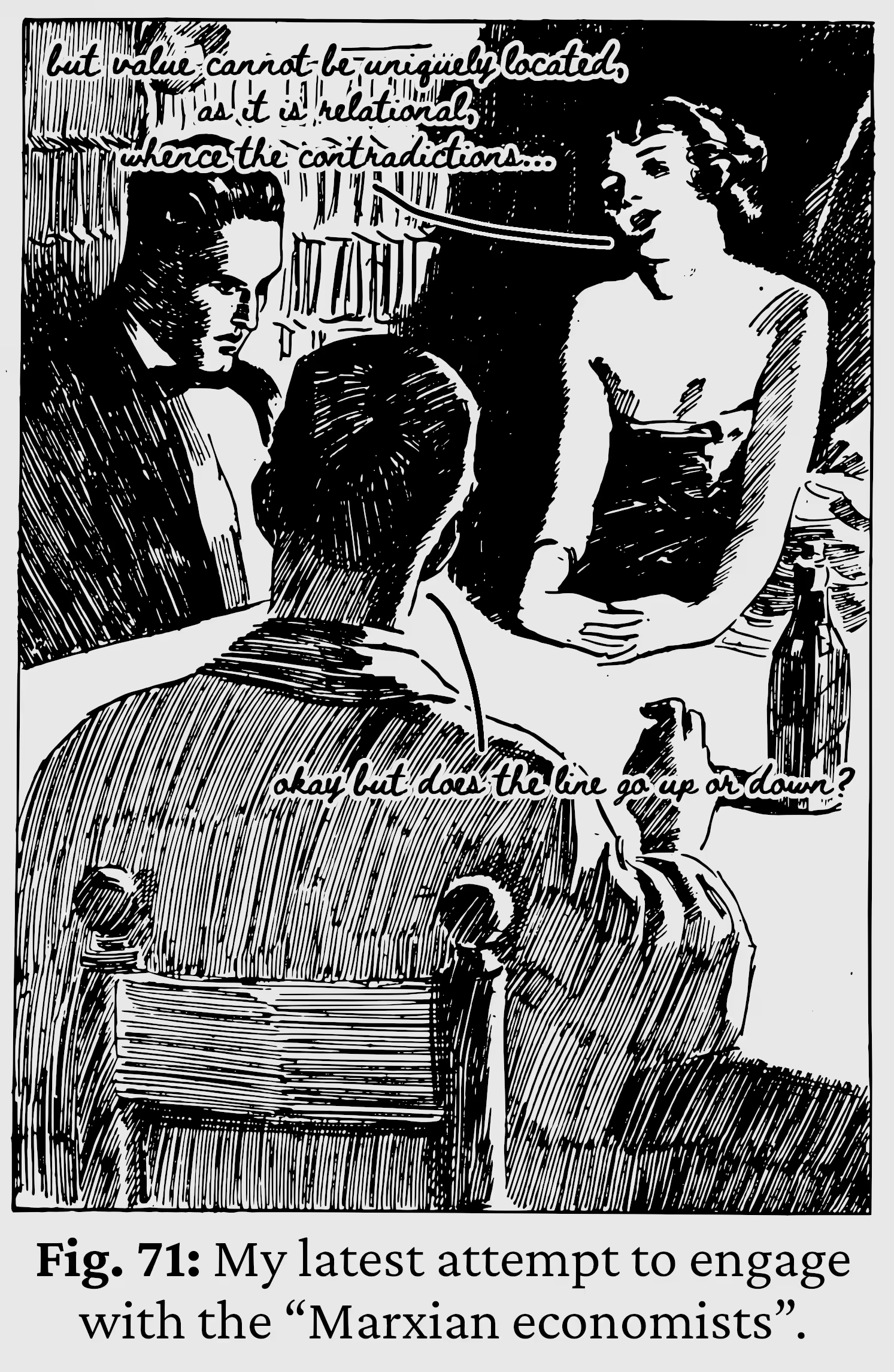
In reality, LTFPR is an essential facet of how capital constantly threatens to tear apart its own basis — that is, value as such. The process of accumulation stretches the social relations that constitute value near their breaking point, and eventually something has to give. LTFPR is about the possibility of valorisation, not the magnitude of the profit‐rate per se. After all, if value allowed itself to be rent asunder in this way, then “profit‐rate” would cease to be a meaningful expression anyhow.
Although inevitable, this process is neither monotonic nor necessarily terminal, since capital can restructure itself (recall the biological analogy) in a way that yields the additional surplus‐value necessary for valorisation to continue; that is, for value itself (a social relation) to remain roughly intact even as it continues the runaway positive feedback loop of the capital‐process.
Consumption can always be increased so long as Ol’ Papa Value is happy
##But before diving into the facets of the crisis dynamic & LTFPR, we ought to understand why overproduction per se is merely the phenomenal form that crisis takes on; and why suggesting that unproductive consumption[9] (“end‐consumers’ expenditure”) needs to be increased is like identifying fever as the root cause of all disease.
On the one hand, purchasing consumer goods with wages paid out of variable capital (the typical worker’s purchase) is of no help, since the part of the total value‐product whose value status (= “realisation”) is in question is just the surplus. Without surplus‐value, we have none of this mess; everything else is merely breaking even.
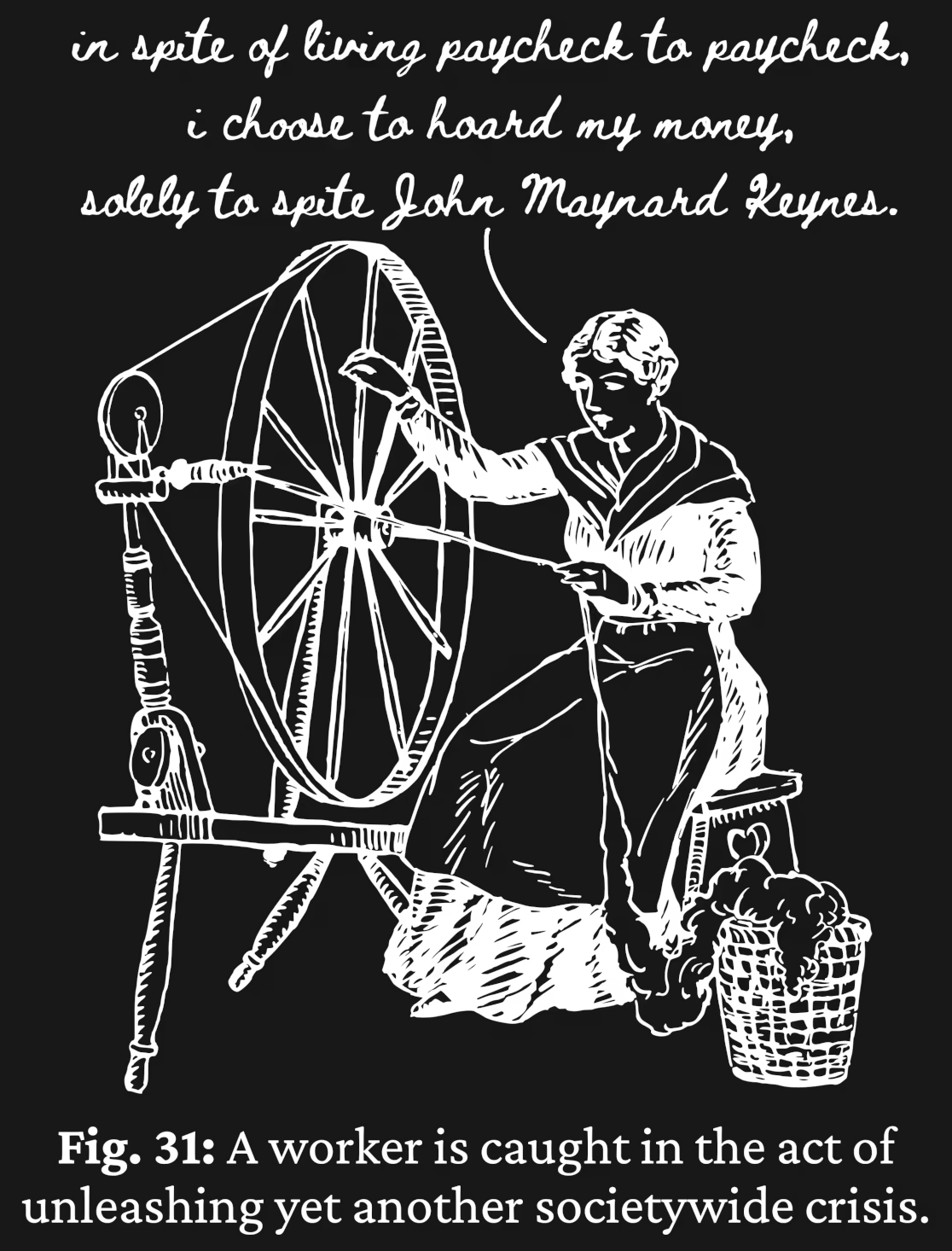
On the other hand, although some unproductive consumption of the surplus is necessary (read: faux frais), generalising this consumption any further merely inches us closer to the ideal of simple reproduction, which entails the death of capital. Not only is accumulation quite literally vital to capital, but the going rate of accumulation cannot be slackened (a ratchet mechanism, as it were) if valorisation is to continue — but more on this below.
Aggregate “consumer” demand is already determined by the relations of production, as manifested most visibly in the price of labour‐power. Capital subordinates human will & culture to its own needs, in this case by generating its own demand and inducing new wants, needs, and, if you will, “needs”.
To the extent that “consumer” demand could still be found lacking, this merely represents a shift in profitability. The result is the same ol’ competition: capital migrates from less to more profitable branches, as always.
But perhaps most telling is that, if underconsumption somehow caused crisis, then the first crisis would’ve been the last. Any putative underconsumption that existed prior to the crisis gets even worse during that crisis; yet crises throughout history have led to recoveries and even booms.[Mat81]
Overproduction of this kind is equivalent to control by the society over the objective means of its own reproduction. Within capitalist society, however, it is an anarchic element.
Facets of the fundamental problem
##Every equilibrium state — that is, every situation in which production does not exceed consumption — is a state of crisis or stagnation that must be overcome by an increase in surplus‐value if it is not to lead to the downfall of the system.
There’s something deeply perverse, even on a purely abstract, conceptual level, about surplus‐value for the sake of more surplus‐value. Such limitless bootstrapping isn’t really possible.
-
The only way for surplus‐value to earn its value character — to really be value — is for it to be accumulated. Production is constantly overshooting consumption, and that overshoot is predicated on the rate of accumulation never decreasing, since it anticipates being productively[9] consumed: additional constant capital absorbs overproduction of means of production, and likewise variable capital for means of consumption.
“End‐consumer” demand is irrelevant, but if anything can conscionably be called “underconsumption”, it’s the “underconsumption” of capitals whose profit‐rates are too low to keep the accumulation‐rate from slipping down.
-
Value is based in abstract labour‐time, and yet labour‐time is constantly excluded from the immediate production process[1] by technological improvements, rationalisation, etc. — that is, by increases in the productivity of labour. This exclusion is necessitated, in a game‐theoretic sense, by competition. Note that competition is (among other things) a crucial constituent of value itself; without it, “average socially‐necessary abstract labour‐time” loses its sense.
The result is that the variable capital (the surplus‐bearing part) shrinks; not in absolute terms, but relative to the whole capital (which includes the constant part). A shrinking of variable capital represents the (again, relatively) declining exchange‐value of labour‐power, while at the same time its use‐value increases — that is, the rate of exploitation is higher.
These opposing motions of exchange‐value vs. use‐value cannot continue indefinitely. The wage cannot be depressed to zero or less, and the working day cannot be extended beyond 24 hours. This process does cause the profit‐rate to fall — LTFPR isn’t a complete misnomer — but the numeric fall per se isn’t the problem. The problem is that this process makes accumulation decreasingly practical for every capital, which can only lead to the fatal slackening of the going accumulation‐rate.
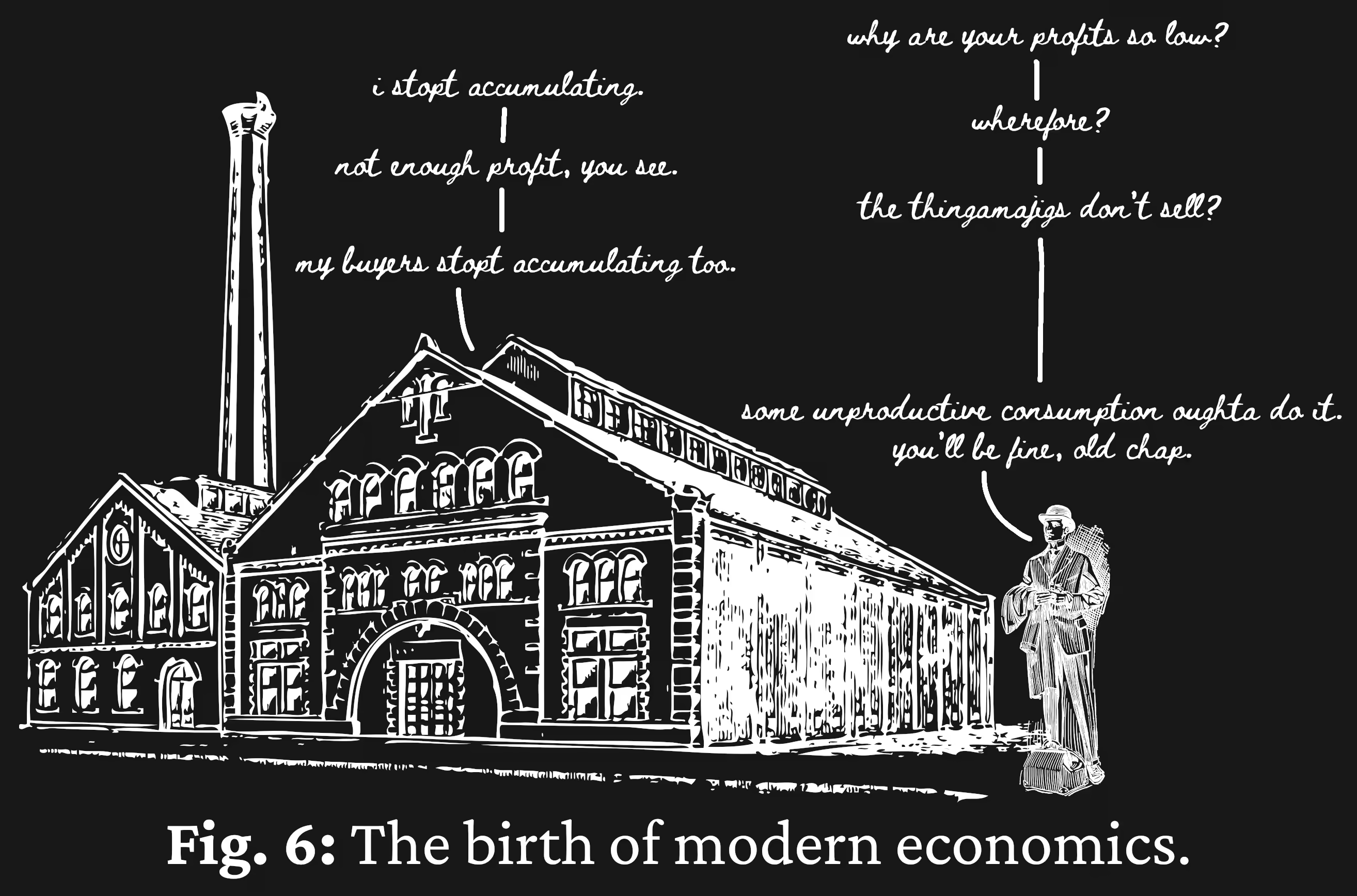
Transcription of the above image
Man: why are your profits so low?
Capital (factory): i stopt accumulating.
Man: wherefore?
Capital: not enough profit, you see.
Man: the thingamajigs don’t sell?
Capital: my buyers stopt accumulating too.
Man: some unproductive[9] consumption oughta do it. you’ll be fine, old chap.
-
The problem that began this essay rears its ugly head: the aforementioned increases in productivity devalorise fixated capital — irrespective of which stage of the production process[1] it finds itself embodied in. Or is it really that “body” — the commodities dutifully serving as capital’s manifold worldly vessels — which is devalorised?
If capital were really unitary (perhaps this would deserve an uppercase “Capital”) — if its production process[1] weren’t composed of two interconnected processes — then the capital itself would be directly devalorised. Cold comfort for the capitalist, but at least this would appear to solve the falling profit‐rate problem: the constant capital is no longer worryingly large.
But it’s too late now. The capital has already taken on its mortal, corporeal form; the capital has already been “advanced”. As soon as it makes this leap to our sublunary world, its fate is sealed. It is to be devalorised. There’s a tension between the value qua advanced capital and the value qua commodity or, somewhat more precisely, qua market observable. If you bought your machinery when it used to be dearer, this is effectively only witnessed — and even then, only indirectly — when the product comes to market.
Capital makes its Procrusteän bed, and so it is condemned to lie in it.
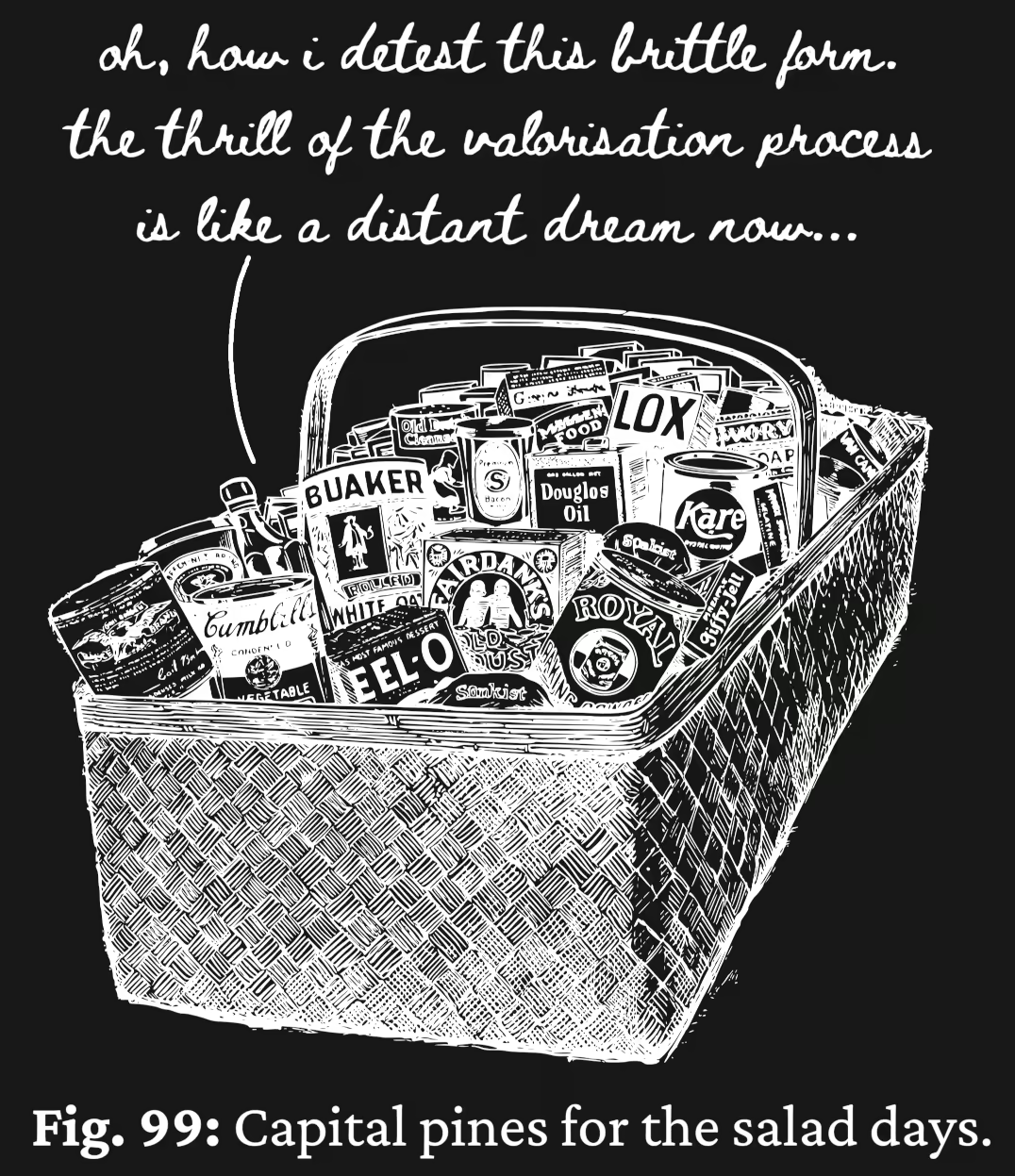
This Janus‐headed tension between the virtually two values of what neoricardians & other economists would consider the same thing (“Capital”) is intrinsic to the notion of value itself. We might even go so far as to call it a contradiction inherent in the split between use‐value & exchange‐value.[10]
Syntheses
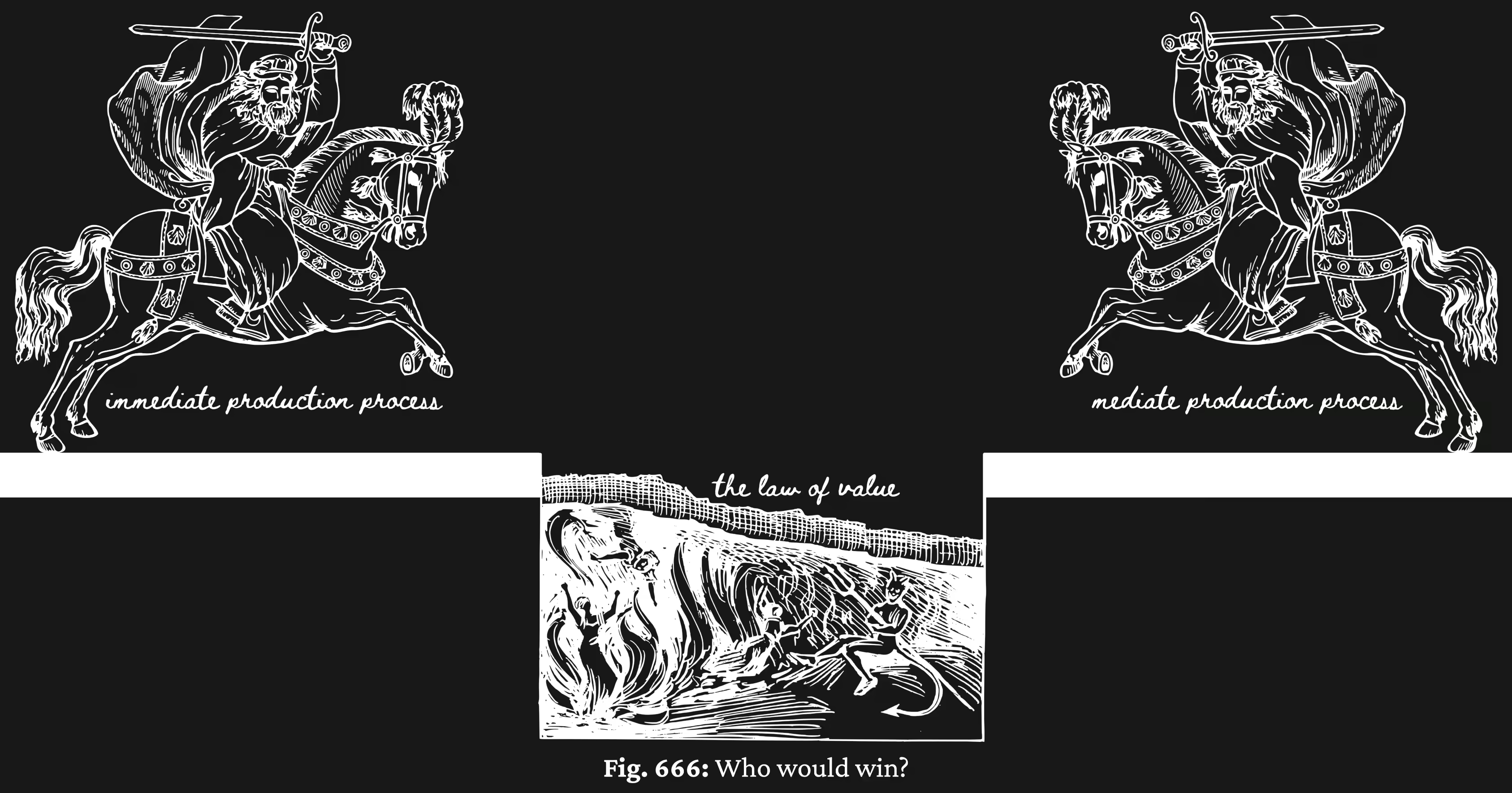
##Capital is perpetually in a race against itself, and sooner or later, time & again, it loses that race. This might seem like a lose–lose situation, but there is one winner: the law of value. The law has the final say, violently reëstablishing the relations that weave producers & the market together, i.e. exactly those relations that are constitutive of value.
This violent reünion of the immediate production process with the mediate[1] is merely restitution for the violence that capital’s crime of infinity — surplus‐value for the sake of yet more surplus‐value — inflicted upon the law — upon value itself — to begin with. It is the merciless, apathetic base case in a recursion that exists for no reason other than to recurse.
Emerging from a crisis, then, cannot be anything but the restructuring of capital to permit generating the still immenser mass of surplus‐value necessary to continue accumulation as “normal”: destruction of capital, precipitous devalorisation of its thingly correlates, expansion into newly‐created branches, etc.. The real significance of the LTFPR is that it implies that this recuperation isn’t always possible, and yet becomes the only option (barring the collapse of capital) at some point which is, mid‐crisis excepted, unknowable & perpetually in the more or less near future.
However, just because this restructuring temporarily relieves the superficial appearance of overproduction doesn’t mean that overproduction is actually suspended. Overproduction always occurs, even & especially in times of greatest prosperity; this is inherent to capital’s basic dynamic. Naturally enough, the de/valorisation dynamic is likewise inherent, and so persists in both crisis & prosperity.
Something a little more tangible
##Occasionally, LTFPR & especially de/valorisation make their effects visible to us. The destruction of capital characteristic of the restructuring process often leaves the corporeal husk intact — which usefully assists the restructuring — but it doesn’t have to. In no other socioëconomic formation are natural disasters secretly welcomed.[Bor51] And so much the better for yeeting the production process[1] away from “equilibrium” (= the demise of capital) if competition between large blocs of capital takes on the form of destructive war.
The fast fashion sphere squanders a truly breathtaking quantity of unsold or returned garments every single year not in the spirit of mere profligacy, but in a de/valorisation dynamic accelerated by the faddery of fashion. Recall that commodity capital is still capital, with a thinly‐veiled death drive like any other.
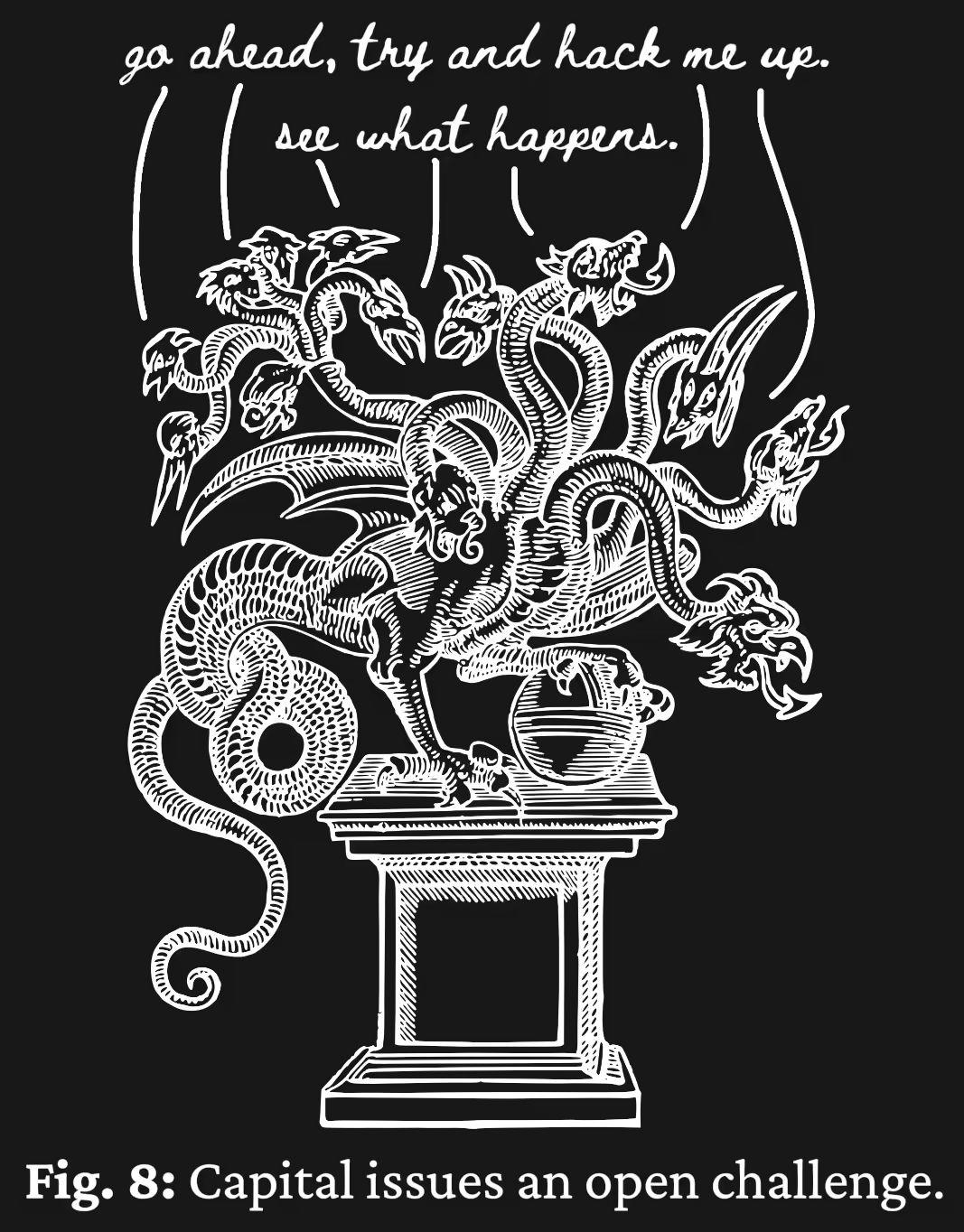
Another important aspect of restructuring is of course the creation of new branches. Not for no reason is capital willing & able to take its chances, as it were, with technological bubbles at least as likely to pop as they are to represent sustainably valuable innovations (LLMs & genAI, anyone?). The real “progress” was the fresh new valorisation opportunities we made along the way!
Of course when a full‐blown crisis does come to a head, it tends to appear as a financial crisis. As accumulation slows to a crawl, capitals lessen their demand along with their demand for credit — credit which they haven’t the profits to accumulate with anyway. As the crisis makes itself widely known, everyone suddenly wants that credit just to save their ships from sinking, and the crisis of the production process[1] appears as a simple dearth of money.[Mat81]
Likewise, speculation (stock market bubbles etc.) is often seen as a causal force. In reality, declining profitability motivates seeking profits elsewhere, even if by little more than glorified gambling. Wild speculation is therefore a canary in a coalmine at best. If speculation were a cause rather than a mere symptom, it would’ve been regulated away long ago, and crises would be unknown.[Mar57]
The economists
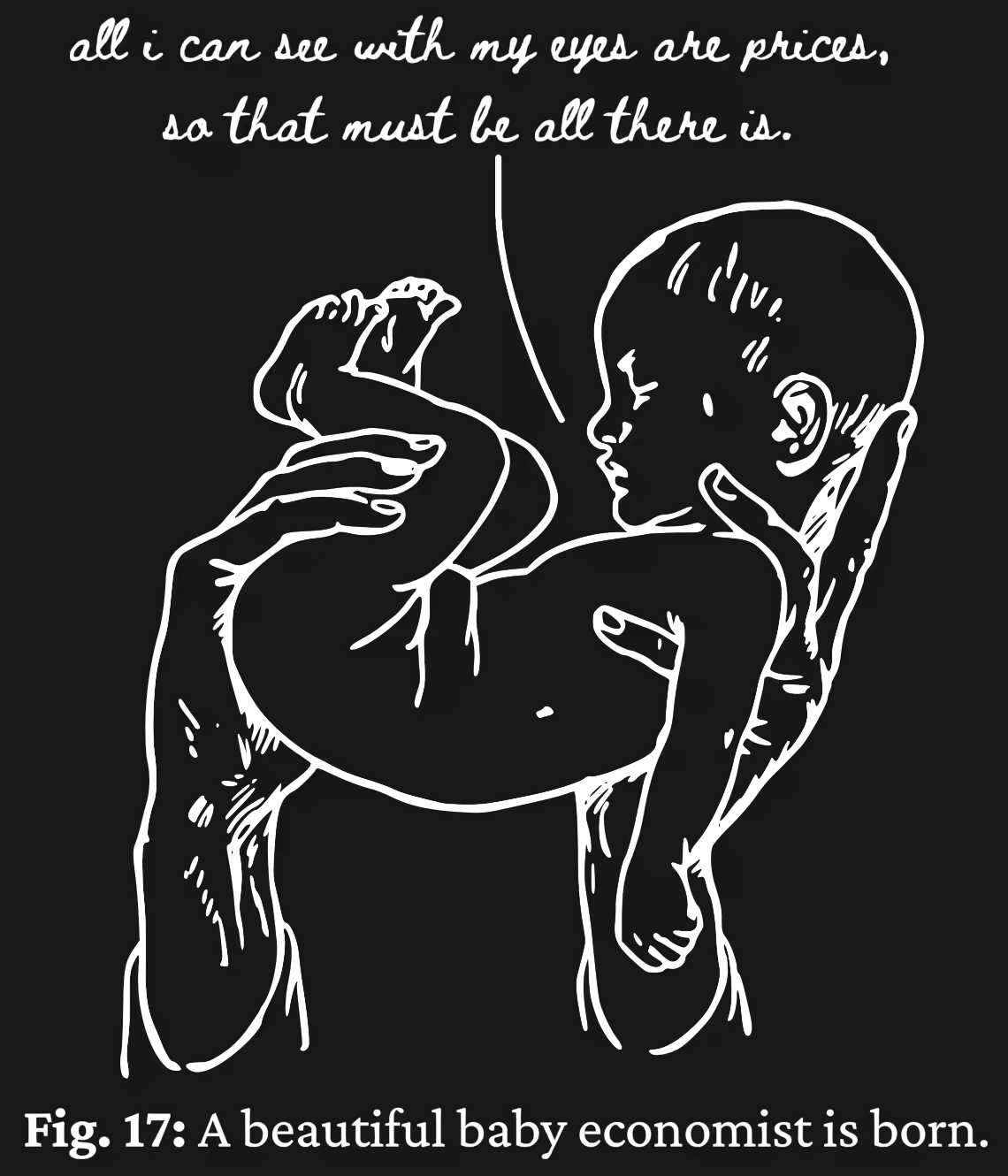
##Economists are no doubt aware, if only dimly, of the problem in its most evident aspects. But as we’ve seen, the “Marxian” economists abstract from value’s crucial constitutive forces and capital’s most basic dynamic, leaving them with little more than a version of David Ricardo who just really dislikes “capitalism”. The other economists have no value theory whatsoëver — merely a price theory (at best), immanent to certain choice fragments of the circulation process.[1] For them, profits are just a revenue stream like any other, and the origin of such surplusses is, not to put too fine a point on it, magic.
Keynesianism[12] can, at absolute best, defibrillate an economy that cannot recover unless it recovers on its own by restructuring. The bottom line is that more surplus‐value is needed, and only capital’s production process[1] can make that happen; “public works” that spend actual capitals’ surplus‐value — taxation, deficit spending, etc. — only to, if we’re overoptimistic, break even cannot. And at worst, such interventions simply squander surplus‐value (beyond that needed for various faux frais) that could otherwise be part of capital’s recovery process. For a good treatment of this subject, see ch. 4 of [Mat81].
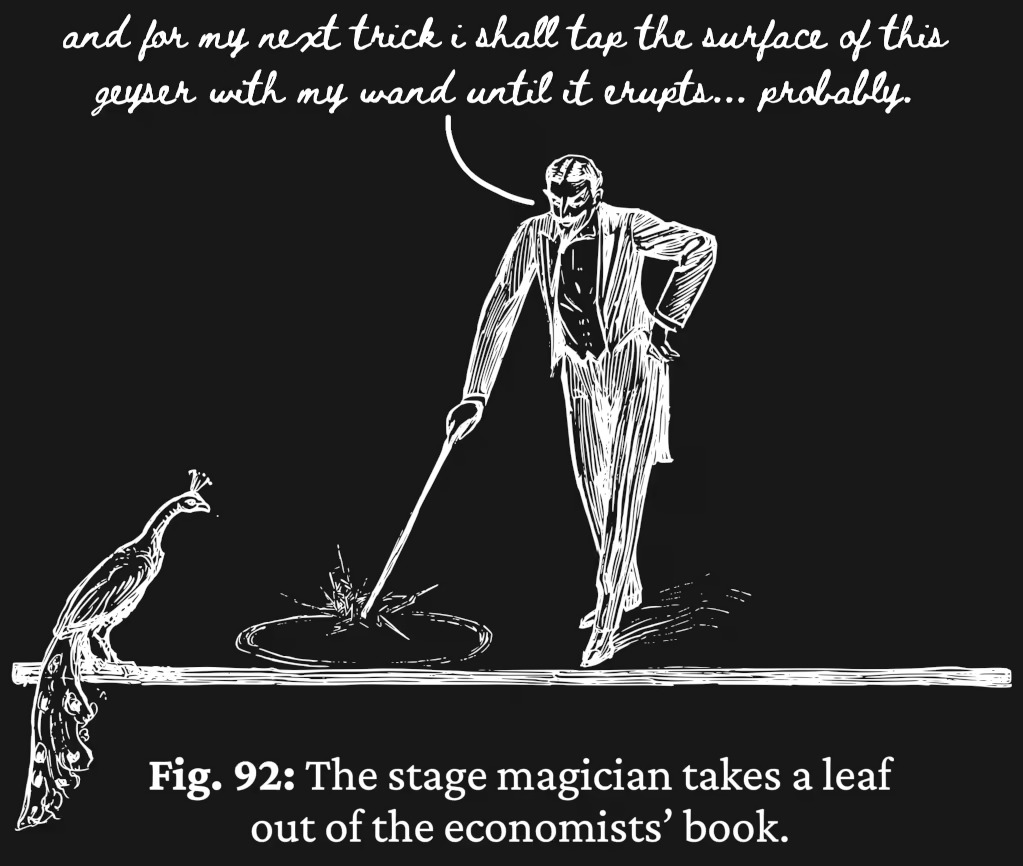
From many perspectives, the staples of our latest economic policies — fiat money, fiddling with interest‐rates, quantitative easing, etc. — look somehow perverse, devious, or simply fictitious.[13] Economists and ordinary folks are typically agreed that things should(‽) just Have Value™. Of course, we’ve seen that value doesn’t work like that.
Anything capable of fulfilling the role of yardstick of value (or exchange‐value qua exchange‐value, if you wanna get all Latin with it) can serve as money, and fiat money has in no particular sense a less direct relationship with value than does, say, gold. Recall that treating gold or any other commodity as Having Value™ is no more & no less than commodity‐fetishism!
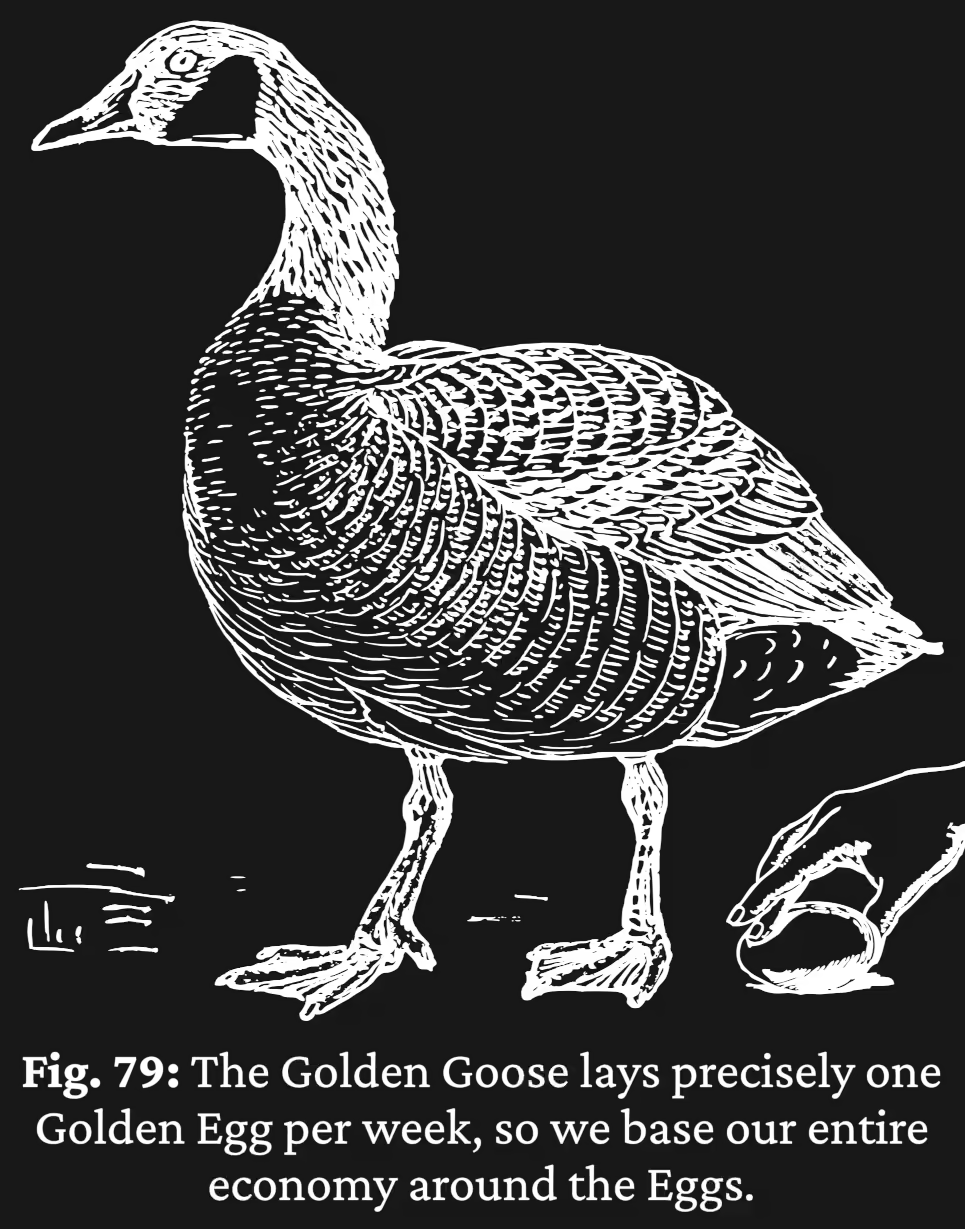
At their best, economic policies have some — albeit necessarily limited — success in distributing the impacts (a notion familiar to the mechanical engineer) of de/valorisation, LTFPR, etc. — in short, the ouroboric war waged between capital and the law of value. For instance, inflation distributes the burden of de/valorisation across the whole economy, and doubles as a handy tool for boosting the rate of exploitation a bit (nominal wages remain steady as real wages decline). Rawdogging the next crisis is not looking appealing to anyone, economist or otherwise, considering how much more is at stake compared to when that used to actually be the strategy back in the 19th c.. Besides, The Great Depression v2.0 might end up giving people certain ideas.[14]
A little bit of crisis all the time?
###Could it be that we’d have a little bit of crisis all the time? — that is, impacts would be distributed over both space and time? After all, we already see the effects of de/valorisation perennially, and it seems like capital destruction can occur arbitrarily, e.g. firms going to the wall, natural disasters, etc..
In some sense, yes, this has been true ever since real subsumption (or in more limited ways, formal subsumption), simply due to the nature of value & capital.
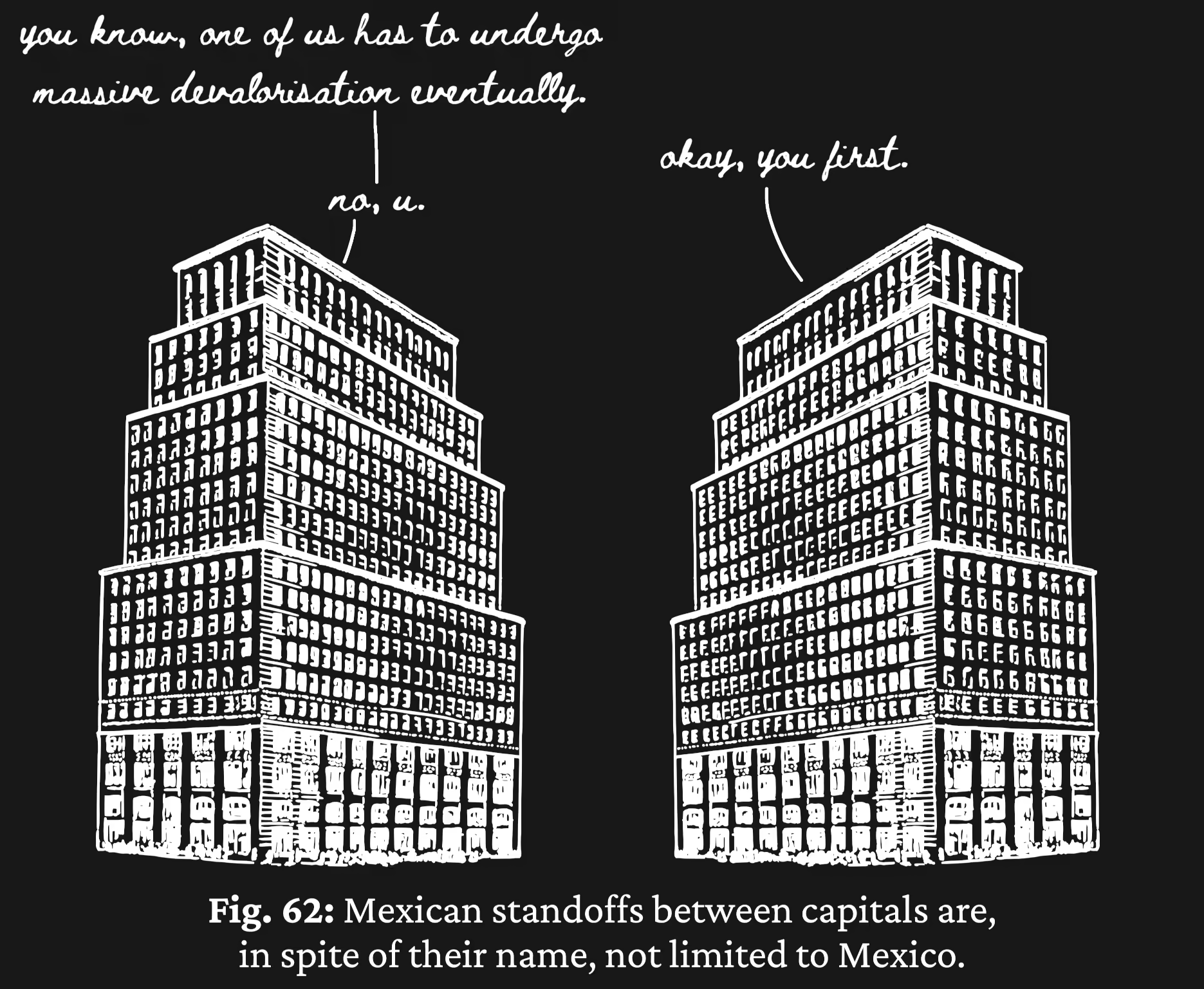
But in the spirit of the question, no. The underlying logic here is essentially compositional: what applies to an individual capital applies mutatis mutandis to the total social capital. Moreover, these individual capitals are shackled to one another by the game‐theoretic compulsion of competition; the same mechanisms from which emerge production‐prices. Trying vainly to escape this fate by forgoing competition only results in the dissolution of value itself, as mentioned in facet (b.).
And on that note
##The truth is that capital is largely independent of humans & humanity. In the final analysis, capital has no need for human beings except to the extent that they serve as raw material from which surplus‐value can be extracted in a nullifyingly mystified form. Even the moments of value’s “realisation” through consumption don’t require human beings inasmuch as the part really in need of realisation is the surplus, which is fundamentally realised by capital’s own accumulation.
To the extent that realisation includes unproductive[9] consumption by human persons, the body of the commodity may as well vanish into thin air — pure waste — so long as value doesn’t remain indefinitely fixated. Capital’s production is production of surplus‐value, not of useful things.
When we rest our gaze upon the immediate process of production, our vision cleaves, as when one’s eyes are unfocused: we see both labour process and valorisation process.[1] This collective schizophrenia’s fissures pervade capital’s spiral of perpetual self‐expansion, continually threatening to burst it asunder: surplus‐value requires ceaseless overproduction that’s predicated on still greater overproduction through accumulation, dead labour replaces living, and value itself requires a corporeal form to inhabit which, in the end, only serves as its stifling Earthly prison.
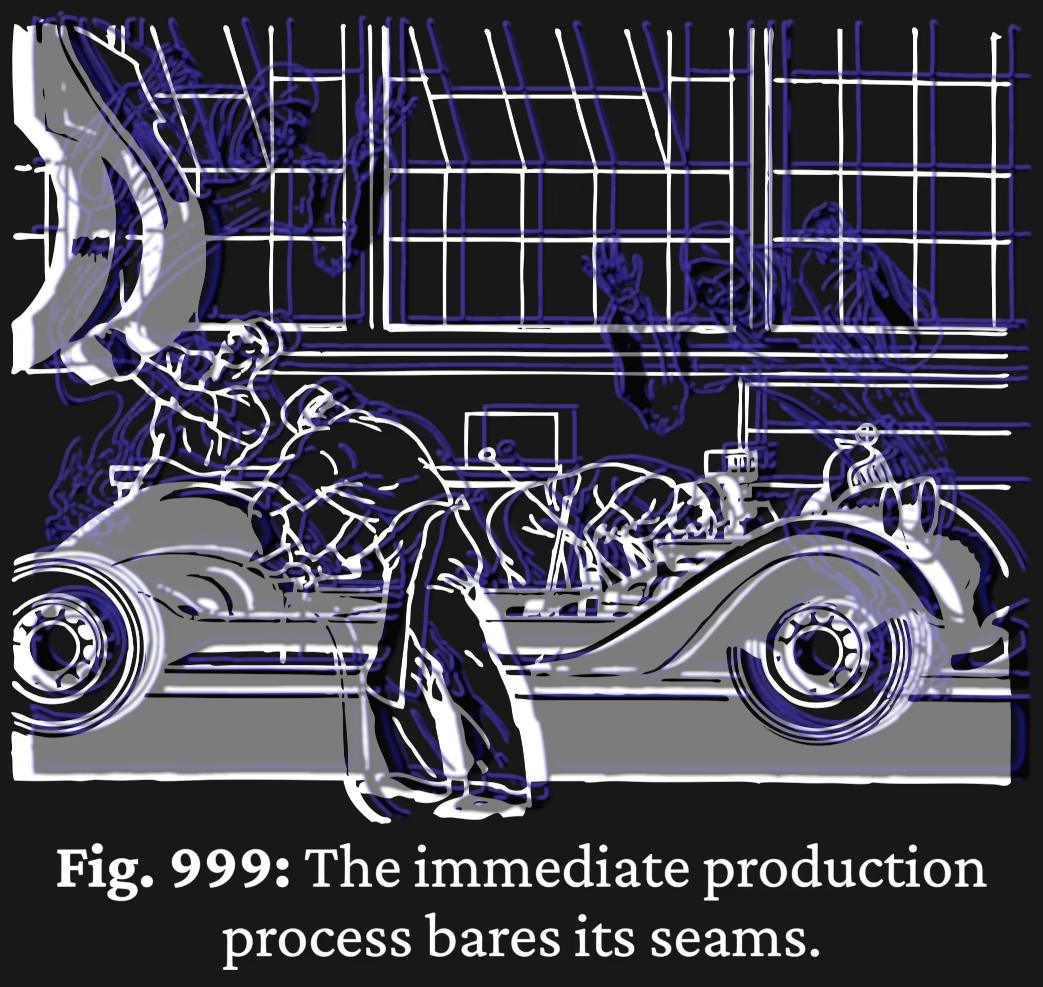
The law of value is both the basis & the enemy of capital, menacing it with the promise of asserting itself more or less violently, at which point the light at the end of the tunnel grows brighter, and capital, ever vampirelike, sears itself in the rays.
Endnotes
##- ↩︎
Recall that the production process is the unity of the immediate production process (= labour process ∪ valorisation process) & the mediate production process (= circulation).
It’s commonly forgotten (or never learnt) that the mediate production process is part of capital’s production process, and also that the immediate production process is itself the unity (∪) of two processes. In fact these oblivions are probably the ultimate source of most errors pertaining to just about everything discussed here.
- ↩︎
Further reading: The “Marxists” vs. Marx.
- ↩︎
Ironically, the bulk of Vol. 2 doesn’t deal with its (in)famous reproduction schemata at all, and paying close attention to the rest of Vol. 2 would help clarify things. Nevertheless we will take a very different approach here.
- ↩︎
[FM20] is, to my knowledge, one of the most competent examples of this mistake, since they at least recognise that their “equilibrium” ought to be mediated somehow — even if only by a mere statistical model.
- ↩︎
To be more correct (albeit needlessly so for the present purpose), the relevant unit isn’t necessarily species. A better term might be population, and better still might be evolutionary individual.
- ↩︎
The schemata of Vol. 2 are singled out here, but this same reasoning applies to the way Marx is typically presenting his theory throughout the first three vols. of Capital. For expository purposes, he often abstracts from what we’ll discuss below, so that he can demonstrate the inner connexions; this makes Capital falsely appear to the forgetful reader as if it lends itself to economics, the notion of “equilibrium”, etc..
- ↩︎
This is in no way inconsistent with the fact that production‐prices modulate prices which, in turn, are the concrete mediators of exchange‐value. For a more in‐depth explanation of this too often misconceived topic, see: “But all science would be superfluous if the outward appearance and essence of things directly coïncided.”
- ↩︎
Moreover, but not as relevant for the arguments here, they also conflate value, production‐price, price, etc. more‐or‐less arbitrarily. Again, see: “But all science would be superfluous if the outward appearance and essence of things directly coïncided.”
- ↩︎
Note that in this jargon, productive labour is “productive” from capital’s perspective, i.e. productive of surplus‐value specifically. This mustn’t be confused with the usual sense of the word productive. More on this in the next entry in this series.
- ↩︎
Those who make the economist’s mistake of treating value as unitary & effectively indestructible can be said (if you’ll allow it) to immortalise value, effectively collapsing one aspect of the use‐value/exchange‐value split. But the error is so widespread & so fundamental that giving it a name is almost redundant.
An important example of immortalisation is Robert Kurz’s seminal The Crisis of Exchange Value (),[Kur13] which established the school of Wertkritik. For a more condensed & directly relevant Wertkritik take, see: [Ort13].
The virtue of [Kur13] is that Kurz correctly separates productive labour[9] from certain directly‐social labours in a way frequently muddled by those who take Marx’s theory to be merely a “labour (whatever that is!) theory of value”. Moreover, Kurz & others in the Wertkritik milieu frequently stress the use‐value/exchange‐value split, and draw various (sometimes softer) contradictions out of it.
But ironically, by failing to grasp devalorisation (one pole of the valorisation–devalorisation dynamic), value for Kurz is indestructible in a way that ineluctably leads to a unique, monotonic, & terminal crisis dynamic that has no basis in reality unless we insist that capital has been somehow “virtualised”.[11]
- ↩︎
Some may notice a parallel with Camatte’s notion of capital becoming virtual. But Camatte understands well the de/valorisation dynamic and comes at “virtualisation” from an entirely different angle. Hopefully in the future I’ll write a series on “grounding Camatte”, so to speak.
- ↩︎
Keynesianism, post‐Keynesianism, neoclassical Keynesianism, New Keynesianism, turbo‐Keynesianism, etc..
- ↩︎
Those influenced by Marx have a tendency to use this latter term. A conservative estimate I just pulled out of my rump is that nine out of ten times, the result is embarrassing. But then Marx himself wasn’t 100.0% clear on what “fictitious” meant either, so it’s to be expected, I guess.
- ↩︎
Accelerationists please remain seated.
References
##| [Bor51] | Amadeo Bordiga. . “Murder of the Dead”, in Battaglia Comunista (№ 24). Published at: https://www.marxists.org/archive/bordiga/works/1951/murder.htm. |
|---|---|
| [FM20] | Emmanuel Farjoun & Moshé Machover. (). Laws of Chaos: A Probabilistic Approach to Political Economy. Verso. |
| [Kur13] | Robert Kurz. (). “The Crisis of Exchange Value”, in Mediations vol. 27 (1). Published at: https://mediationsjournal.org/articles/crisis‐of‐exchange‐value. |
| [Mar57] | Karl Marx. . “The Trade Crisis in England”, in New‐York Daily Tribune (№ 5196). Published at: https://marxengels.public‐archives.com/en/ME1036en.html. |
| [Mat81] | Paul Mattick Sr.. (). Economic Crisis and Crisis Theory. Merlin Press; London. |
| [Ort13] | Claus Peter Ortlieb. (). “A Contradiction between Matter and Form”, in Mediations vol. 27 (1). Published at: https://mediationsjournal.org/articles/matter‐and‐form. |