Based on the commonplace understandings of the terms, the organic composition would seem to merely be the “correct” version of the value composition: the value composition that we’d compute based solely on knowledge of the technical composition and the values of its component parts.
Defining the notion of service is notoriously difficult. This is my brief attempt at systematising it in an historically‐specific and thus useful way, incidentally critiquing Endnotes (especially [End10]) along the way.
[T]he labor‐time socially necessary to make products forcefully asserts itself as a regulative law of nature […] just as the law of gravity does when someone’s house falls on his head.
Most readers should skip the bulk of this essay, which is dedicated to a thorough analysis of the piece in question. The “Putting it all together” section does not assume that the reader has read anything else, and importantly, provides hyperlinks back into the bulk of the essay, for the benefit of readers who want or need additional explanation, detail, &/or argumentation.
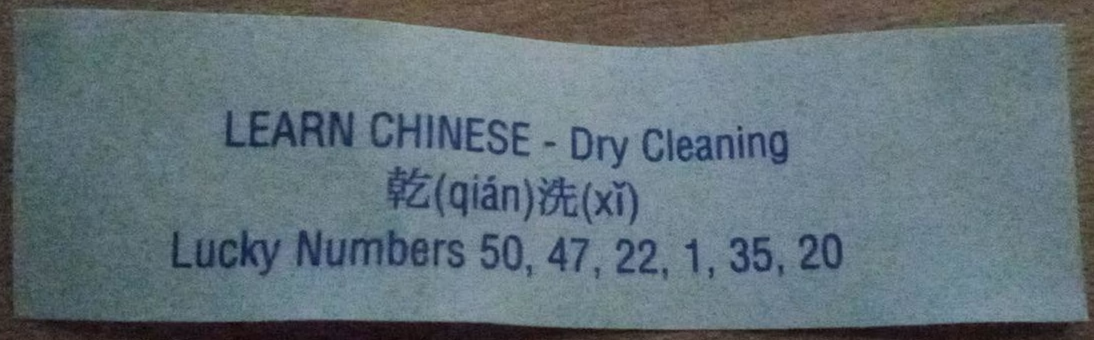
Fortune cookies are not Chinese. At best, they’re Japanese, and really, the modern form that we know is an American invention. The transfer in association from Japanese to Chinese (or rather, from Japanese‐American to Chinese‐American) seems to largely boil down to the gastronomic preferences of Americans at the time (viz. the first half of the 20thc.):
“A lot of Chinese restaurants were owned by Japanese,” Stephen said, noting that there wasn’t a lot of demand for sushi back then. “They opened Chinese restaurants as a means to an income.”