
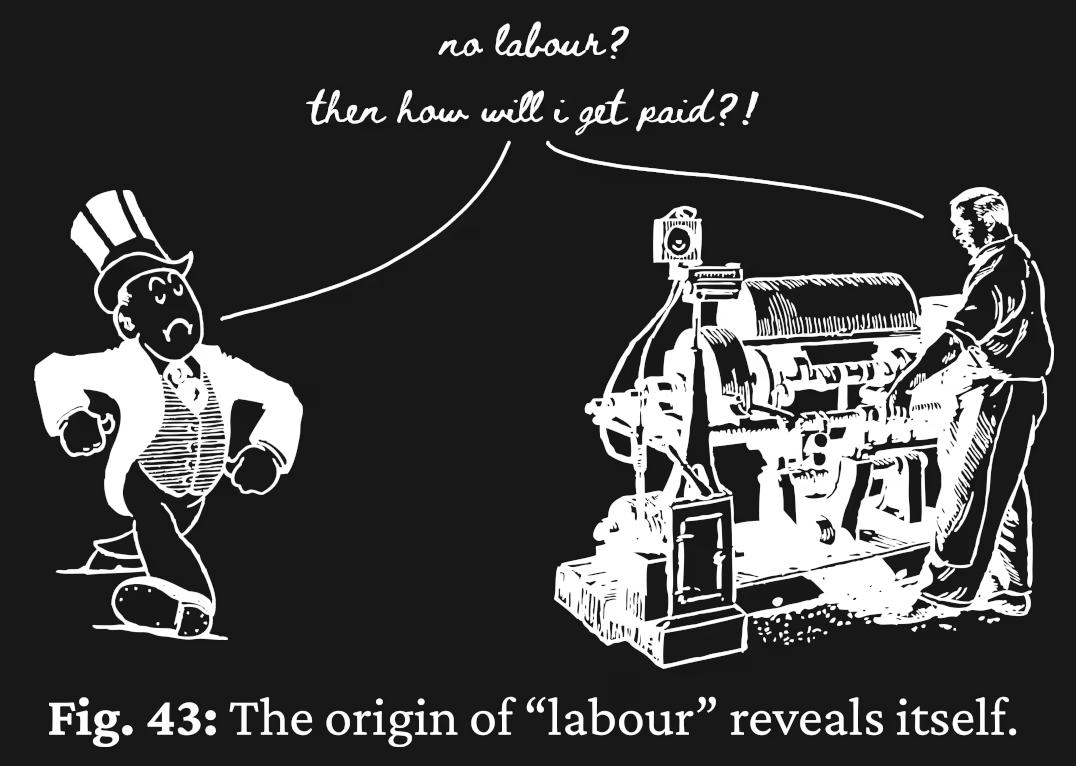
“Labour” is itself a recent & ephemeral historical artefact
#“Labour” by its very nature is unfree, inhuman, antisocial activity
I: Born (and reborn, and…) of exchange
##Like Marx, we start with the commodity‐form.
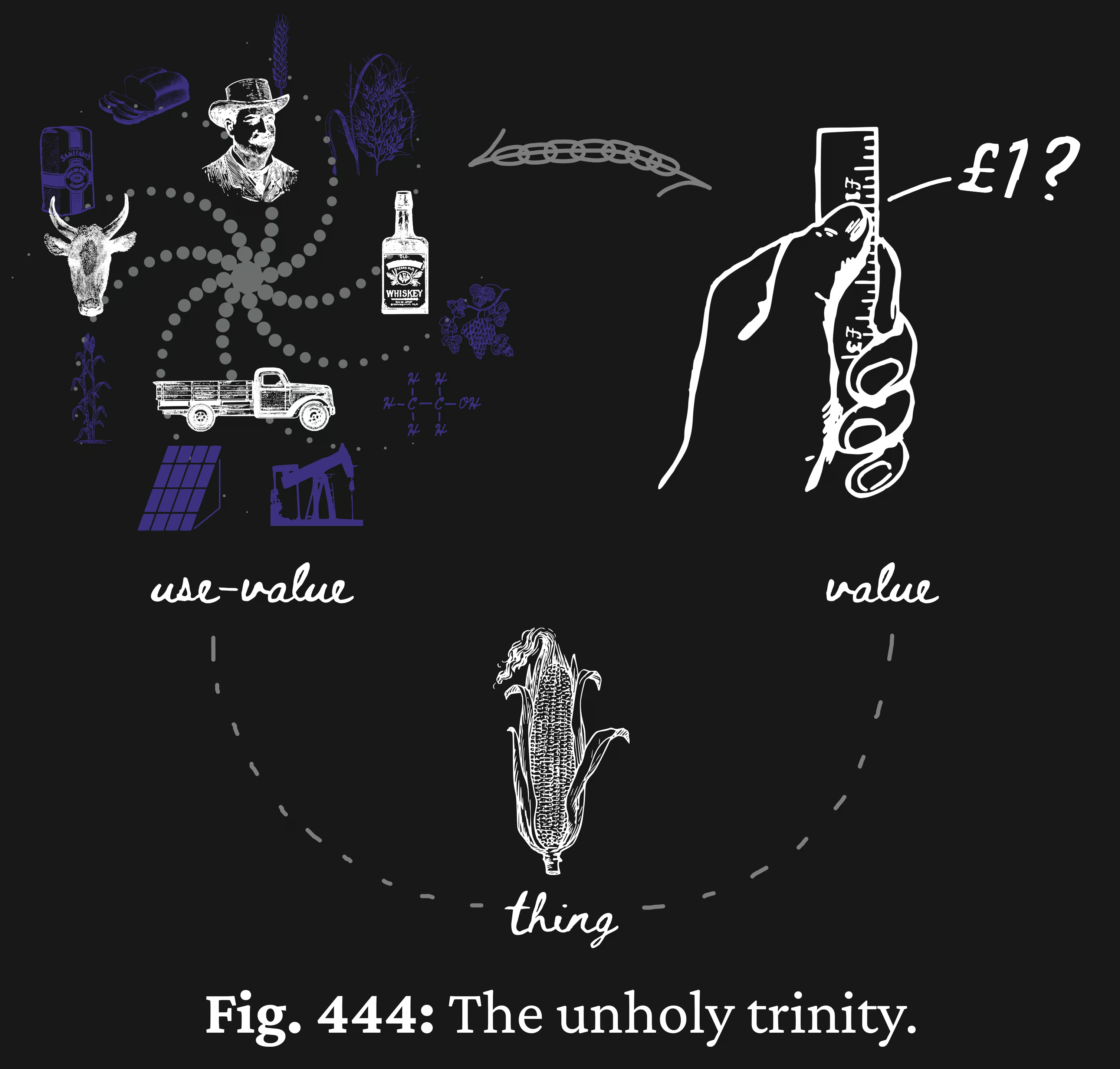
First we note that use‐value isn’t the thing (= the body) itself: there’s nothing physical about it, it changes with time & with place even when the body is meanwhile unchanged, and it’s an historically‐specific real abstraction[1] — only real relative to a very particular socioëconomic formation.
Use‐value is value’s[2] necessary yet resented[3] partner in crime, providing not merely a way to abstract over individual things (an ear of maize is just as good as another ear of maize), but also a way for commodities — or, less fetishistically, their producers — to compete on the market. Maize competes with a cornucopia of other commodities whose bodies (and use‐values, for that matter) range from very similar to wildly different; all this enabled by their mutual overlaps within an everchanging use‐value space.
One‐valued logic
###But we’re getting ahead of ourselves. The commodity‐form’s raison d’être is exchange, and for two qualitatively distinct things to be compared & exchanged, they must be levelled by involuntary subjection to a common measure: value. But at this level of analysis, value is only a logical category lacking any content, not really distinguishable from the nonnegative rational numbers.[4]
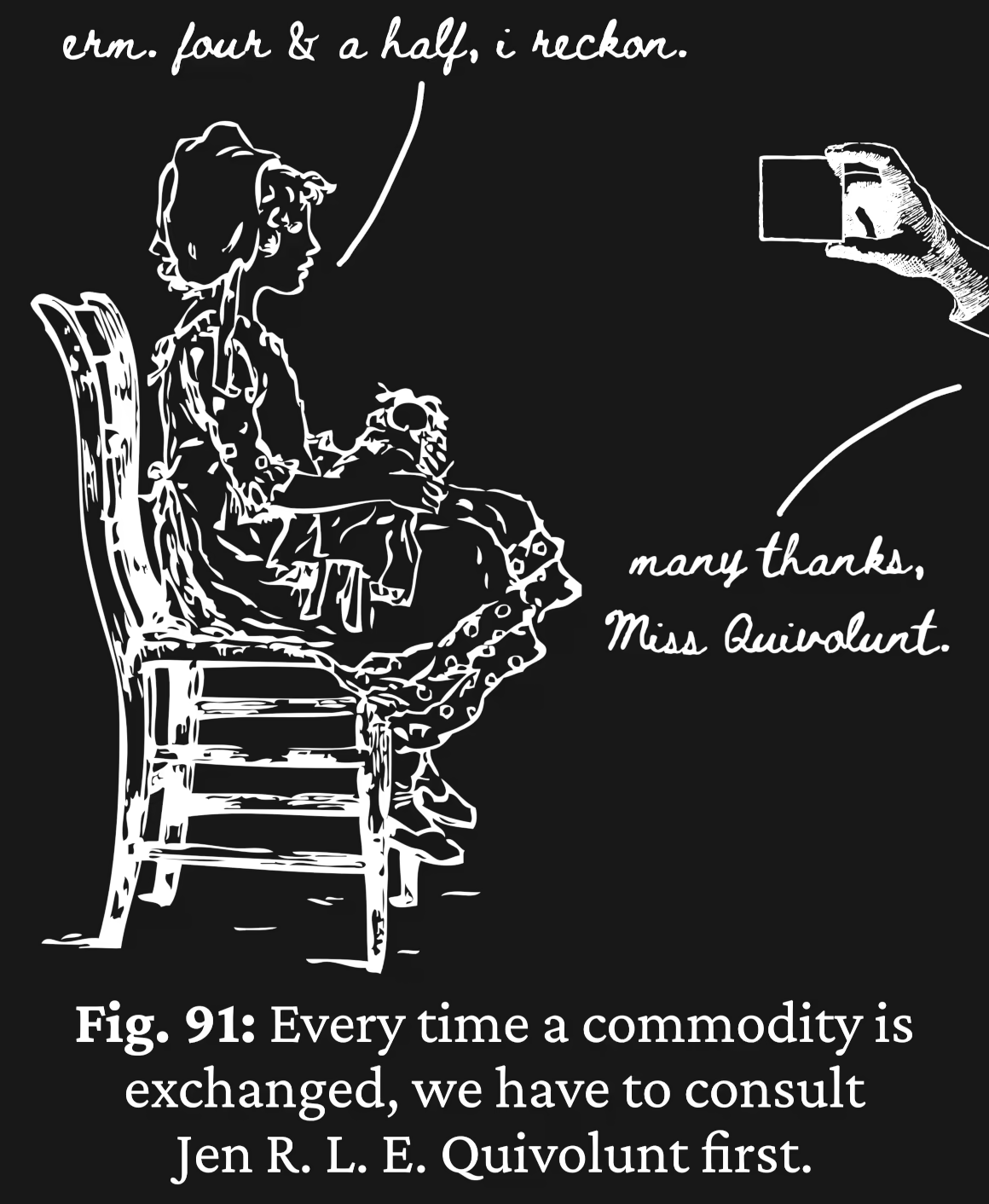
Still, this logical form suffices to demonstrate that valorisation cannot occur within exchange itself. The entire purpose of levelling things to a common denominator is so that equivalents can be exchanged, tit for tat.
For value to become real — a social fact[1] — it must continually be replenished, since part of it is irreversibly destroyed each time one of its commodity appendages is used, consumed, or devalorised.[5] This perpetual replacement is equivalent to the valuewise total social reproduction discussed in the previous part; it is the metabolism of value as such, i.e. its means of vitality and therefore existence. But because fresh value cannot arise within exchange per se, value is obliged to orient itself towards the production of commodities — its Earthly vessels. It must assume control over the fateful crossroads of production if it is to exist at all.
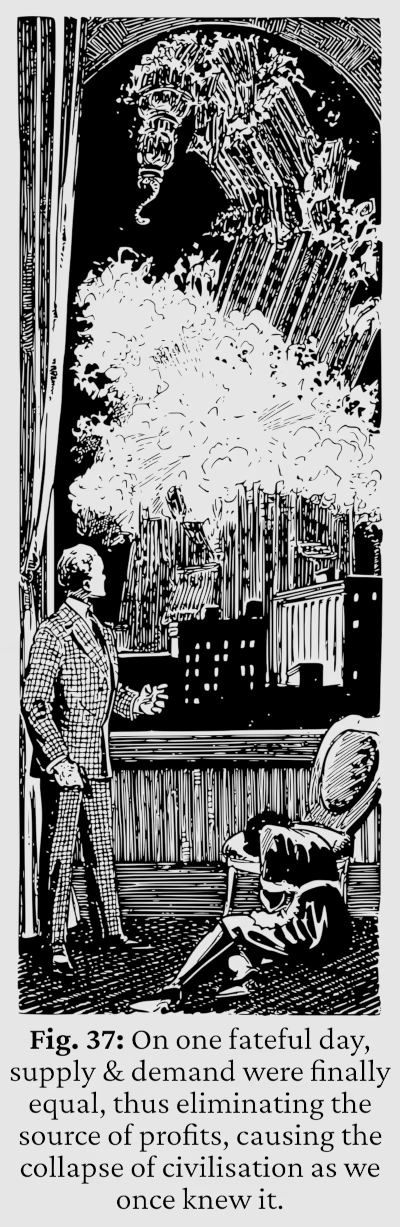
This is enough to suggest that the content of value has something to do with the point of production of the commodity, but still reaches no firm conclusion. Nonetheless, any possibility of value’s content being supply & demand, or some kind of aggregate subjective desires & willingnesses, is eliminated. For “value” of this kind to replenish itself, it would have to produce & reproduce both desires and general social dependency upon exchange. But as a real abstraction, it’s value’s job to explain these kinds of facts — and in an historically‐specific way, no less — so we’d merely be begging the question.
II: Labour process, schmabour schmocess
##To be general social wealth, value must subordinate human social activity to its own purposes. It must demonstrate itself to be a realer truth than petty, traditional, direct personal relations. As value sweeps aside all else in an attempt to produce more commodities and so renew itself, the labour process is defined reflexively: what exactly “abstract labour” is is irrelevant, so long as it’s the kind of human social activity that maximises the number of commodities that come out the other side (per unit of input value). This is the content of value.
By the way, this is why machines themselves aren’t productive of value, and why capital isn’t stuff. Machines do what they do because they’re designed that way (or, for domesticated organisms: because they’re artificially selected that way), and are therefore not in need of subsumption, because they’re already subordinated in a way that doesn’t need to be continually reproduced — only the machines themselves need reproducing (repair, replacement). Humans are a little trickier, since they can only be subordinated to self‐sustaining social relations;[1] that’s where value — and its content, abstract labour — come in.
Just‐so (hi)story
###Some activities seem like they could be “labour” in an ahistoric sense: people baked bread in precapitalist times, and now bread can be commodified. So, through our fetish‐tinted glasses, we can see all bread‐bakings as particular instances of Abstract Labour™.
But this is analogous to seeing a biological trait as having always‐already been destined to serve a particular purpose. Even if we admit a kind of synchronic, immanent teleology in which the organism’s (& its ecology’s) components mutually serve one another towards a collective end that we typically call life, it’s still untrue that arbitrary diachronic (i.e. evolutionary) changes due to random mutations etc. already have a “function” as soon as they arise. Much more commonly, neutral or even maladaptive mutations suddenly become adaptive when the stars align (…or not); changes simply accumulate (…for better or worse); structures get coöpted or repurposed (…or become vestiges); and so on. “Function” appears inevitable only in retrospect.[7]
A reflexive taste of totality
###So the labour process is defined reflexively as value’s (in effect, commodities’) creätion process teleologically oriented towards its own home turf — i.e. exchange — while, at the same time, value’s content (if not its form) is defined in terms of said “labour process”. This reflexivity is bootstrapped, as we well know, via the commodification of labour‐power, allowing value to purchase the means of its own vitality. This is what Marx calls formal subsumption. Abortive attempts at this bootstrapping occurred many times throughout history, since value has plenty of things working against it: the labour process has to start out by working with whatever materials it historically finds lying around, proletarians have to be reproduced as proletarians (as against going back to being peasants or whatever), stuff like that.
Once the bootstrapping succeeds, though, value reveals itself to be inherently capital, and it becomes a totality. The analysable parts of a totality aren’t truly separate except in theory, because each part is a precondition of every other part[8] — whence the need for bootstrapping.
“Labour” isn’t merely “subsumed under” capital, as if “labour” were somehow a preëxisting phenomenon that value merely appropriated or dominated. To be sure, the materials (including e.g. techniques) are initially those found readymade, but even this isn’t true once real subsumption takes hold. “Labour” — meaning abstract labour (≘ value) and, as we’ll see, concrete labour (≘ use‐value) too — is included as an inextricable part of capital qua totality. Like the God of Genesis, capital creätes labour in its own image, moulded by its own terms, as something not definable without reference to capital.
As the unholy ghost of social mediation
###Labour, then, is the basic form of social mediation as far as capital is concerned: the qualitative division of labour cleaves along concrete labour lines, and is quantitatively allocated by abstract labour.[9]
Instead of direct, traditional, overt, personal relations, we have unconscious abstract compulsion that operates “behind the backs of the producers”.[11] This is the source of Marx’s famous commodity fetishism: this unconscious social relation between people appears as a property of, &/or relation between, things.
This has its counterpart in labour fetishism: an historically‐specific but real social relation[1] — namely, abstract labour — appears absolute & ahistoric; a property of human activity per se.
One might attempt to wriggle out of this by treating abstract labour as a useful construct (bracketing the realism question) that’s essentially psycho‐practical and therefore basically ahistoric, perhaps with some minor historical modifications. But this is no better than importing commodity fetishism into historical formations with nonexistent (or marginal) commodity‐production.
Épistémè
###For those oblivious to Marx’s mode of inquiry & presentation, it seems that Capital vol. 1 furnishes us with an ahistoric definition of abstract labour:[12] “a definite quantity of human muscle, nerve, brain, and so on is expended”. In truth, this physiological definition only makes sense given Marx’s immanent perspective; that is, immanent to “the completed bourgeois system”. From this standpoint — that of our ordinary experiences within capitalist sociëty — such a sapping of bodily energies is the only apparent substance of value, the only thing that abstract labour, for mystified reasons, seems to impose upon us. That’s what we get paid for, right…?
Marx takes it as obvious that his highly specific unfolding of capitalism’s totality is exactly that: historically‐specific. His immanent standpoint has epistemological implications: grounding the critique of capital in capital’s own logic eliminates both historically‐contingent undesirable biases in the structure of thought, and any purported need to know one’s (the subject’s) exact relation to the object of study before knowing anything about the object in a noumenal sense. This is initially what justifies Marx’s positing of “labour” as the substance of value, as a concession to capital’s own logic, as already generally understood (albeït woefully incompletely) by the political economists.
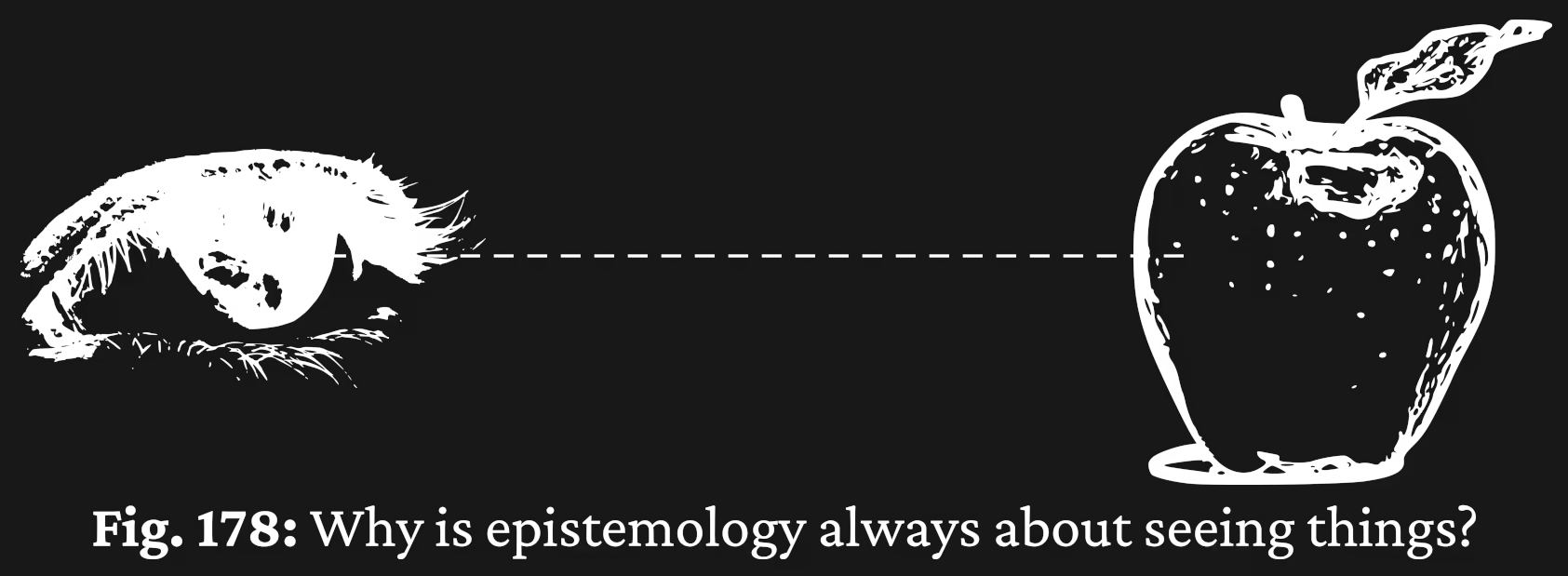
The categories Marx introduces in order to understand capitalism are retroäctively justified, each one only becoming clearly necessary long after its basic definition is given, at which point the totality is reconstructed in a way that seems obvious — in retrospect. Totality implies that all these categories are interdependent; moreover, the underlying structure can’t be how it appears on the surface, or else our “understanding” would be no more than a prolix articulation of common sense. It’s therefore impossible for Marx — or anyone else — to present the matter in any way other than retroäctive justification. This is ultimately what justifies Marx’s positing of abstract labour as the substance of value.[13]
III: Making a good fist of it
##We’ve seen that there’s no ahistoric version of abstract labour; appearances to the contrary are what we call labour fetishism. For instance, when we were forced to conclude that “what exactly ‘abstract labour’ is is irrelevant, so long as it’s the kind of human social activity that maximises the number of commodities that come out […]”, this clearly assumes the commodity‐form, which we know well to be historically‐contingent.
We’ve also seen that abstract labour is, as substance, merely one aspect of an imbricated, mutually self‐reïnforcing structure (= totality) which we call value (→ capital).
Such reflective determinations are a curious thing. A man is a king only because other people behave toward him as his subjects. Of course, they believe themselves to be his subjects because he is their king.
Likewise, human social activity is only “labour” insofar as people design for it to be commodity‐producing. But of course, the commodity per se is only born within the exchange‐relation; the commodity‐form persists only because people socially orient their activity towards exchange.
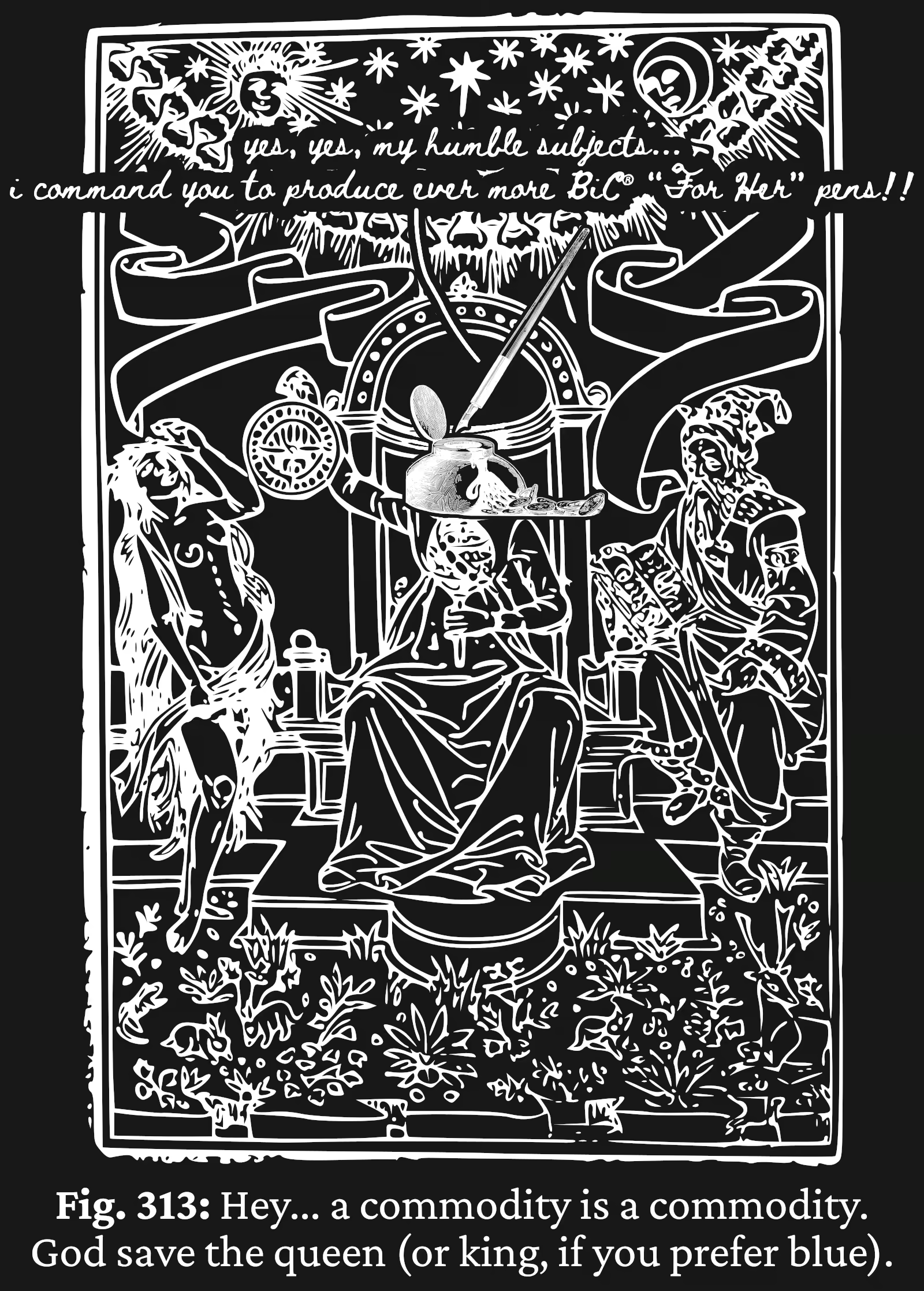
But let’s simplify things by briefly ridding ourselves of these Borromeän rings. What do you call this?:

We’re going to call it a fist, if that’s all right. Yet I wonder what would occur if its grip were perhaps loosened…
![Fig. 5b: Jazz hand [singular, derogatory].](/post/labour/jazz-hand.avif)
Wait, what? Hold on. Where’d the fist go? I was so sure I had already graduated from the object permanence stage of development. Let’s try that again.
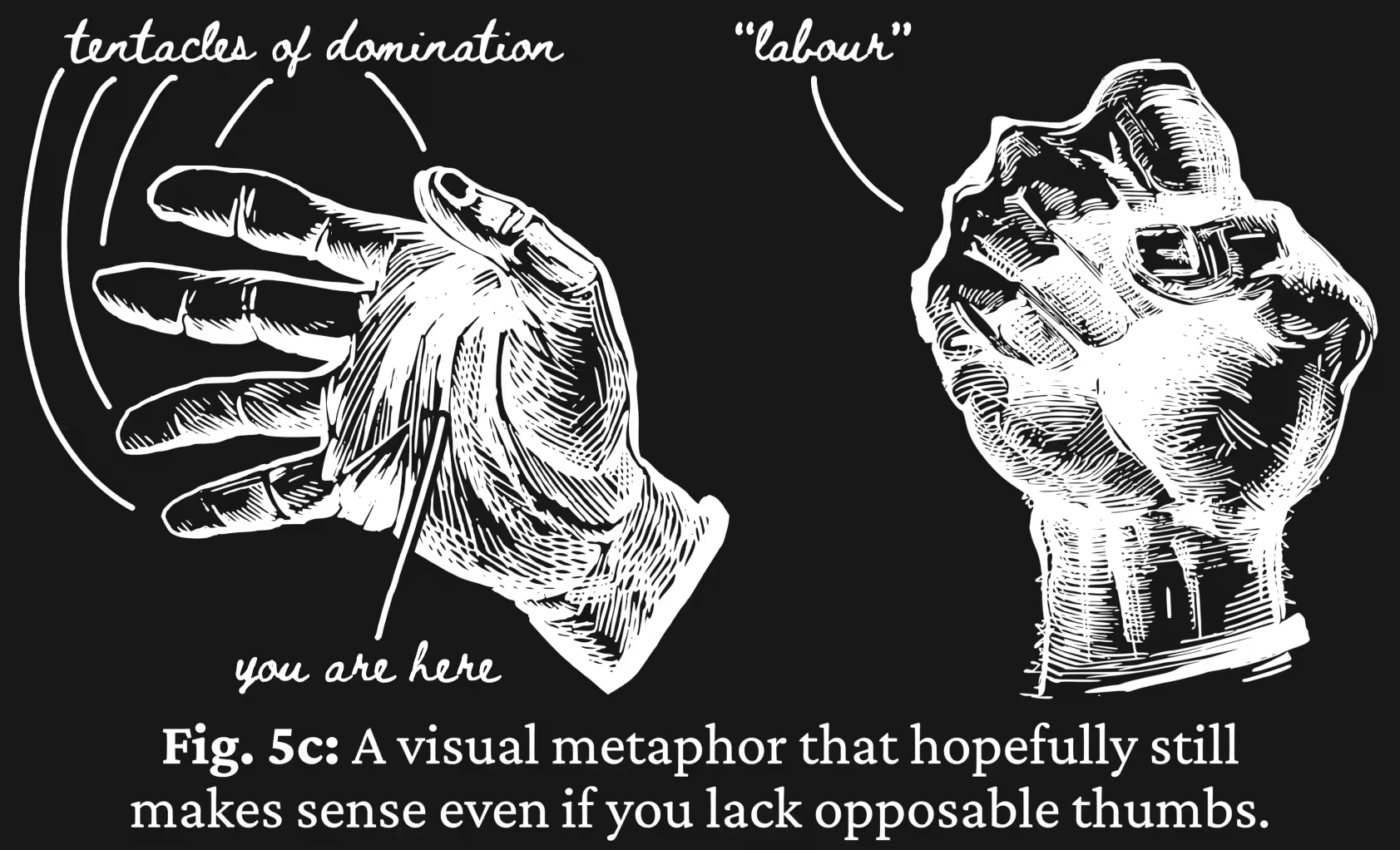
Transcription of the above image
Open hand with all five digits labelled as “tentacles of domination”, and the centre of the palm labelled with “you are here”.
Closed fist labelled “‘labour’”.
It’s not the greatest analogy of all time; there is, for instance, worryingly little sense of a totality. But hopefully you get the idea: fist isn’t prior to hand, nor can “labour” exist unless the tentacles of domination are fully engaged in the right sort of configuration. Once they are, the fist is very real — especially if you’re being crushed in its grip or getting punched by it. Yet, when the tentacles retreat, “labour” mysteriously vanishes. Where did it go? I guess it was all just a bad dream…
But the tentacles need to hook into something or other. The bird’s‐eye view is unavailable in everyday life (and even theory is a poor substitute indeed), so we need some more or less vaguely defined categories that can be passed off as social “common sense”. Such categories are used to organise sociëty at the level of concrete mediation, where people and, more to the point, institutions live.
In this case, concrete labour is the Heracliteän sea of loops which the marionettist of a myriad hooks we call abstract labour manipulates to its own ends.[14] By construction, this sea exists only for the sake of marionettistry: no hook, no loop; and vice versa. A corollary is that, like all use‐value‐oids, the space of concrete labours is everchanging in response to the everchanging needs of the relevant form of domination. Concrete labour may be closer to blood, sweat, & tears than abstract labour is, but it has no fixed physiological basis whatever. Concrete labour too is historically‐contingent.
We’ll encounter other forms of domination with their own corresponding loops (≘ use‐value‐oids). But for now, let’s consider some objections.
IV: Ahistoricising capital the hard way
##Whereas psychologically projecting capital’s categories (typically muddled by superficial appearances) onto precapitalist formations is the economists’ age‐old pastime, leftists — “Marxists” included — prefer to distinguish themselves by doing the same thing, but in the future direction instead. This has sometimes been called utopianism.
To put it simply: if your “future sociëty” still has “labour” in it, then it has value, and vice versa. And that means it’s not so much of the “future” as it is of a disfigured, fictionalised version of the present. Abstract labour is a form of domination, concrete labour is its partner in crime, and value implies capital.
Typically we have two flavours, give or take:
- calculation‐problemocracy
-
What your uncle thinks “socialism” is (assuming he doesn’t think it’s state‐funded healthcare etc.). Usually a big computer does some lineär algebra based on technical coëfficients and
exchange‐valueslabour‐times, and we worship the power of the almighty sparse matrix by allocating ourwage‐labourworking time accordingly. Sorta like a classical physics simulation, except instead of simulating something potentially useful, we simulate capital.Exemplified by [CC93], which takes this to its logical conclusion by reïnventing or reïmplementing credit, taxes, property, foreign trade, and even a market for select “consumer goods”.
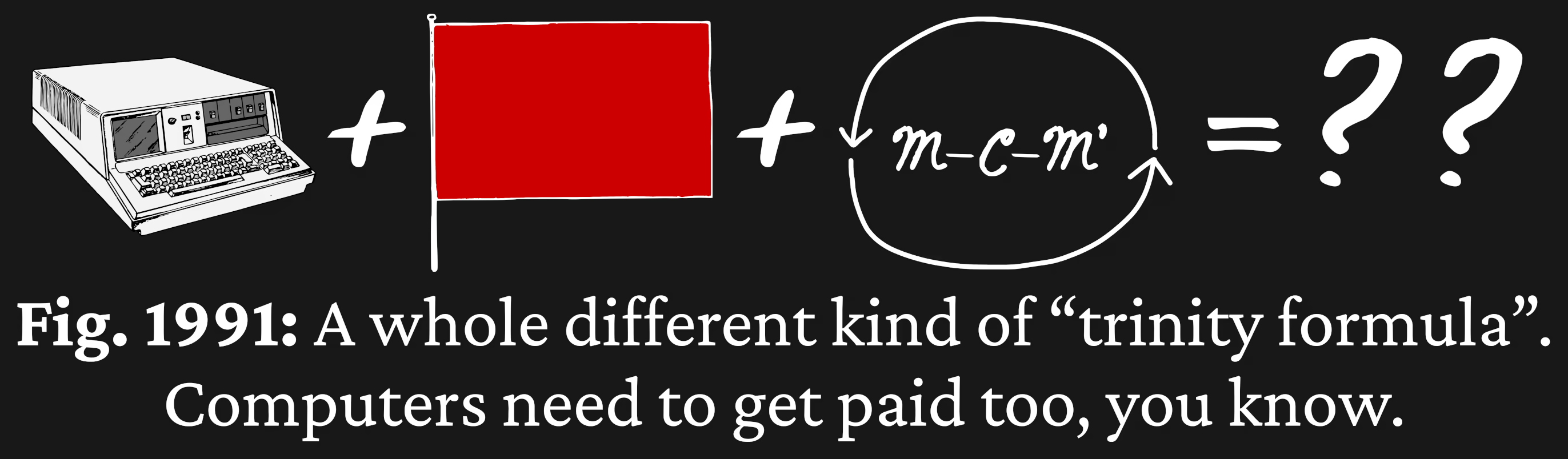
- seize the means of production, comrades
-
Anarchists instinctively recoil from the above for its distinct stench of “authoritarianism”, and left communists (councilists, in this case) know[15] it to be capital in disguise, even if only instinctively. Instead, we’ll take over our workplaces as independent enterprises, free of the fetters of the state and the boss who extracts our surplus labour.
With some added nuance, arguably(‽) a respectable revolutionary tack for a certain time & place (a long time ago in a galaxy far, far away…). But for some anarchists, this is endgame. “One could argue that exchange‐value is not directly the enemy of sociëty and is not necessarily an abuse of reason, but the drive for the accumulation of surplus value […] is the negation of human values”.[16] The basic idea seems to be that if freeholding peasantry worked well enough, then it can work even better enough if we swap out whatever it is peasants do (one can never be sure) with commodity‐production.
These exemplars of ahistoricisation teach us at least two things:
-
Capital needs no representatives — it is (in a turn of etymological irony) headless — and its telos isn’t enrichment.
In the calculation‐problemocracy case, the idea is that the USSR was kind of a mess, but only because their computers weren’t good enough. This aligns closely with the usual banality that the USSR was “socialist” in some meaningful sense, that “command economy” is a coherent notion, and so on. We can’t go into any depth here, but suffice it to say that just because a bureaucracy claims to be in absolute control doesn’t mean that, in real life, there aren’t all the mechanisms of capital, up to & including exploitation, the mediate production process, accumulation, etc..[Cam78]
On the other hand, the anarchist method of “no masters” has similarly little effect on capital (even assuming some kind of coherence in the theory under consideration). The point of having capitalists & their hangers‐on — the (petite) bourgeoisie et al. — isn’t so that at least some of us can enjoy wealth, but rather, is merely one of many possible ways for capital to manage itself: personification.
-
The epoch of capital & its attendant ideologies teaches us to replace human community (Gemeinwesen), interpersonal relationships, ways of life, intentional living, hopes, dreams, love, etc. with various things, the most relevant here being narrowminded organisational concerns.
The “calculation problem” is of course a paragon of this, although that’s to be expected given that economist types (economists, lawyers, bureaucrats, wonks, et al.) essentially embody this aspect of bourgeois ideology. Nonetheless there are other important examples: democracy (perhaps the apotheosis of this ideal), the regimentations of fascism, vanguardism & its vulgarisations, etc..
The common psychological thread here is the attitude that, on some level, “individuals” (in the specifically modern, bourgeois sense[58]) are too stupid for their own good, and will revert to a Hobbesian State Of Nature™ unless someone imposes civilisation upon them.
V: Value vs. exchange‐value in two different ways
##So far, we’ve been taking exchange‐value and value to be the same thing — and not for no reason. Exchange‐value is the only adequate manifestation of value,[17] since exchange is the birth & sole purpose of the value‐form. Nonetheless, we must now consider two ways in which the distinction can be made.
Capital (≝ value in its capital‐form ≝ value made autonomous) is capital throughout its entire production process. We saw in the previous part of this series that this production process is the unity of the immediate production process with the mediate (the latter typically glossed as “circulation”), and drew out the consequences of this, including e.g. de/valorisation. It follows that as totality, and more specifically as a kind of metabolism — i.e. the valuewise total social reproduction — value really does exist outside of — or more precisely, about — the individual exchange‐moment.
![Fig. 12: “As the subject predominant [übergreifend] over the different phases of this movement, as value sustaining and multiplying itself in it, as the subject of these metamorphoses proceeding in a circular course — as a spiral, as an expanding circle — capital is circulating capital.”](/post/labour/spiral.webp)
Marx makes this point at greatest length in the Resultate, but Capital vol. 2 is explicit:
“Value”, says Bailey, opposing the autonomization of value which characterizes the capitalist mode of production, and which he treats as the illusion of certain economists, “value is a relation between contemporary commodities, because such only admit of being exchanged with each other”.
[…] This derives from his general misunderstanding, according to which exchange‐value equals value, the form of value is value itself; thus commodity values cease to be comparable once they no longer actively function as exchange‐values, and cannot actually be exchanged for one another. He does not in the least suspect, therefore, that value functions as capital value or capital only in so far as it remains identical with itself and is compared with itself in the different phases of its circuit
In any case, our main concern is with the second way of prising value apart from exchange‐value. Value sunders off its negation, this negative shadow taking on its own form:
- value
-
The realm of the value‐form: exchange & exchange‐value, the commodity‐form, the money‐form, and the capital‐form.
Value seems to remain more‐or‐less intact throughout its capital‐process, as subject thereof. We saw in the previous part that this is vaguely correct at a certain level of abstraction, but that upon further inspection, value necessarily threatens to tear itself apart. Nonetheless, this latter tendency is immanent to value as such.
- nonvalue
-
The realm of all human social activity that cannot be, or at least isn’t, commodified — value’s dissociated underbelly.
Since it’s defined negatively in relation to value, nonvalue only makes sense “immanent” to the capitalist totality. But unlike what’s immanent to value (its contradictions etc.), this is a false immanence. Human social activity is only “productive of nonvalue” (to abuse the technical sense of productive) insofar as that activity is indirectly linked to the capital‐process, as part of capital’s connexion to this terrestrial plane.
Exchange‐value has no underbelly, because it’s only intelligible in relation to exchange; it’s a form of value, and not value per se. Only value, properly speaking, forms a totality, a totalising system of the capital‐process, which must have an externality — a sandbox to play in — if it is to implement itself within reälity.
VI: Dissociation, diremption
##Value‐dissociation (≝ value‐diremption < Wertabspaltung) is, as we’ll see, an inherently gendered & gendering process by which the nonvalue sphere is cleft from value. The term & concept are both due to Roswitha Scholz.
Value‐dissociation is just as constitutive of the genesis — the bootstrapping — of value as anything else, including e.g. subsumption of “labour” (both formal & real). Although it’s true virtually by definition that value is (negatively) constitutive of nonvalue, the reverse is also true; they’re two sides of the same coin. Labour qua human social activity needs to distinguish itself from social activity that’s excluded from the orbit of the commodity‐form, in the same way that there’s no clergy without a laïty.
We’ve seen that labour (concrete + abstract) arose historically as a form of domination. Other social activity cannot be dominated in this way, because its social form, its structure, isn’t determined by maximising “the number of commodities that come out the other side” (ultimately, the extraction of surplus‐value). The duality value/nonvalue therefore corresponds to the duality labour/nonlabour.[18] This is, of course, not a moral–practical judgement: nonlabour is just as well‐described by “hard work” as labour is — and at least as “useful”, to boot — but simply cannot be seen from capital’s perspective as labour, inasmuch as it resists subsumption (= labourisation).
The labour/nonlabour divide doesn’t correspond to the kind of activity itself. Only capital decides whether a social activity is labour, based on its ability & willingness to commodify the results of that activity. Nonetheless, because nonlabour is, like labour, allocated (& otherwise shaped) by forms of domination, said forms require loops into which to hook, leading us to the various everchanging & historically‐contingent types of concrete nonlabour. There is, however, no corresponding *abstract nonlabour, because the defining property of nonlabour is exactly that capital can’t, or won’t, cohere a (real[1]) abstraction over it.
Nonidentity
###Many kinds of activity are destined to the fate of nonlabour. To the degree that they can be commodified, this is only indirectly, when labour is compelled to produce commodities whose use‐values ease the burden of, enhance, or transform — ironically, often in a way that increases the burden of — nonlabour activity.

Only things which are conformable to identity logic — roughly speaking, the ability to use equals signs — can exit the realm of nonlabour.[19] Everything else is, as Scholz puts it, “the contingent, the irregular, the non‐analytical, that which cannot be grasped by science”.[Sch13]
This implies that concrete nonlabour is distinct from concrete labour in a crucial way: two nonlabours of distinct concrete types — or even of the same type — aren’t directly comparable except for the bare fact of being nonlabour, and for the purpose of assigning bodies (nonlabour‐powers, as it were) to said types. This is another way of saying that *abstract nonlabour is nonsensical.
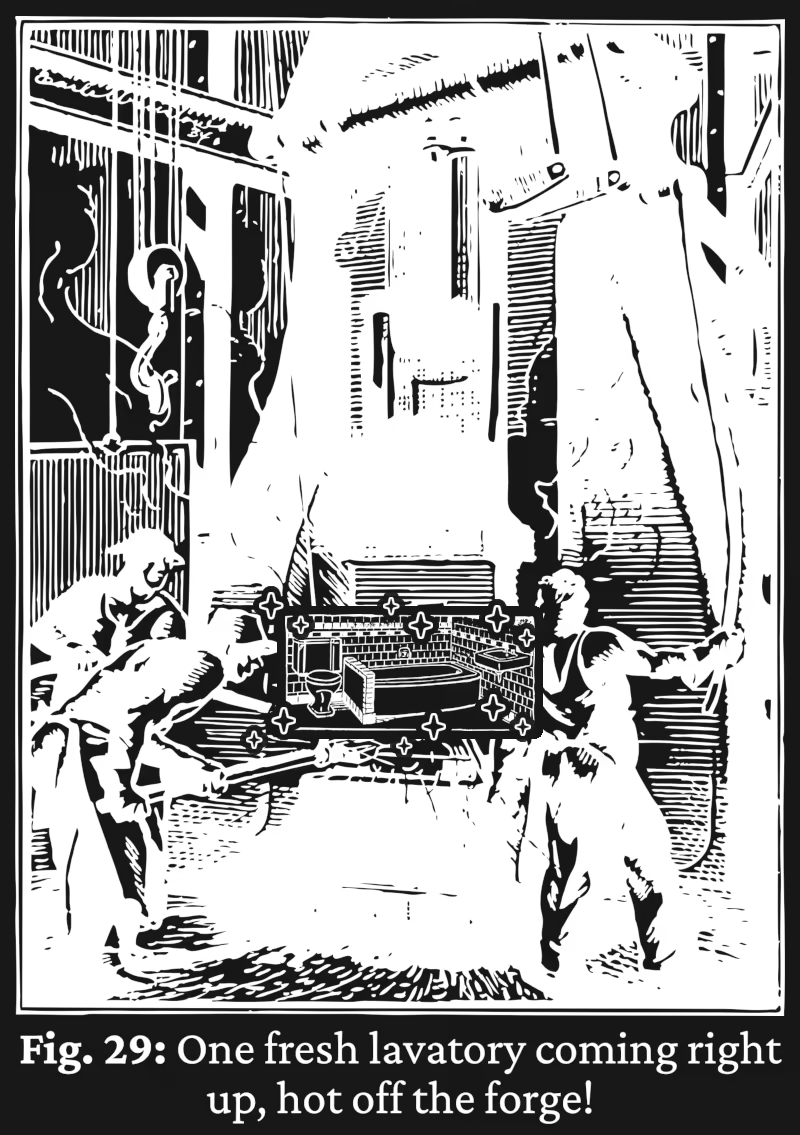
As a simple example, consider cleaning a watercloset (a washroom, if you will). This act of cleaning is unique & nontransferable, because the watercloset just is how it is: it’s in a certain place at a particular time, in some state of various uncleanlinesses of varying degrees. Acts of cleaning — even of one & the same watercloset — aren’t directly comparable, since they depend more on the thing being cleaned (& the standard of cleanliness) than anything else. The only way to truly commodify watercloset‐cleaning would be to just print a new one!
And this does happen. For instance, mending clothes used to be far more widespread, especially as domestic nonlabour. Nowadays, we produce — as commodities — unfathomably more clothing than the human population could ever reasonably wear, making mending not quite so appealing anymore.
Dissociation and the wage fetish
###But we must be very clear: a thing or service is not commodified just because one can pay for it. If you wanna commodify sexuality, you’re gonna have to stick with producing sex toys and pride flags, because prostitution ain’t gonna do the trick.[20]
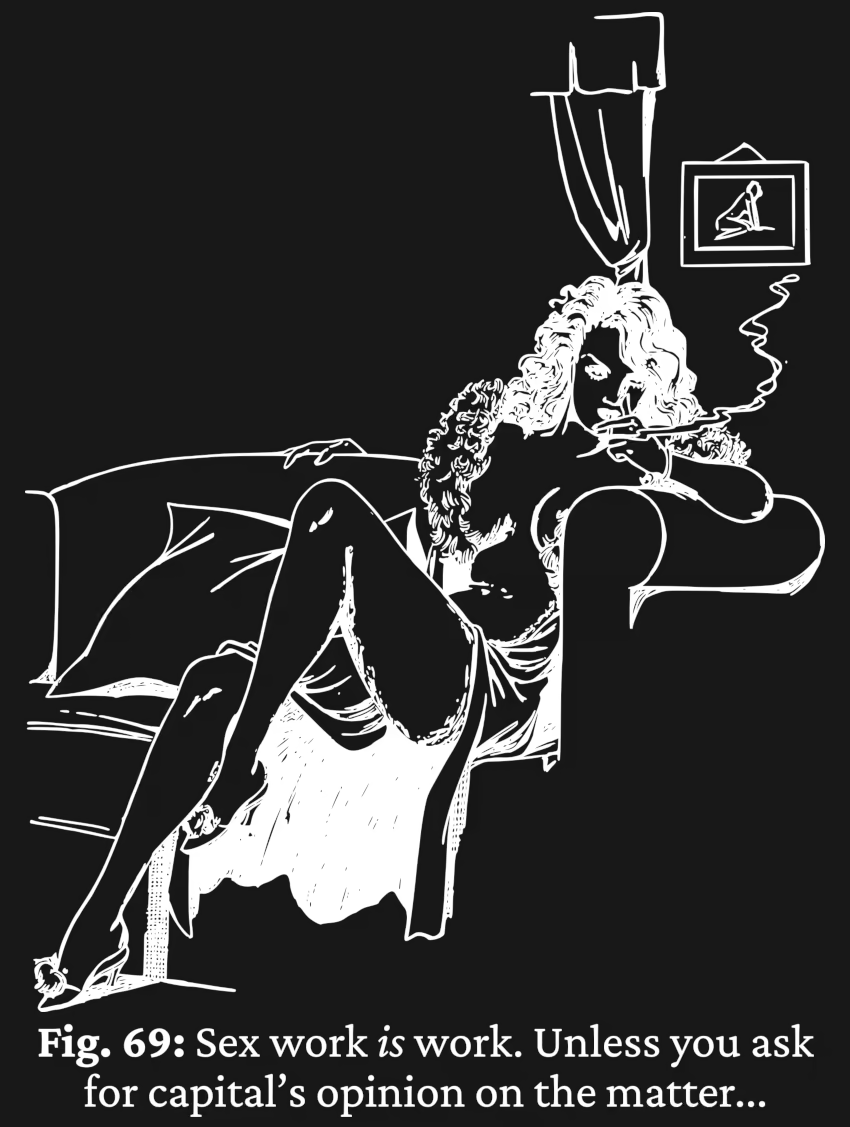
The basic insight is already in Marx:[21] no amount of labour — nor nonlabour — is ever paid for by any wage.[22] The wage pays, at best, for the value of labour‐power. This is a crucial aspect of the forms of domination which surface in the wage. For instance, the form of domination called labour seeks to compel surplus‐labour and to thereby extract surplus‐value. The fact that the wage nonetheless appears to be paying for the labour itself — thus concealing the real social relations which underlie it — is the wage fetish.
How the value of labour‐power is determined will become clearer soon enough. For now, we note that when nonlabour is waged, “it takes on some characteristics that resemble those of abstract labour”.[End13b] Although nonlabours of the same concrete type are, as we’ve seen, not directly comparable, the ways in which they’re indirectly comparable become the basis for a social standard of performance. The dim echoes of socially‐necessary labour‐time make themselves felt.
But we ought to ask: can nonlabour even be waged? — and if so, how? The short answer is yes, and the wage itself doesn’t turn the activity into labour. An argument to this effect follows, and a summary table is provided afterwards.
How to separate nonlabour services from labour services
Typically, a “service” is defined as human social activity that’s both waged, and consumed for the sake of the activity’s immediate (unmediated) effect, rather than to produce something(s) that can be extracted from the activity and sold separately. I’m inclined to argue that any “service” can be labourised — that is, subsumed — if three basic conditions are met:
-
The worker must be separated from the relevant means of production, specifically in the sense that she’s incapable of selling her service as an independent worker–seller for a price similar to or greater than the price she’d get by selling to a capitalist, agency, corporation, or what have you. The latter fulfils the role of advancer of capital.
Note that restricted access to the means of production may take on any combination of manifold forms: legal restrictions (not limited to property), servitude, political authority, means of communication, means of transport, business connexions, etc..
-
The service (or rather, its effect) can be sold consistently enough at a price corresponding to SNLT — the latter being established through a basic level of market competition (or other MPP). This is to say that each instance of the service is a commodity: it can be directly compared to other instances of the same service or to any other commodities, within exchange, in a way that implies exchange‐value.
-
The wage is paid out of the variable capital (advanced by the aforementioned “capitalist”) roughly according to the value of the worker’s labour‐power. The worker then labours beyond her necessary labour time, thus producing surplus‐value for the capital.
In many cases, (a.) is rather unlikely. Nonetheless, it’s always possible in principle.
On the other hand, (b.) tends to be blocked for the same reasons that cause value‐dissociation to occur. No identity logic, no commodification. This barrier is more well‐described as a barrier in principle, with the practical result being that certain activities — waged or otherwise — remain nonlabour until capital can largely eliminate them as activities, if that time ever comes… which it might not.
Even when capital does subsume a service, that capital lacks the ability to restructure itself — to use accumulated capital to further rationalise the labour process — beyond a certain very early point. Doubling the capital mostly entails a mere doubling of the variable capital.[23] In other words, formal subsumption never becomes real subsumption.
This leads us to a proper definition of service: social activity within the capitalist totality that’s waged, but that by its nature cannot be really subsumed — irrespective of whether it can be, or is, formally subsumed.
[End10] makes a similar‐sounding point, but wrongly (in my view) conflates formal subsumption with the mere inability to be really subsumed. There is, of course, another option for activities that resist real subsumption: not being subsumed at all. The mere fact that such an activity might be waged is necessary but insufficient for (formal) subsumption; to believe otherwise is just another manifestation of the wage fetish.
| waged | subsumption | |
|---|---|---|
| labour | yes | yes |
| nonlabour | maybe | no |
| service | yes | real impossible |
Table 1: Summary of the distinctions between labour, nonlabour, and service.
VII: Did somebody say “reproduction”? Oh, I love reproduction.
##In the previous part of this series, we considered the “valuewise total social reproduction” (total social reproduction will be abbreviated as TSR). But the key word here is “valuewise”. This is essentially the reproduction of the total capital for itself — that is, the basic process by which value continues to exist (value’s “realisation” via accumulation, etc.).
The gap is glaringly obvious, and has frequently been problematised: where’s the reproduction of, well, the actual sociëty? Labour‐powers don’t grow on trees, you know!
This is where nonlabour is seen to be the other side of the labour coin in yet another crucial way: the social “cost” of reproducing labour‐power (from day to day, plus raising the next generation) only congeals into the value of labour‐power to the extent that it’s not already covered by nonlabour.[24]
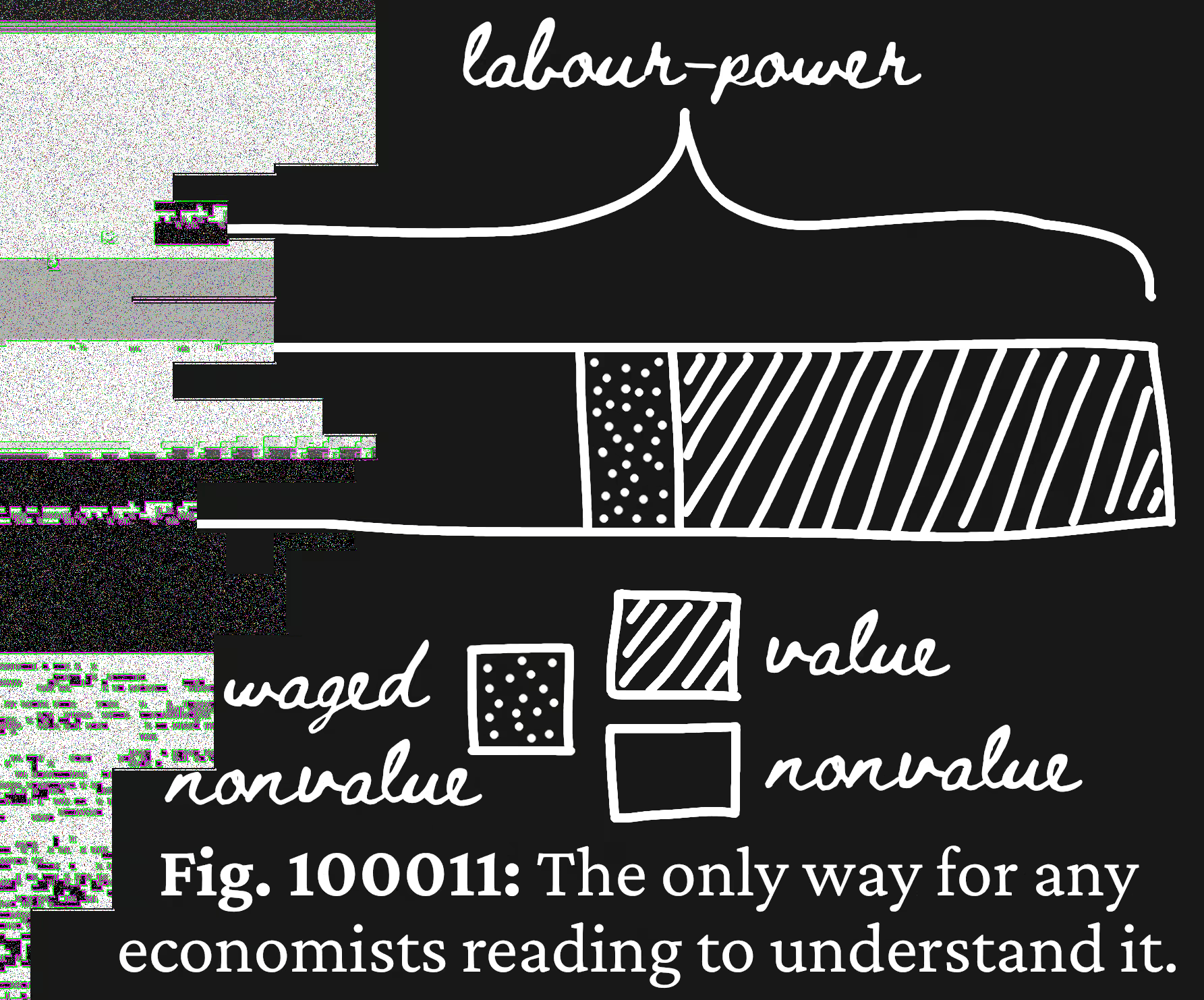
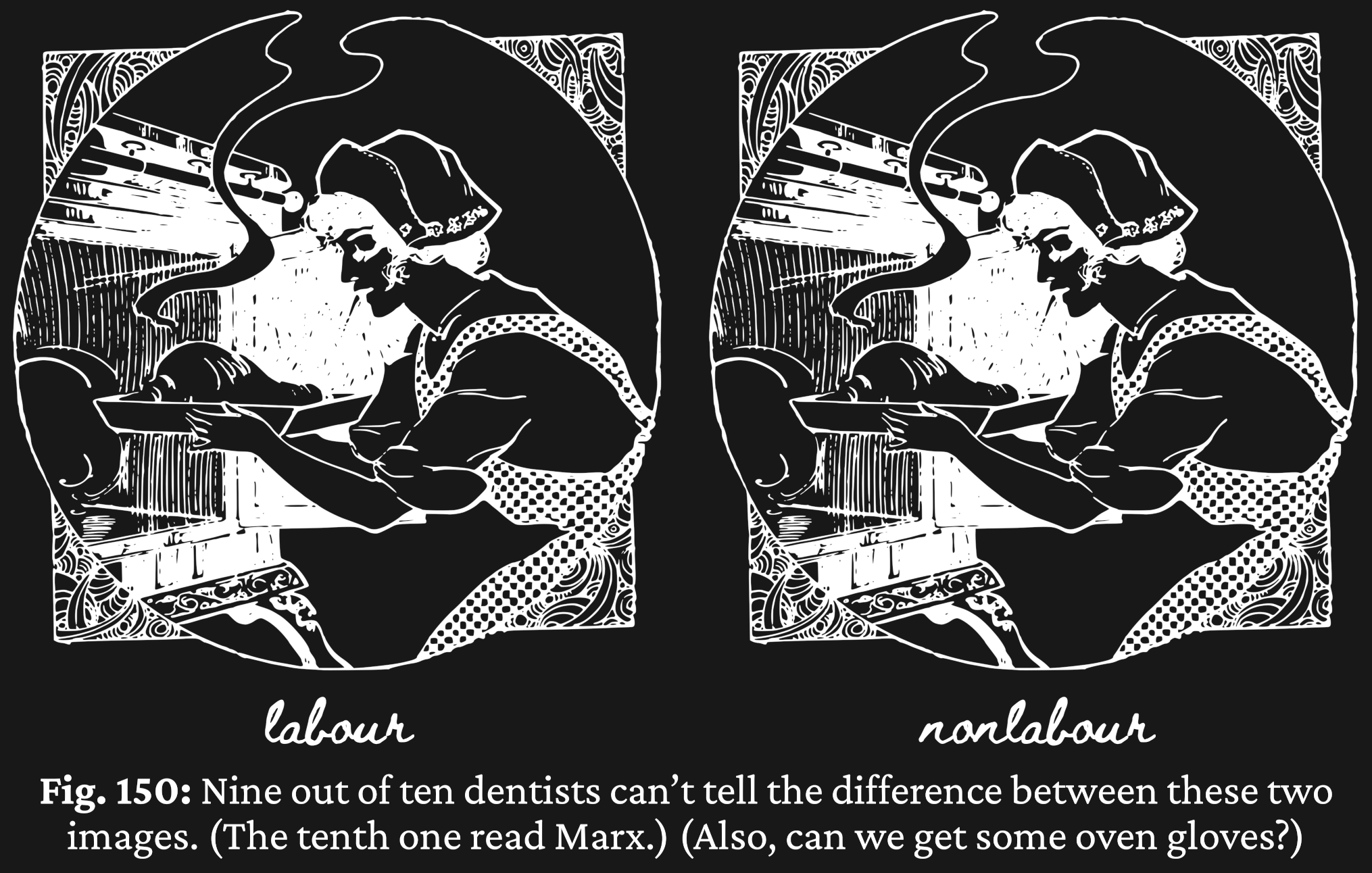
In no way does this imply that nonlabour is somehow “reproductive activity”. Any social activity that isn’t subsumed — even if it could be subsumed, or already is subsumed in other contexts — is nonlabour, irrespective of its content. Home cooking is nonlabour, whereas restaurant cooking — even if the task isn’t materially changed — is labour. Yet both are “reproductive” (if perhaps not valuewise) inasmuch as they both feed people.
Social‐reproductive dissociation
###Naïve readers of Marx may be tempted to split the TSR along the usual use‐value/exchange‐value duality. Although we already have a valuewise TSR,[25] there’s no *use‐valuewise TSR. Use‐value only exists as a loop into which exchange‐value can hook. Moreover, the “use” in “use‐value” is misleading. Use‐values only satisfy real human needs opportunistically; they exist to serve exchange‐value, which in turn exists to serve infinite surplus‐value. If a use‐value is wantonly destroyed — consigned to the void — then so be it, so long as value doesn’t remain indefinitely fixated.
If we instead consider making the split valuewise TSR vs. nonvalue‐wise TSR, we still get something a bit underwhelming. For example, nonvalue is unquantifiable. Nonetheless, a breakdown of the nonvalue‐wise TSR presents itself equivalently to how the valuewise failures considered in the previous part do: crisis. In particular, the value of labour‐power — a key element of what makes surplus‐value and therefore capital “go brrr” — is inextricable from the nonvalue‐wise TSR. A failure of the nonvalue‐wise TSR is a failure of the preconditions for the current capital structure.
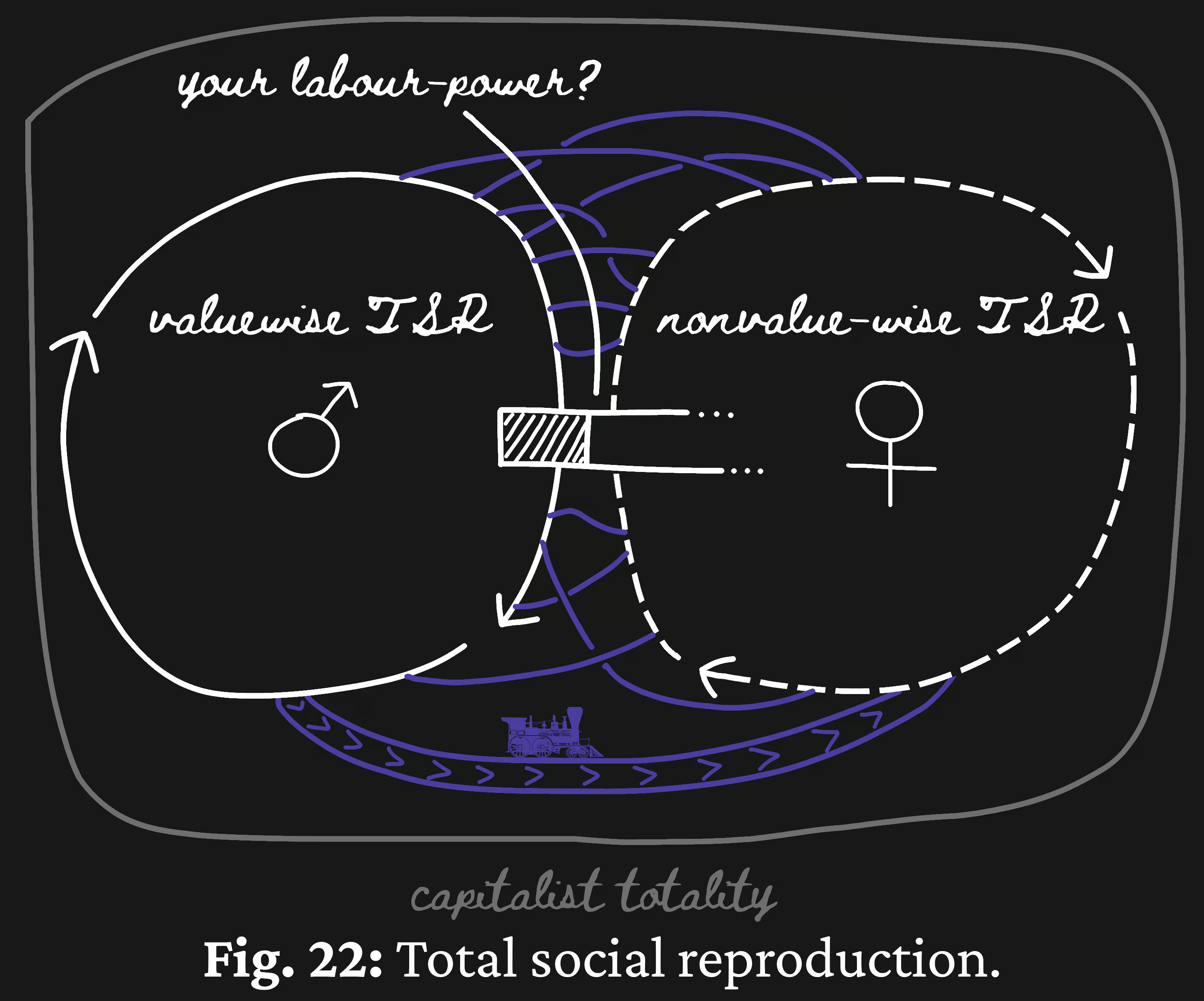
Transcription of the above image
Faint outline labelled “capitalist totality”. Inside are two directed cycles, “valuewise TSR (♂)” and “nonvalue‐wise TSR (♀)”. The two cycles are connected by various haphazard faint purple paths, one of which supports a train moving from one half of the TSR to the other.
The two TSR’s are connected by a bar filled in on the valuewise side, and fading into indeterminacy on the nonvalue‐wise side. The bar is labelled “your labour‐power?”.
Furthermore, by allowing us to consider all human social activity as part of the capitalist totality, applying value‐dissociation to the TSR lets us grasp some key dynamics:
-
When nonlabour is waged (≝ a nonlabour service), the (non)labour‐power of the worker who receives that wage shows up not directly in variable capital, but rather, in the value of the labour‐powers of those who pay for the service; or in expenditure of revenue, as the case may be. Either way, this is a deduction from surplus‐value. This deduction isn’t really something extra (a pure loss), but more like a way for capital to indirectly allocate nonlabour via the market.
-
As discussed above, for certain kinds of social activity, capital qua totality decides whether it be subsumed (labour) or not (nonlabour). When subsumption looks appealing for the purpose of generating more surplus‐value, the activity is carried through a turnout by the TSR train, from nonlabour to labour.
Yet this can have “adverse” effects on the TSR, e.g. increasing the value of labour‐power so that these newly‐available commodities can be purchased,[26] or a lack of profitability that can only be sustained by siphoning surplus‐value from other capitals (via production‐prices etc.). If the labourised activity cannot produce enough surplus‐value to justify its subsumption, then the reverse process transmigrates the activity from the value‐ to the nonvalue‐wise TSR.
-
The welfare state; “social services”; guaranteed income programmes; new deals (& New Deals) between “business”, “workers”, & “government”; and the wage’s ever‐expanding suffusion into services (hospitals, schools, restaurants, childcare, hotels, call centres, mental health services, etc.) — only some of which end up subsumed as a result — can all be seen as capital widening & tightening its grip on the nonvalue‐wise TSR.
This effectively “completes” proletarianisation, making the human species finally reliant in seemingly every possible way upon the TSR as such — that is, as capitalist totality (lest we ahistoricise the TSR…). Of course proletarianisation is, properly speaking, never completed; it must constantly be reproduced. But the point is that this reproduction process in some way approaches perfection on an historical scale.

-
To the degree that certain bodies are assigned to the nonvalue sphere, they’re partly divorced from the valuewise TSR. This is reflected in, for instance, devalued labour‐power.
VIII: The, shall we say, not entirely painless process of enwomaning
##Which reminds me. So far, our picture of nonvalue & nonlabour has been largely missing a crucial aspect: forms of domination. Labour has abstract labour, and thereby acts as an impersonal, unconscious social regulator. Nonlabour, on the other hand, has no such thing — indeed, it cannot have any such thing, since nonlabour is defined in opposition to abstract labour, making it inherently unquantifiable. So instead, value‐dissociation masculinises the labour sphere and feminises the nonlabour sphere.[27]
Naïvely, it would seem that, for want of a biological basis of sex‐gender,[28] there are no particular loops into which such a form of domination could hook. But this is to commit the same error as conflating use‐value with the thing itself. Sex corresponds not to the body (the body corresponds to the body!), but rather to use‐value, and therefore to loops.
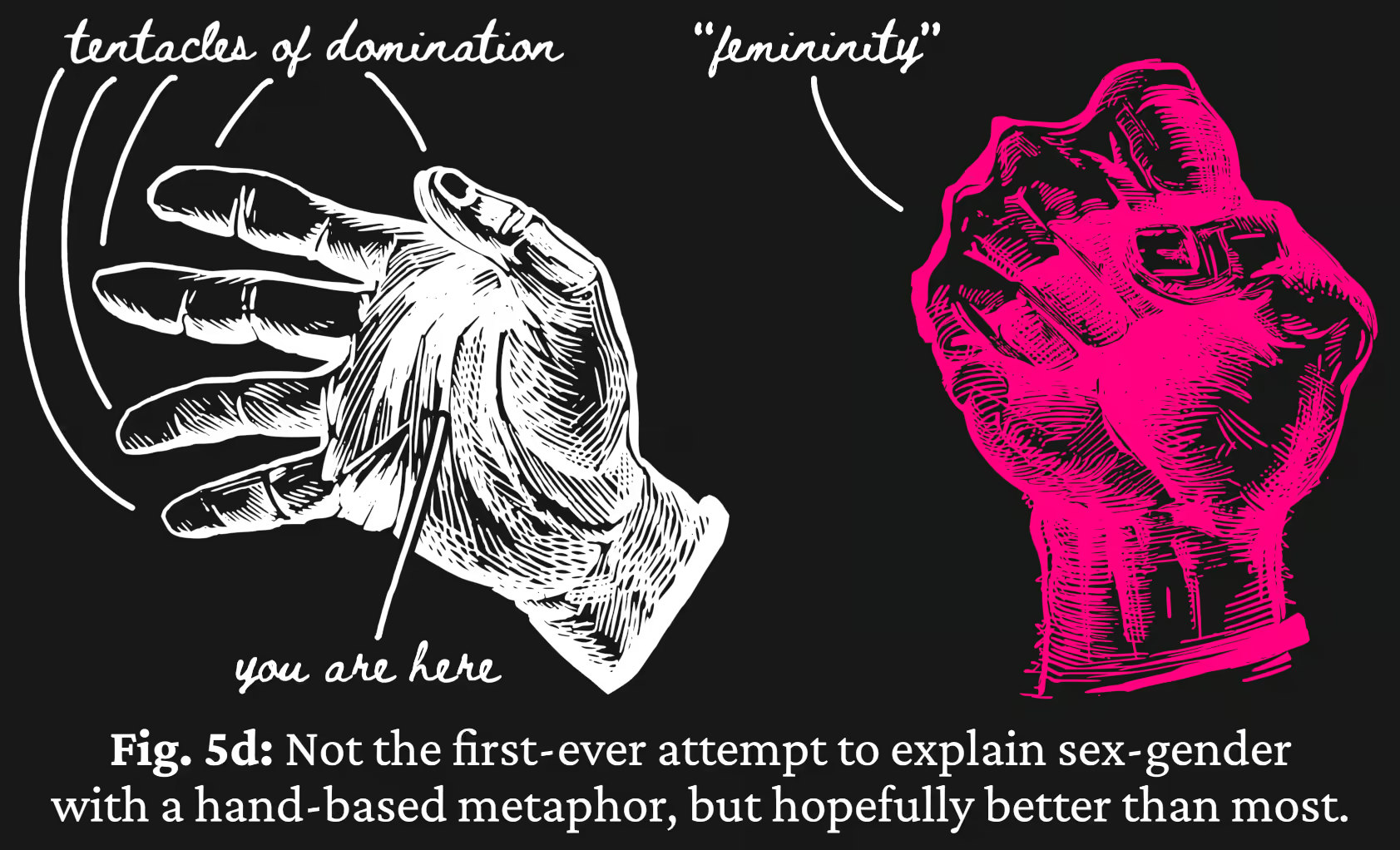
Transcription of the above image
Open hand with all five digits labelled as “tentacles of domination”, and the centre of the palm labelled with “you are here”.
Pink closed fist labelled “‘femininity’”.
Sex is therefore not really separable from gender (and thus the primary term used here will be sex‐gender). The purely analytical sex/gender distinction is salient only insofar as some ways of ascribing & of reading the sex of an individual have little need to make reference to “the body” — or an imagined body, as is often the case.
Ascription
###The paradigm of nonlabour is childrearing[29] — or, as capital would have it, growing the next generation of labour‐powers. It ultimately resists commodification, it’s inherently time‐consuming, and it’s indispensable. At the same time, childbearing capacity is clearly insufficient for gendering: many women lack this capacity for perfectly ordinary reasons, and children are gendered too, even at the age of zero (“assignment”). Moreover, many of those who can won’t, thus rendering the capacity irrelevant.
Nonetheless, capital is averse to investing in specialised (“skilled”) labour‐power unless it can count on squeezing every last drop of surplus labour out of it. Since the totality assures that labour‐power is never scarce,[30] and since there’s always plenty of nonlabour to be done, capital just needs an approximate method of assigning bodies. Operating through averages & vague generalisations, capital offloads its costs onto the nonvalue‐wise TSR by assigning “women” — thereby associated in one way or another with childbearing, childrearing, & by extension “domestic” nonlabour, etc. — to the nonlabour sphere, which necessarily devalues those labour‐powers.

Clearly, the use‐value‐oid (sex‐gender) that concretely mediates this form of domination (value‐dissociative gendering) is fluid and in constant flux, both historically and from one locale to another. It may seem objectionable, even preposterous, to “ascribe a use‐value” to a person, but that is in fact — or better yet, in social fact[1] — what we’re doing when we gender them.
Waged women
###To get a somewhat clearer picture, it’ll help to give an extremely(!) simplified gloss of the history of women & the wage in the “global North” — that is, the most advanced capitalist countries.
- active settling, or otherwise pre‐proletarian
-
Exchange is nonexistent, or marginal & informal. “Production” is petty production. Some activities are divided along gendered lines, but “men and women did not perform categorically distinct kinds of activity”.[MT17] Many activities later associated with men, value, labour, etc. remain ungendered.
- pre‐Fordist proletarian
-
Labourisation generates the “domestic” sphere by cleaving the new “workplace” from it. Nevertheless, putting‐out systems opportunistically & sporadically employ women (& children) in labour by distributing raw materials to the home. Women enter the “workplace” only as a desperate measure, as effectively a stratum of the reserve army.
Any wages earnt by a woman are owned by her husband or father. Thus her labour‐power (in a labour context) appears as a mere annex of the valuewise superior labour‐power of her husband.
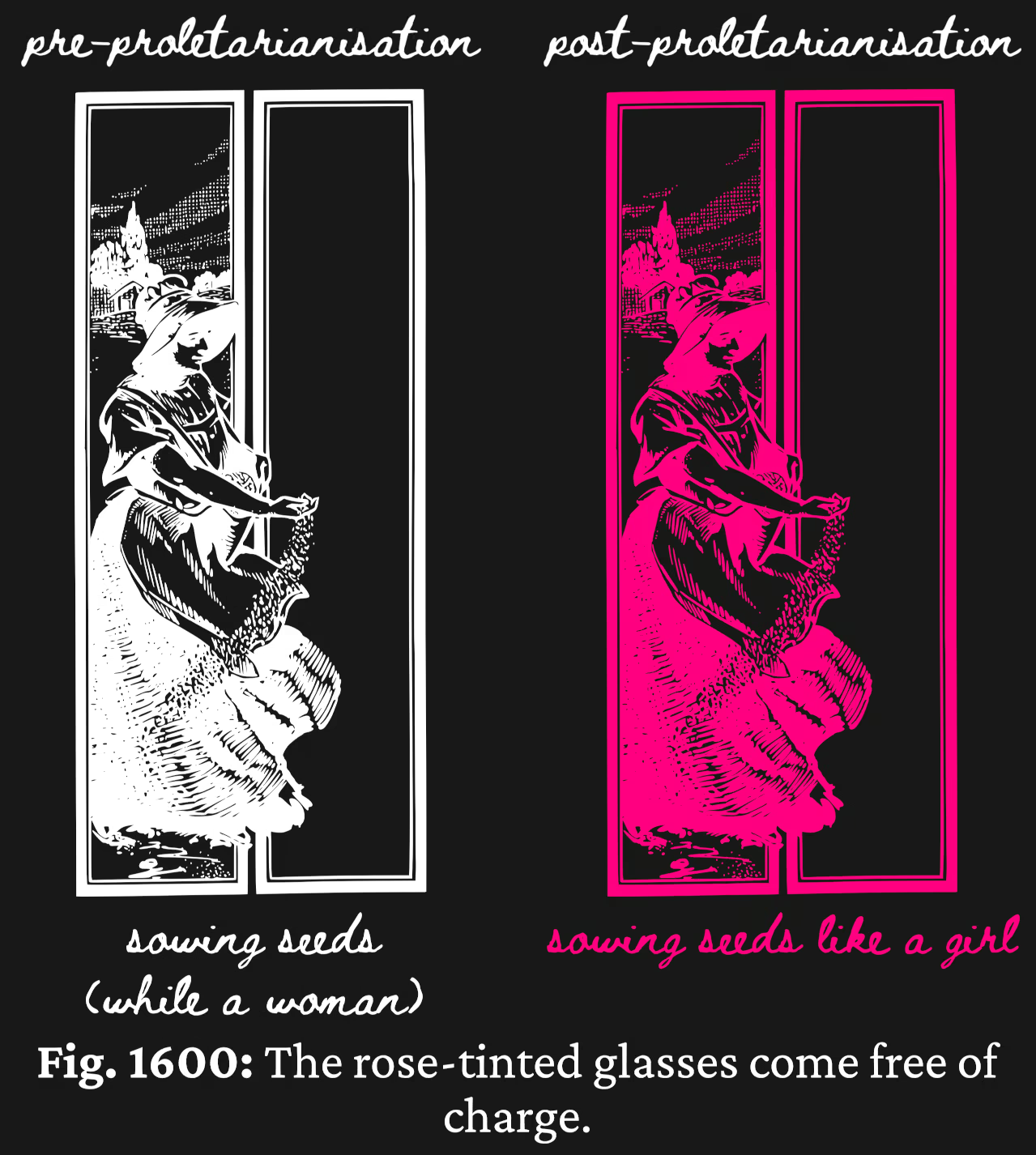
- Fordist nucleär family, pre‐[31]
-
The progress of real subsumption obsoletes the putting‐out paradigm, effectively leaving women wageless. The woman is still effectively owned by her husband, as she legally requires permission from him to do anything of social significance — especially labouring — outside of the home.[32]
At the same time, the scope of the “domestic” sphere is restructured, ultimately yielding something like our current conception of it. This includes a general increase in standards of living, sanitation, etc., as well as a new conception of childhood. Children are seen less as proto‐human creatures possibly useful for some kinds of (non)labour, and more as small persons whose childhoods, propensities to “play”, etc. must be nurtured.
- post‐[31] double duty
-
Deïndustrialisation takes hold, causing a rapid shrinking of the proportion of the population employed in the production of the total social surplus‐value. As part of this process, wage‐(non)labour in general becomes less “skilled”: labour processes are rationalised to an extreme, thereby expelling skilled labour; and services (formally subsumed, or unsubsumed) proliferate.
On the one hand, gendering is somewhat decentred. Widespread deskilling effectively truncates some of the barriers to employing women. Moreover, education becomes a central industry in its own right, ensuring that most persons — sometimes especially women — are skilled in this particular sense. Although the “domestic” sphere is at least as intensive as ever, many commodities that lighten the nonlabour burden are now commonplace.
On the other, skilled labour is by no means entirely eliminated, and there’s still much nonlabour to be done, both within & without the “domestic” sphere. Women are therefore still generally assigned to nonlabour, but in addition to the need to earn a wage — often through even more nonlabour. Thus we have double duty. To make matters worse, the woman’s labour‐power is still devalued — partly for the usual reasons, and partly through the sheer persistence of this form of domination “already so well established that it could appear as the enactment of some mysterious natural law”.[End13b]
The skill fetish
###None of this is to say that gendered nonlabours are unskilled in the casual sense — to the contrary, many of them require a lifetime of training. Rather, our notion of “skilledness” is inextricable from labour in all its historical specificity.
“Skill” in this sense is not embodied in the human being, but in the wage‐relation: capital calls skilled that labour‐power which presents itself as an up‐front cost not already borne by the whole sociëty. To attribute this kind of skill to a particular capacity or capacities possessed by people is therefore an instance of the skill fetish — itself a particular kind of commodity fetish. Skilledness is a property of commodities (viz. labour‐power), not of things.
Thus nonlabours, gendered or otherwise, can only ever appear as unskilled — or more precisely, as not being the kind of thing that can even be skilled. With this, the social assignment of female‐ascribed bodies to the nonlabour sphere turns itself back around to appear as a “free gift of nature”: the nonlabourer woman needn’t be skilled, because she’s already “naturally” good at what she does. In reälity, any skilling required for nonlabour is, by continual (re)definition, just so much more nonlabour — in other words, not capital’s problem.
Deïndustrialisation as gender equality before the law
###Accompanying post‐ double duty is, of course, the legal & nominal dismantling of women as a directly dominated class: notional equality of “the sexes”. Yet if we really meant it when we said “equality”, then the sexes would be equal, i.e. one & the same sex, i.e. the human species. So what gives?
We start with the obvious: legal–nominal equality doesn’t exist for its own sake. The classic (or rather, classist) example is that Sir Richard Bourgeois VII and Joe Public are formally equal before the law, in spite of being vastly unequal in class terms. In this case, legal equality permits certain citizens (the gentleman Rich) to act as personified conduits for capital’s accumulation by the detour of private wealth, while certain other citizens (our humble Joe) act as raw material for capital’s valorisation process, via a “free” exchange between legal equals: labour‐power for wages.
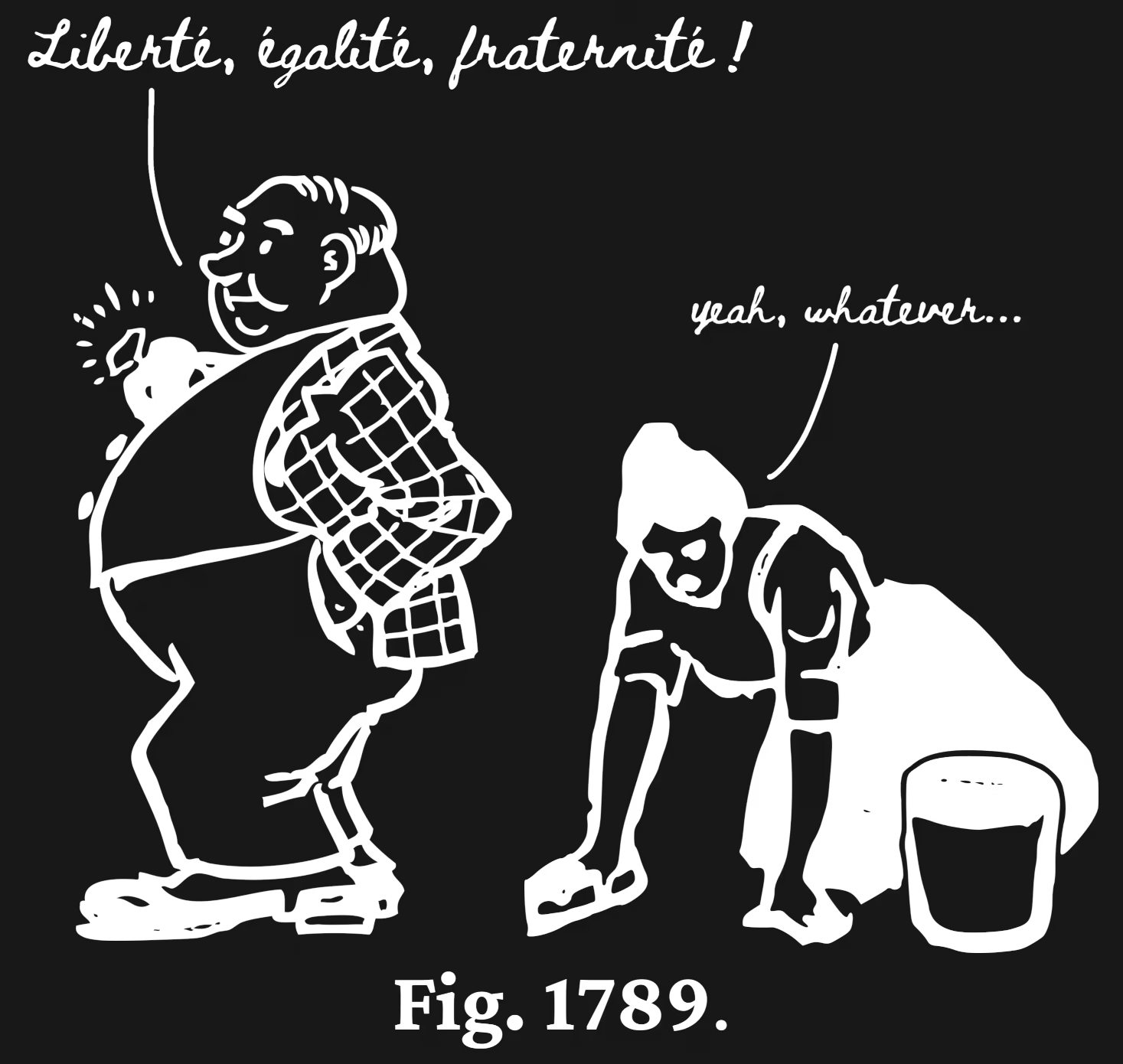
Likewise, making genders equal before the law clearly obviates neither the need to assign values to labour‐powers, nor the need for nonlabour to be performed.
For instance, pay gaps & other discrimination against women in recruitment & the workplace are no doubt mediated, or at least influenced, by employers’ (et al.’s) prejudices. But ultimately these processes reflect a social fact[1] about value‐dissociation. The employer might not know whether you’re a single mother, or are childless & with an employed partner (“dual income”), so how do they know how much to pay you? Of course, this is a trick question. Even if the employer knew all your relevant personal circumstances, this cannot affect the valuation of your labour‐power, because your labour‐power presents itself like any other commodity does: defined only by use‐value & exchange‐value, and thus interchangeable.
Your labour‐power is therefore valuated for its use‐value (the labour‐power of a “woman” who is “Black”, of a certain age, etc.) based on a social average, for a given time & locale: given the prevailing family structure(s), given the ways in which those ascribed “woman” status are assigned to various kinds of nonlabour, given the propensity of competitors (i.e. other employers) to hire “women” in spite of any associated valuewise costs — the most obvious example being the “maybe baby effect”[GLLF18] — and so on.
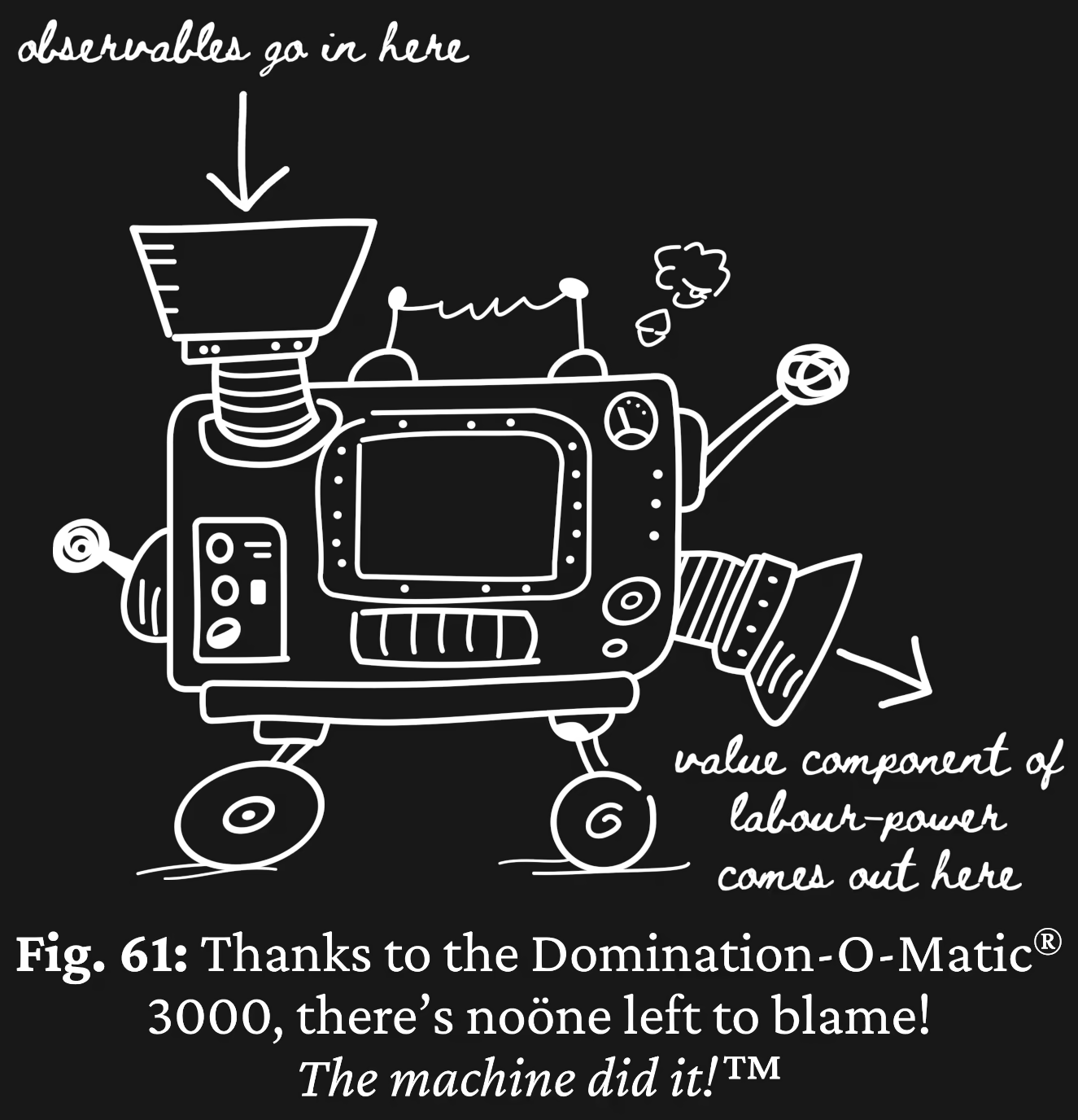
Conversely, these valuations reäct back upon all of the above: family structures, the assignment of women to nonlabour, and so on. Law which aims to influence these things for the benefit of capital might otherwise nebuously reference “women”, but has an easier time just saying what it really means anyway: your reproductive freedoms (abortion, maternity leave, etc.) aren’t yours to have unless graciously bestowed upon you. The capitalist totality continually moulds traditions, the collective imagination, and ways of life as expedient for its own purposes.
The result is a continuous gendered & gendering flux that can only be concretely mediated at the surface level, the phenomena, data, correlations, associations, vague pattern‐recognitions,[33] all operating almost entirely unconsciously as the stuff of a social relation — namely, value‐dissociation, and therefore the constitution of value itself.
In particular, since the 1970s,[31] the legal equality of genders has been concomitant with at least two phenomena tightly tangled up in deïndustrialisation:
- feminisation of labour
-
As waged activity becomes increasingly deskilled, temporary, part‐time, gig‐like, ad hoc, etc., it becomes feminised. It becomes closer to (or actually) nonlabour. The labour market is suddenly eager to exploit the assignment of women to these tasks and the correspondingly low value of such labour‐power.
- labour arbitrage
-
Capitalist relations are now planetary relations, and demand for the highly productive (of surplus‐value) consumption of labour‐power is dwarfed by the sheer size of the reserve army — spoilt for choice. Vast arterial “logistic” networks embrace the globe, allowing labour to be relocated at a moment’s notice as soon as slightly cheaper labour‐power can be found. This is “absolute surplus‐value masquerading as relative surplus‐value”.[Ber13]

The massive entry of women into the wage‐(non)labour force, and the enwomaning necessary for the latter to make sense, are therefore as vital as ever. Feminisation becomes, in effect, another form of labour arbitrage.
Mystification, fetish, and the phenomenalisation of gender
###No doubt those bewitched by the gender fetish see a social relation (sex‐gender) as a property of things (human bodies). But we must be very careful not to immediately draw the conclusion that gender is a form of abstract domination in the way that labour is.[34]
The continual process of value‐dissociation defines womanhood by assignment to the nonlabour sphere. Nonlabour is, again by continual definition, the negation of all that capital abstracts. Yet capital exploits the wage fetish to generalise wage‐relations across enormous swaths of human social activity, thereby obscuring gendered & gendering determinations that were formerly evident. The mystification of sex‐gender — some minimum degree of which is necessary for the existence of sex‐gender — approaches completion.

Deïndustrialisation, legal equality, and the generalisation of the wage manifest in the yet more phenomenal, superficial, positivistic, behaviouralistic mediation of gendering discussed above. As a result, sex‐gender must become simultaneously more bizarrely specific — providing fuel for this phenomenalised gendering process — and less directly grounded in the (imagined) body.[35] The gendered body — which is every human body, courtesy of value‐dissociation — is thus offered an ultimatum: conform to the now exorbitantly manifold & highly‐particular aspects of this gender, or else those of the other one. Any questions?
Some respect for the ancients
###It goes without saying that sex‐gender is, so long as it exists, in a perpetual state of mutation — constitution & reconstitution. And moreover, that the sex‐gender system of this epoch is immanent to the capitalist totality, and therefore must somehow differ categorically from any found in precapitalist formations. Nonetheless, Hesiod’s Pandora can in some ways be read eerily like the writings of a 700 BC incel.
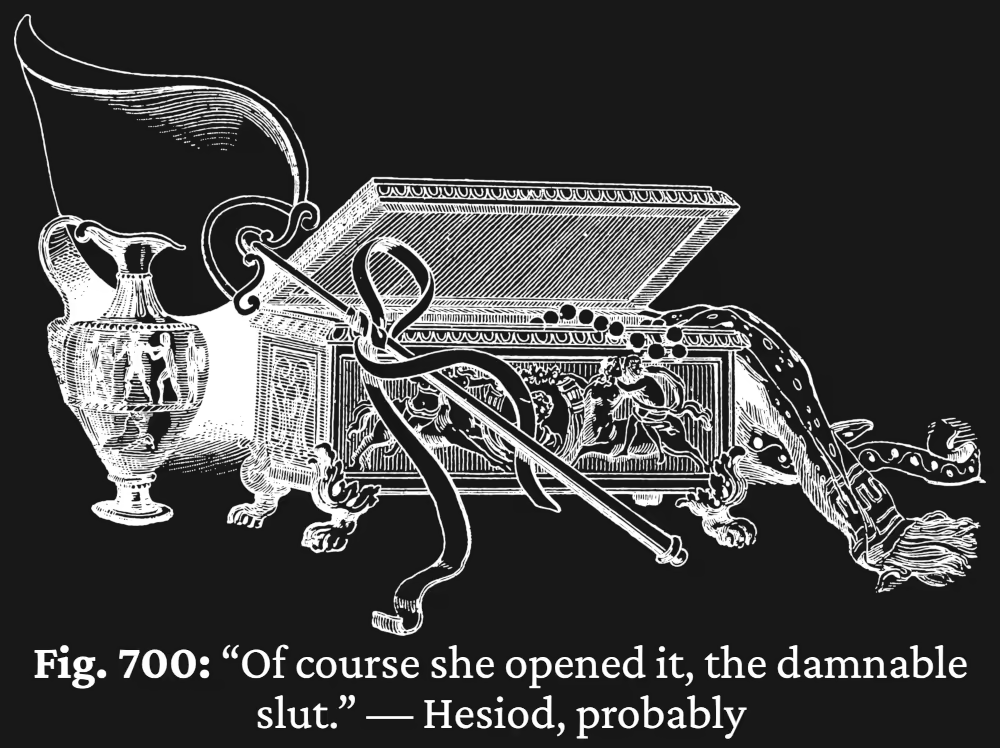
It seems that equality (not in the bourgeois sense) — or should we say, complementarity — of sex was one of the first casualties of the break with so‐called “primitive communism” (a double‐barrelled misnomer if there ever was one) or, if you will, the Gemeinwesen. Our best reconstructions suggest that the “primitive” woman, insofar as she was meaningfully socially differentiated in at least the most basic sense of “mother”, “must have been man’s equal and may well have felt herself to be his superior”.[Ler86] Not only was she responsible for human life itself, but her practical knowledge & skills were at least equivalent to those of her male counterpart. Her role in ritual & in narrative‐making thus would’ve been of corresponding importance.
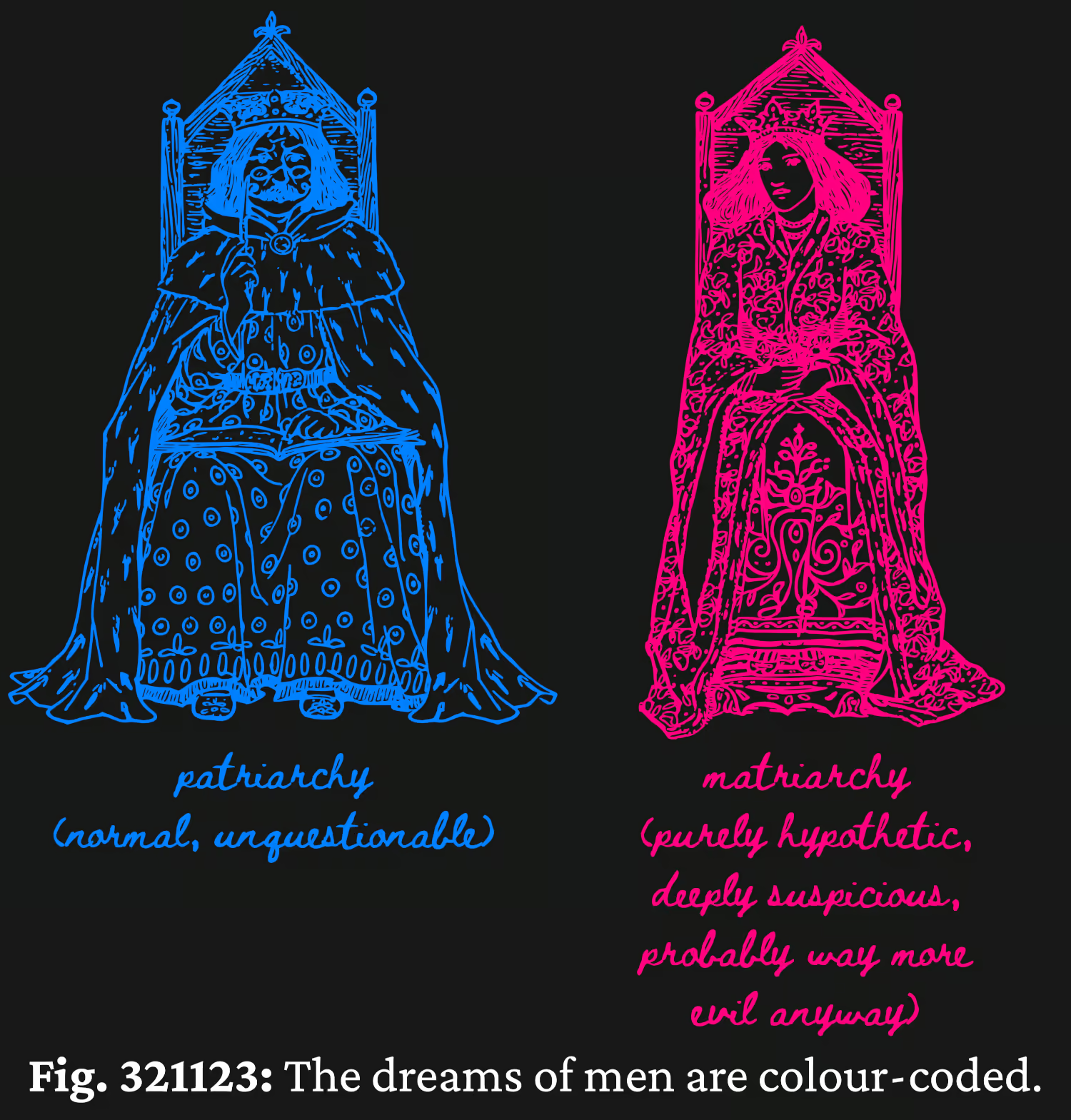
This is something entirely different from “matriarchy”. As the simplistic inversion of patriarchy, matriarchy is a fictional construct that represents little more than the idle fears of men benefitting from what they know (on some level) to be its opposite. Complementarity of sex‐gender isn’t the domination of men any more than heads is the domination of tails.
A turning point
####Fast forward a few hundred thousand years, give or take, and the Neolithic brought with it agriculture and sedentary lifestyles. Early adopters, particularly in western Asia, entered this epoch ca. 10 000 BC. The development of plough agriculture in the mid‐to‐late Neolithic increased both the physical burden of some agricultural activity, and the potential for generating surplusses:
-
On the one hand, this reïnforced a burgeoning tendency to view more children beyond a certain point not as burdensome, but as a source of (child, and later adult) labour‐power that was now surplus‐generating and therefore more useful than in a horticultural or hunting/gathering context.
This new significance of procreätion meant that marriage institutions (intra‐ &/or intertribal) and habits of warfare (winner kills the men and gets the women) arose with the ultimate goal of securing more procreätive power.[36] Although this didn’t reïfy women qua persons, it did reïfy childbearing — and ultimately, also sexual — services.[37]
-
On the other, plough agriculture was in many cases followed by a gendered redivision of labour: an “easy” way out was to just allocate all child‐related activities to women. This left men plenty of time for the heavier agricultural work, preserving surplusses, extracting surplusses (directly & indirectly) through warfare, and developing crafts.
To be sure, women still engaged in agricultural activity, preservation of surplusses, and crafts. And more to the point, this redivision of labour was a contingent one. Nothing about any kind of agriculture inexorably leads to this kind of development.
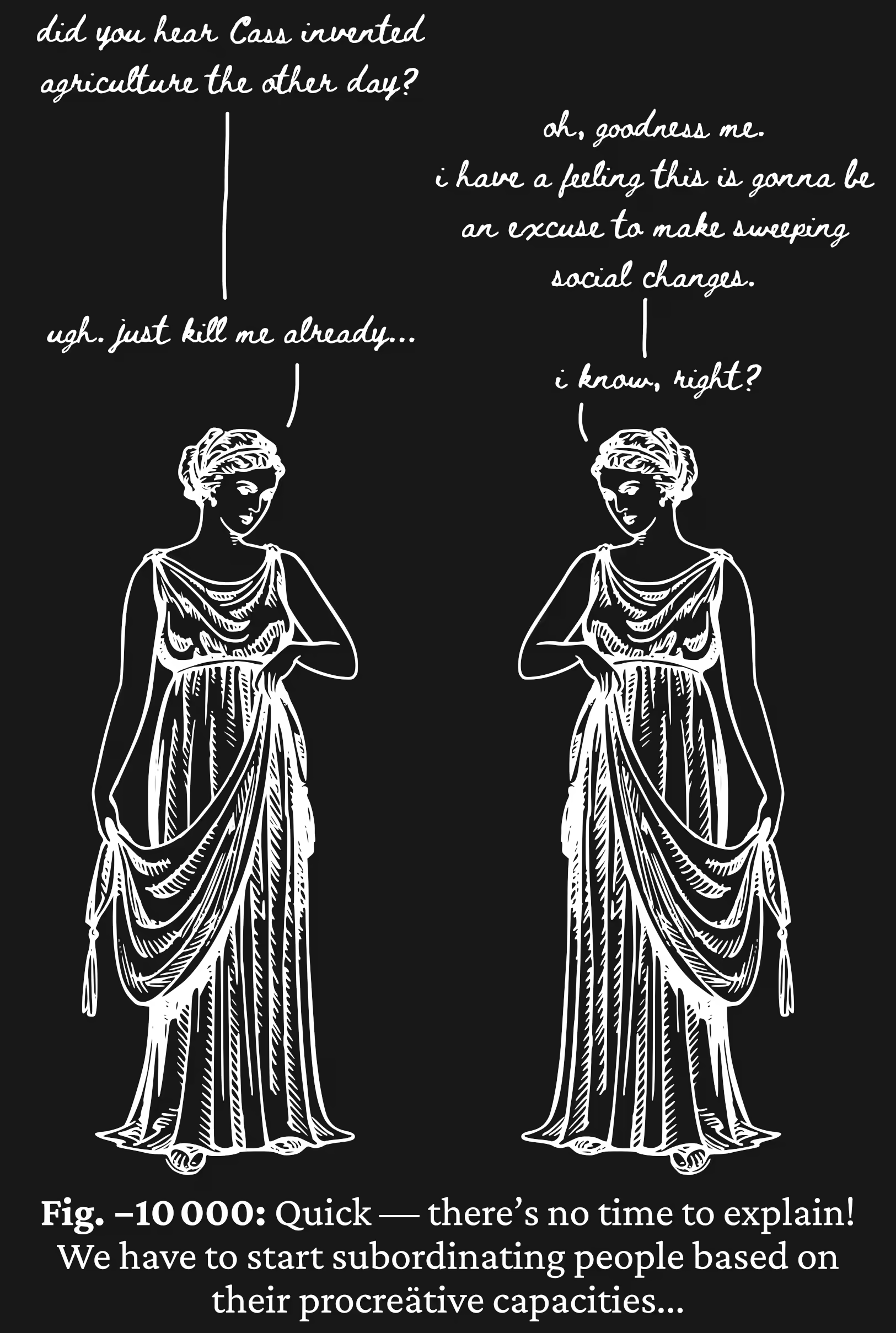
Contingent as these developments were, it’s likely that those involved — women & men alike — assented, for everyday practical reasons, to these changes — insofar as they noticed that such changes were happening, which was probably not very far. The fact that this was roughly the turning point in the development of patriarchy would’ve been as obvious back then as it was obvious to the earliest capitalists of western Europe that their capital would eventually be responsible for ravaging the planet.[Ler86]
Another important development was the turn from matrilineälity, or at least matrilocality,[38] to patrilineälity. In effect, this was the turn from procreätion or descent for its own sake, to descent as the basis for continuity of accumulated wealth (made possible by agricultural surplusses) and of access to immovable agricultural resources. Structuring sociality around the continuation of a given patrilineäl gens further entrenches the reïfication of childbearing powers, and is indeed made possible by the latter.
Thus the domination of women is a precondition for private property. Indeed, woman‐as‐reproducer is the prototype of private property, forming the basis for later developments, e.g. slavery.
State & stratification
####With the nascence of archaïc states, the kinship structure — now decidedly patriarchal — becomes merely the basis for other, superior hierarchical structures which are formed in its image. The father, exercising absolute power over his daughter’s virginity — capable of being sold, commanding a brideprice, or perhaps even enabling upward mobility for the family — socialises his children in a way that prepares them to experience state power as natural & eternal. The difference for the sons is that they can hope to become patriarchs in their own right one day, whereas the daughter can only hope that her procreätive & sexual capacities prove satisfactory to her husband or master.[Ler86]
With private property and the state of course come classes. These classes are often (but not always) partially hereditary, but they exist at a higher level than the family, and exist essentially independently of individual families as such. Yet the woman’s place in sociëty remains firmly lodged in kinship structure, and so gets undertowed by these larger hierarchies.
As a result, women form one half of each dominated group, however dominated. The woman’s position is subordinate to that of her male counterpart within the same stratum, because her membership in the stratum is directly tied to her childbearing & sexual services, along with her conformity to gendered expectations (agreeing to marriage, performing all childcare & any other “womanly” work, etc.).

The deep tangle of domination
####The practical consequences are then self‐reïnforcing. A woman striking the best deal for herself, or even simply surviving, means perpetuating patriarchal norms. For instance, ensuring the integrity of patrilineäl descent means dividing women between the “reputable” or “virgins” (those permitted to wear a veil[Ler86]) and the “disreputable”. Being in the former category is the only means of upward mobility, and sliding into the latter is tantamount to downward mobility. Complicity is not optional.
It’s now even clearer that sex‐gender is a form of direct — that is, not abstract — domination. This remains true even after deïndustrialisation. Gendered domination hooks into the level of the human person — or, in the bourgeois epoch, the level of the individual, fragmented as they might be by phenomenalisation. Abstract domination does no such thing. As socially‐necessary labour‐time, it makes itself felt automatically, via the market, by whosoëver engages in commodity‐production.
Here we see one way in which abstract domination necessarily rests upon a deeply‐rooted tangle of direct domination — but now from a more diachronic angle, rather than the synchronic angle of value‐dissociation. When push comes to shove, the basic forces underlying “civilisation” float to the surface, baring their faces whose uglinesses are proportional to their depths. As I write this now, the state of Iran — a relatively well‐educated, “civilised” country — is raping women imprisoned for participating in countrywide protests.
IX: Racialisation
##But to understand this deeply‐rooted tangle of direct dominations upon which abstract domination rests is to also understand “race”.
Origins
###The creätion of racialised populations was both concurrent with, and necessary for, the bootstrapping of capital in western Europe and, ultimately, in the rest of the world. Still‐youthful capital found itself saddled with a suddenly voracious appetite for labour that couldn’t be sated by local populations and existing forms of labour organisation.[Rob20] Moreover, it was — as always — hungry for raw materials, but in a world in which capital was not yet global, thus strongly motivating anything that might make such materials as readily available to productive investment as possible.
But this is no “primitive accumulation”.[39] The latter is a term specific to the political economists, which is why Marx felt the need to engage with it in his Critique.[40] Therein lies the weakness: “primitive accumulation” supposes that the conditions of capital merely needed to be laid out like so much set‐dressing, after which point it is — absent any magical “disturbances”, of course — an essentially steady‐state process. In reälity, capital has undergone many deep & path‐dependent changes through trajectories, epochs, & régimes of accumulation as it has wrestled with the planet & the human species: manifold patchwork schemes of labour mobilisation; constructing, destructing, & restructuring its branches; exhaustion of land & other material reservoirs; rationalisation of labour processes; and so on.
Capital is, and always has been, compatible with direct forms of economic exploitation: slavery, peonage, colonisation, prison labour, simple plunder, etc.. It’s not a matter of neverending “primitive accumulation”, but in a way, something even simpler: accumulation is accumulation, and we know from the previous part of this series that value is, as a condition of its very existence as value, perpetually hungry for any surplus that it can possibly command.
The exploitation of wage‐labour is a narrower notion than the exploitation of abstract labour. Slave‐labour, insofar as it’s commodity‐producing — that is, capitalist slavery, not to be confused with premodern slaveries — is thus also cleft into concrete & abstract labour components. Similar comments apply to other “unfree” forms of commodity‐production. It was correct to say that “the commodification of labour‐power [allows] value to purchase the means of its own vitality”, but we mustn’t make Marx’s mistake of seeing specifically the wage as ultimately or fundamentally the sole “properly capitalist” way of making this purchase, nor should we see unfree labour as mutually exclusive with waging.[41]
Race is a verb, not a noun
###Racialisation is much more recent than gendering, the former being inextricably implicated in the birth & continued existence of capital, and the latter being inextricably implicated in the same, but also in the entire “wandering” (Camatte) of humanity from the Neolithic onward. The extrapolation of “race” to premodern sociëties is, at best, a different sense of the word meaning “social formation based on kinship (e.g. gens)” or “ethnolinguistic grouping (e.g. Nez Perce)”, and at worst simply nonsense.[42] But make no mistake: as we’ll see, this makes racialisation no less integral to the capitalist totality than anything else.
By now, you know the drill.
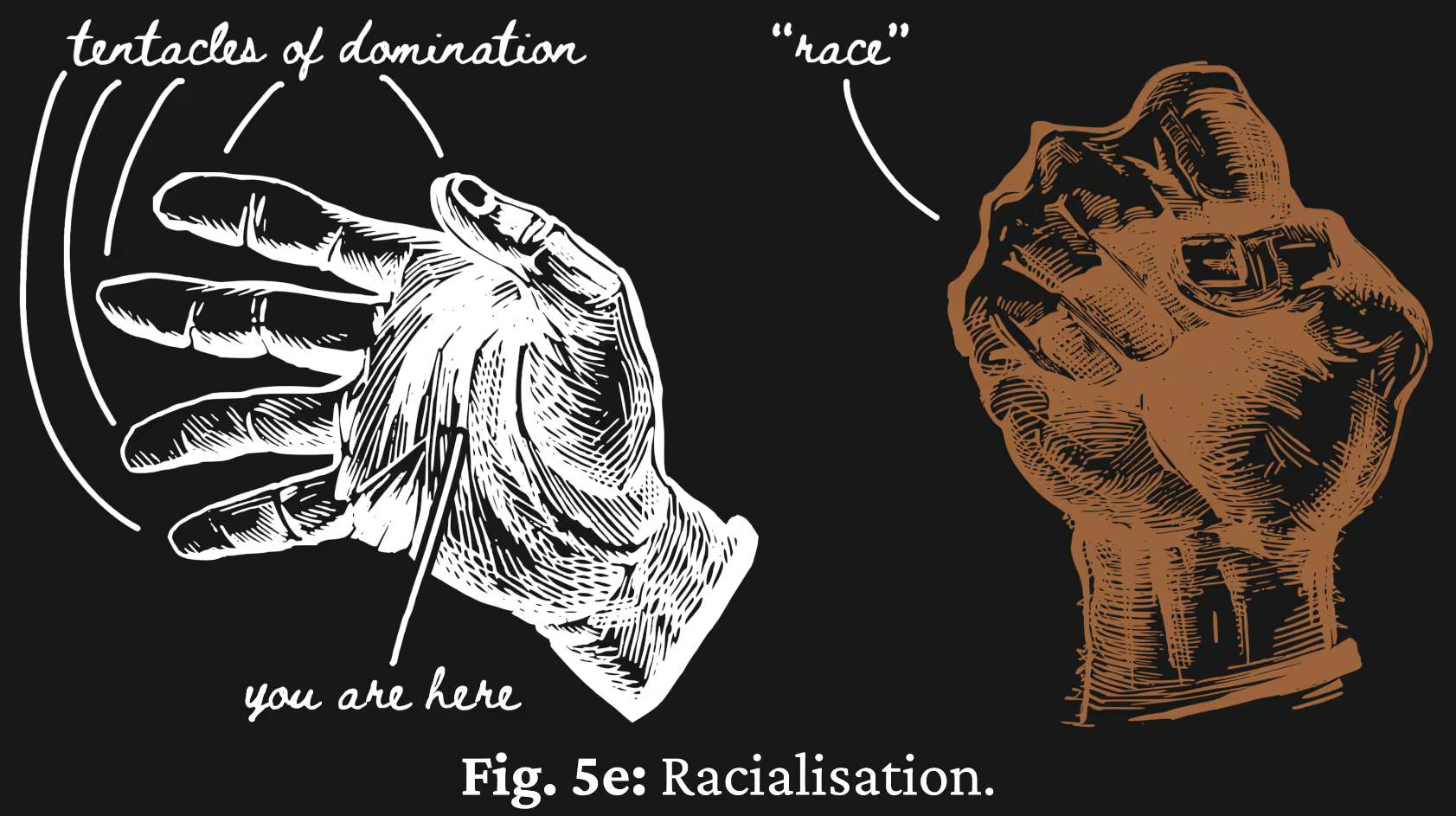
Transcription of the above image
Open hand with all five digits labelled as “tentacles of domination”, and the centre of the palm labelled with “you are here”.
Brown closed fist labelled “‘race’”.
Like any form of domination, “race” has its corresponding ideological system: racism. But as acutely implicated as racism might be, it isn’t constitutive of racial domination, nor even of racialisation. Any population or individual possessing the requisite racialisation‐defined hooks into which the loops of racial domination may snag can be racialised. This consists in ascribing an ultimately fictive, yet very socially‐real,[1] identity that forcefully drags the population into & under a self‐perpetuating system of subordination & domination.
Because this system is self‐reïnforcing, no racist attitudes, intentions, nor ideologies are necessary to its vitality.[Che13] A myriad of everyday institutional, investment, “criminal justice”, “security”/“defence”, etc. decisions — most of which are, nowadays at least, notionally nonracial (“colourblind”) — continuously produce & reproduce “race” at a structural level.[Dav97] As the totality continually reproduces the racial roles necessary for its continued functioning, individuals are racialised in order to, and inasmuch as, they fill said roles.

As just mentioned, the requisite hooks are “racialisation‐defined”. This is clear enough from the social‐fictional nature of “race”,[43] but it also implies that racialisation is inherently opportunistic: if it can find a way to control relevant populations by hooking into this or that racialisable observable (a racial use‐value‐oid; a racial loop), then it does. The other innumerable possible ways of carving up racialisable observables never make themselves known, because they never get racialised. Furthermore, as we’ll see in an example below, racial loops can even be fabricated from whole cloth — after all, “necessity” is the mother of invention.
Why race me?
###As explained above, when possible & profitable, the capitalist totality resorts to methods of extraction that don’t revolve around the exploitation of “free” wage‐labour. For the most part, this is what makes the history of capital a racial history from the start. Direct extraction demands direct domination. Yet eventually, wells run dry, immediate processes of production metamorphose, and new régimes of accumulation are birthed from the ashes of their precedents. So, no more “race”?
Not so fast. Racial domination is a method of labour mobilisation and of population control. Even with the legal–nominal abolition of unfree or explicitly racialised labour, the mobilisational aspect very much remains in play. As explained above in the context of gendered domination, labour arbitrage is the name of the deïndustrialised game. Racial domination is also crucial to this process, in which case it ultimately boils down to absolute surplus‐value extracted through a combination of racialised reserve armies of surplus labour‐power, and sheer racial terror. Recall that between the Black chattel slave and the white “free” labourer of liberal mythology are just so many shades of grey.
As for the population‐control aspect, this is exactly what capital needs for the surplus populations it generates. Long before the end of the colonial period & official slavery, certain geographies find themselves in a sticky situation: the peasantry has been absorbed, seasonal or otherwise opportunistic rural work has been minimised, and colonies are no longer meaningfully “external” outlands to which surplus workers can be shipped — yet the general law of capitalist accumulation remains in force.[End10] The old pressure relief valve doesn’t work so well anymore. As the capitalist totality increasingly becomes a planetary totality, this problem only worsens.

Transcription of the above image
A barometer with four labels in increasing order: “labour‐intensive”, “honeymoon phase”, “saturation”, and “crisis”. The indicator is broken at its pivot and pointing somewhat beyond the “crisis” point.
We need to emphasise the categorial difference between proletariat and working class. The proletariat is defined by its double “freedom”: notionally “free” to choose how it’s exploited, and crucially, free of its own material basis for human social life, thus forcing its reliance on the former “freedom”. The working class is defined by its living through the wage‐relation,[44] with that wage earnt directly, &/or through family member(s) via unwaged nonlabour.
This makes the working class a subrelation[44] of the proletariat. But this subrelation is an inherently amorphous & porous one, due at least to the necessity of the reserve army. Moreover, even those excluded from the working class are still trapped within the capitalist totality, irrespective of whether capital is destined to reäbsorb them in the future — which it increasingly tends not to do, instead preferring to expel more & more labour from the IPP. Still worse, those earning their wages through nonlabour (or labour recalcitrant to subsumption) may find themselves disgorged from the working class almost arbitrarily. This general law of capitalist accumulation is an aspect inherent to that same process of restructuring discussed in the previous part.[45]
Proletarians excluded from the working class can be said to have an unwaged‐relation to the totality. Unlike with value‐dissociation, whereby nonlabour is at least indirectly recognised (albeït not as labour sensu stricto), the unwaged are considered as superfluous tout court. From capital’s perspective, those firmly dependent on the wage‐relation are “naturally” subdued, since this relation is self‐reproducing. The unwaged, by contrast, must be managed in some other way[46] — and even then, only for the sake of maintaining property over the natural or immovable resources necessary for maximum surplus‐value extraction, and securing near‐universality of the barest, most basic conditions for the wage‐relation.
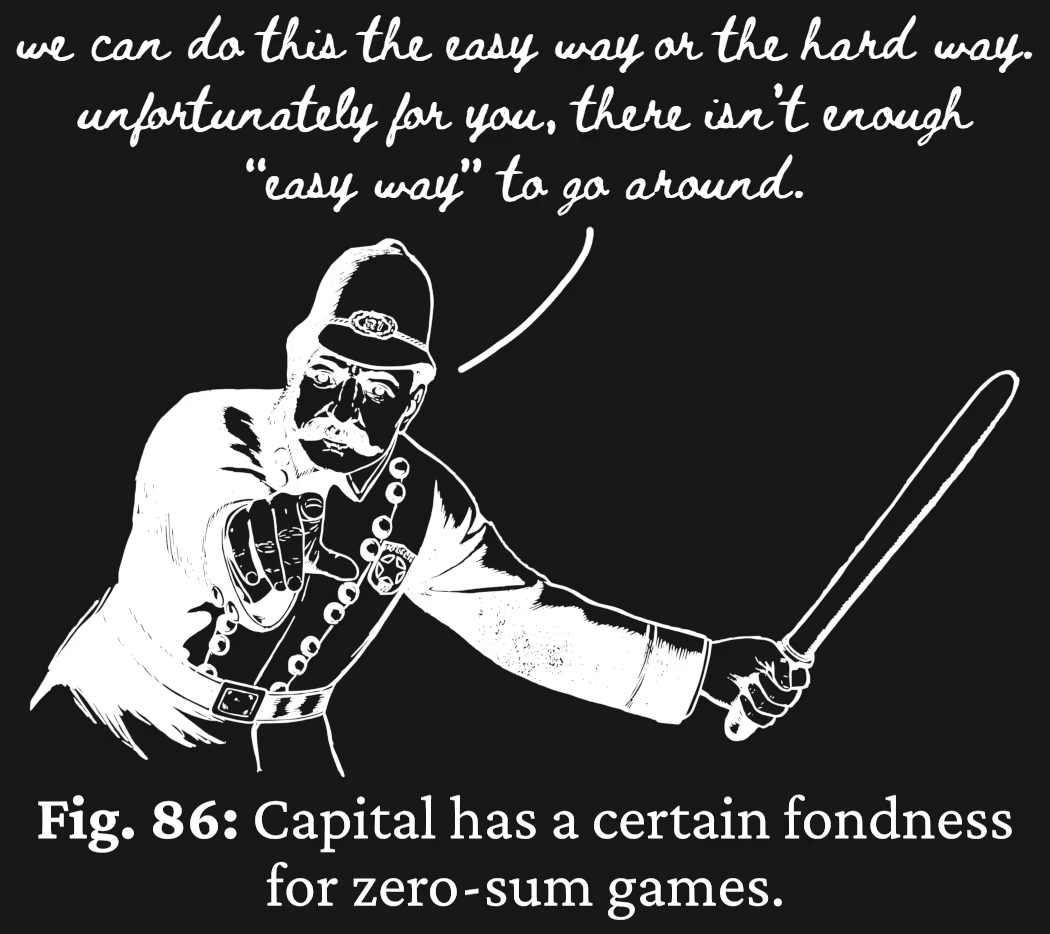
Thus the unwaged‐relation is primarily one of informal economy (black markets etc.) and state violence. Whether it’s “domestic” in the form of policing, riot control, imprisonment, displacement, genocide, etc., or “foreign” in the form of “security” operations, war, civilian “casualties”,[47] etc., racialisation enables state violence to operate with the impunity necessary to protect its surplus‐values from its surplus populations.[48]
Worse still, when convenient or “necessary”, racialisation and its concomitant racism can be mobilised to pit fractions of the proletariat against one another, absolving the state of at least some responsibility for the violence necessary to sustain racial domination and the unwaged‐relation.
Although the unwaged‐relation is clearly defined negatively (as “not waged”), it prefers — when possible — to present itself in a positive guise: “race” as a noun. Deïndustrialisation seemingly universalises the wage‐relation, which has the convenient side‐effect of submerging class relations[44] in its omnipresence. So rather than defining the “good” proletarian as an upstanding “member” of the working class, “civil sociëty” is defined negatively as those not racialised: those not forced into the informal economy, not bound to the state by dependence on transfer payments, not shoplifters, neither rioters nor looters, and so on — and thus, the “good ones”.[End13] In a world where the only relation between human beings is the exchange‐relation, there is no community. Instead, “the community” is a negative image of a negative image.
Race & necessity
###And so the question of whether racial domination is “necessary” for capitalism per se is ill‐posed.
Capital isn’t an a priori construction. To the extent that it has a logic immanent to it, this logic is manifested in diverse & everchanging ways in practice — in implementation, as it were. The need for direct (not abstract) methods of extraction, and the need to control surplus populations while still keeping the capitalist totality a tendentially universal one, are both necessary in this quasi–a priori sense. The exploitation of various use‐value‐oids (= hooks) attributed to “race”, caste, religion, etc. is a way of satisfying these necessities that’s inherently opportunistic, and therefore contingent in its specifics. But the opportunism itself is absolutely inextricable from capital, and even the contingencies were & are deeply baked into the conditions which capital had & has to work with.[49]
It’s in this sense that race & friends — that is, forms of direct domination with no obvious relation to value‐dissociation — are constitutive of labour. Labour must be contrasted not merely with nonlabour, but also with sheer exteriority; the realm of homo sacer & the “outsider‐within”;[Col00] with abjection[50] itself. Moreover, labour needs an internal contrast between “free” wage‐labour and unfree labour. It needs a “civil sociëty” where notional legal equality holds between individuals, and such a sociëty is defined largely by its relation to uncivilised unsociëty.

By locating exclusion from capital’s circuit within the “individual” and her “race”, labour is made plausible as the very fabric of sociëty: everyone participates in labour! And anyone who doesn’t is either a woman — and therefore “naturally” knows her place in nonlabour — or a raced individual — and is therefore always‐already not part of sociëty unless begrudgingly allowed in — or both.
X: We love an example
##At this point the reader is owed a couple examples, for concreteness.
Deïndustrialisation and Black America
###Thanks to the post‐WWII boom, demand for labour (still sensu stricto) was briefly so healthy in the 1960s U.S. that Black men were successfully, albeït incompletely, absorbed into Sociëty™.[End13a] As we know, this boom didn’t make it to the 1970s onwards.[51] The sudden slackening of demand for labour turned incomplete absorption into complete expulsion, and control of this raced surplus population — now notionally endowed with “equality” before the law — meant replacing newly nonexistent industrial jobs with prison sentences.
By the early 1980s, crack cocaine was being introduced into Black neighbourhoods. This informal economy both employed many Black men and served as a particularly useful excuse for imprisonment. Black women could find legal employment, but mostly in the form of waged nonlabour, meaning that it was very precarious — as nonlabour is never a first‐class citizen of the market — and paid little.[Col00] This waged nonlabour also exploited imagery about Black women persisting from the slavery period onwards, creating what [Col00] calls “mammified” work. Thus value‐dissociation affects the Black population at least as much as the white, reproducing structures of nonlabour–labour (female–male) dependency, but without a proper labour pole to support the dissociation.
The result is, from capital’s standpoint, a useful positive feedback loop: imprisonment destroys communities & family structures (including extended kinship networks[Col00]), reproducing the conditions for further imprisonment & marginalisation — what’s often called the “school‐to‐prison pipeline”. The need for explicit mention of “race” is eliminated, as “Black” is proxied by the notionally neutral “criminal”.[Dav97] The mythic “criminal” embodies crime — and is therefore “naturally” predisposed to it; worthy of the preventative increase in imprisonment numbers at any cost; in the limit, the suspect of precrime (PKD) — as against crime being something that a person merely does for some reason. The “criminal” is, of course, a recent invention, necessary if racialised surplus populations are to be controlled through the penal system. If Certain People™ are simply “criminals”, then all we can do is “protect the community” from Them — rather than ask whether “they” even exist and, if so, why?
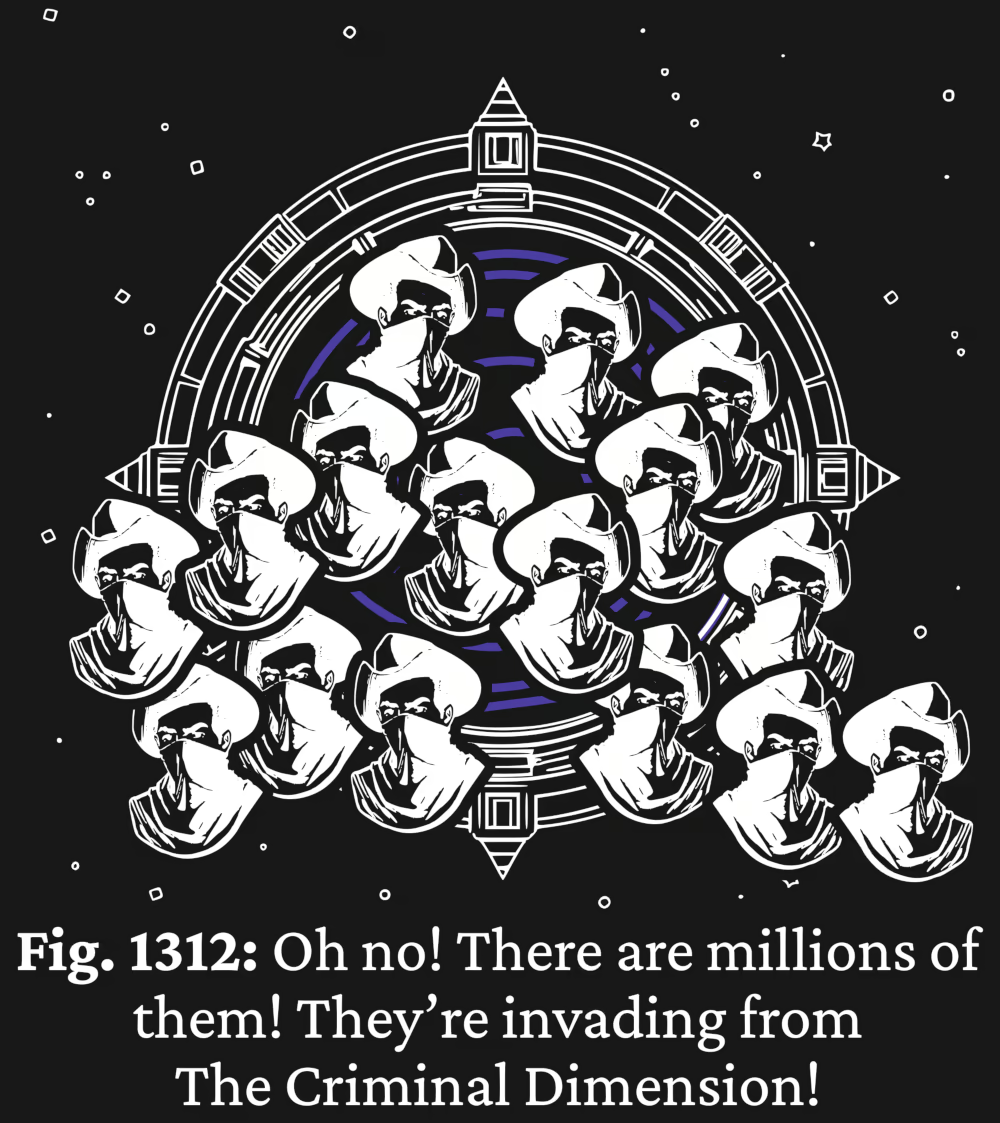
To boot, surplus populations can be big business. Prison (inmate) labour is an industry unto itself,[Dav97] demonstrating that technically‐not‐slavery is just another item on the menu of direct extraction.[41] Moreover, the policing & penal system provides plenty of ordinary opportunities for valorisation: vehicles, military equipment (the state declaring war on its own population), the prisons themselves, etc.. Not to mention plenty of jobs for warders, cops, bureaucrats, psychologists, crime statistics enumerators…
Hùkǒu (hùjí)
###For historico–human‐geographic reasons, the (very much modern) invention of “China” as we know it — an essentially economic category apotheosised by Western‐influenced nationalist ideology — was an exceptionally painful, messy, & protracted process.[Chu16b]
During the first decades of the PRC, the rural majority of the population was used to subsidise urbanisation in the industrial archipelago of eastern & northeastern China. Grain was siphoned off by various, often quota‐based, systems planned by the party‐state apparatus. Real incomes for these rural semipeasants were thereby suppressed for the sakes of accumulation and improving urban standards of living.[Chu16b]
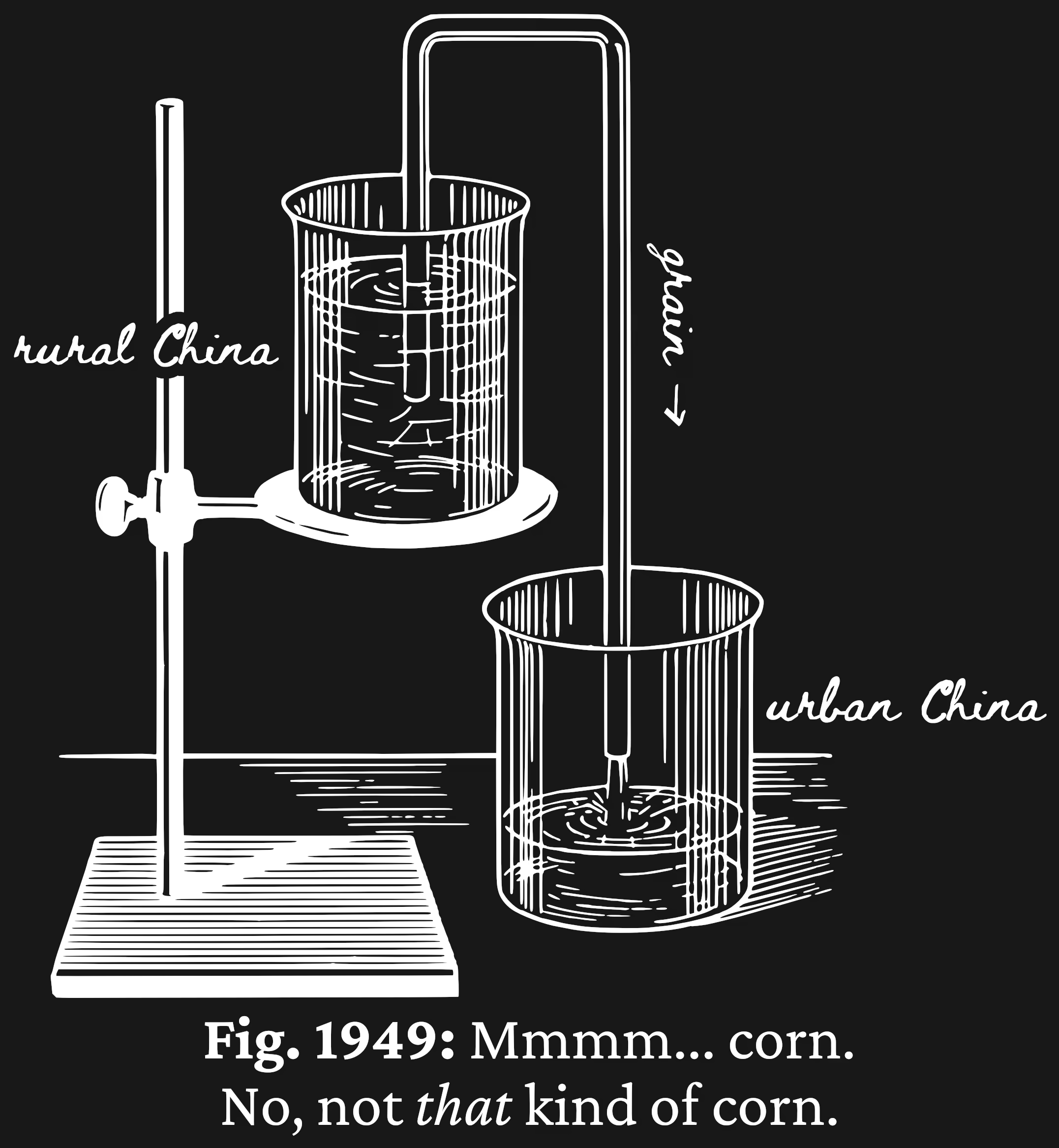
In , the household registration system — the system of hùkǒu (户口) — was extended to rural residents, creating a rural vs. urban hùkǒu distinction. Hùkǒu then combined with dàng’àn (档案) — a permanent personal record, necessary for privileged sorts of employment — and membership (or nonmembership) in a dānwèi (单位) — a “work unit” system now obsolete since the dismantling of SOEs in the 1990s — to form an apartheid‐like system that has defined the Chinese population since .
Citizens with rural hùkǒu can be — and occasionally are — deported to the countryside, as a method of (surplus) population control. Moreover, a rural hùkǒu holder is excluded from many of the privileges of registered urbanites. Prior to the 1980s, the policy of yìgōng yìnóng (亦工亦农) saw semipeasants working part‐time in the cities and migrating back for the growing season. This supplied cheap labour, since these migrants weren’t included in dānwèi (effectively meaning no benefits & no welfare), and could be deported ad hoc anyway.[Chu16b]
Although China is now virtually peasantry‐free,[Chu16] it almost goes without saying that the hùkǒu system has nevertheless remained vital. Most well‐known has been the rapid industrialisation of the PRD, making use of staggering quantities of cheap migrant labour‐power to become “The World’s Factory”.

Nowadays, thanks to deïndustrialisation, female rural migrant workers are increasingly employed in waged nonlabour, e.g. housework. This work is highly exploitative, in part because it can be legally marginalised as not being “work” at all. In spite of the exploitation and pitiful wages, these same women must send remittances back “home” to support children, the elderly, et al..[DR25] The combination of gendered nonlabour with the essentially quasi‐racial system of hùkǒu makes it almost trivial to shunt between wage‐relation & unwaged‐relation whenever the economic mood strikes.[52]
Relations like this — remittances included — form the social‐reproductive basis for an entire population often, and now usually, excluded from the realm of labour properly speaking. The word “home” is scarequoted above because this lack of belonging — neither peasant nor really “working‐class”[44] — is the defining aspect of these migrant workers’ lives.[Chu16a] As the line between waging & unwaging blurs, and people are forced to rely on social supports that frequently fail to exist,[DR25] the threat of social‐reproductive failure becomes the living reälity of riots, strikes, occupations, & other forms of unrest, held back only by the careful segregation of those who can (for now) still be profitably exploited from… the unwanted.[Chu16a]

Meanwhile, in the absence of any other way to boost already razor‐thin profit margins, absolute surplus‐value is extracted through a combination of relocation to countries with even more brutally effective systems of direct domination (see e.g. [Wik26]), and the (technically illegal) “996” working hour system.
XI: The invention of “time”
##Speaking of which, we’ve time for just one more historically‐specific aspect of “labour”: time itself — or rather, abstract time.[53]
Abstract time is the notion that time’s structure is like that of the real line:[54] it’s continuous, and measuring it is not only possible, but specifically means partitioning it into equally‐sized contiguous segments (called “seconds”, or “minutes”, or…).
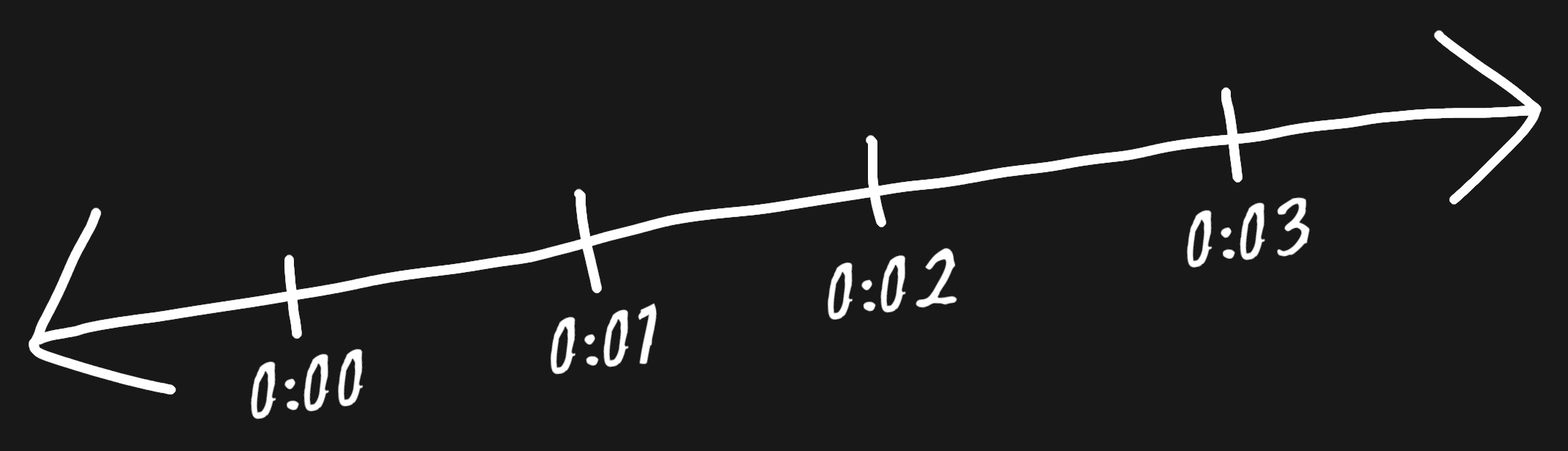
Abstract time is a modern invention. Prior to the capitalist epoch, it was simply not meaningful to pose questions about, for instance, how many minutes it takes to do something.
Concrete times
###Its counterpart in concrete time (le temps vécu[Tho67]) might seem like the purely negative image of the highly specific notion of abstract time. But really, only one distinction is fundamental: with abstract time, events are embedded in time and therefore structured by it. With concrete time (or rather, concrete times, i.e. temporalities) the relationship is reversed: time is structured by events and human activity.
The time it takes to cook a pot of rice & beans; to sleep; to go from birth to coming‐of‐age; to lunch; to bathe; and so on. Each of these processes takes however long it takes. The actual fact of something happening or being performed is more real (or at least more fundamental) than its temporal relation to other things.[Tho67]
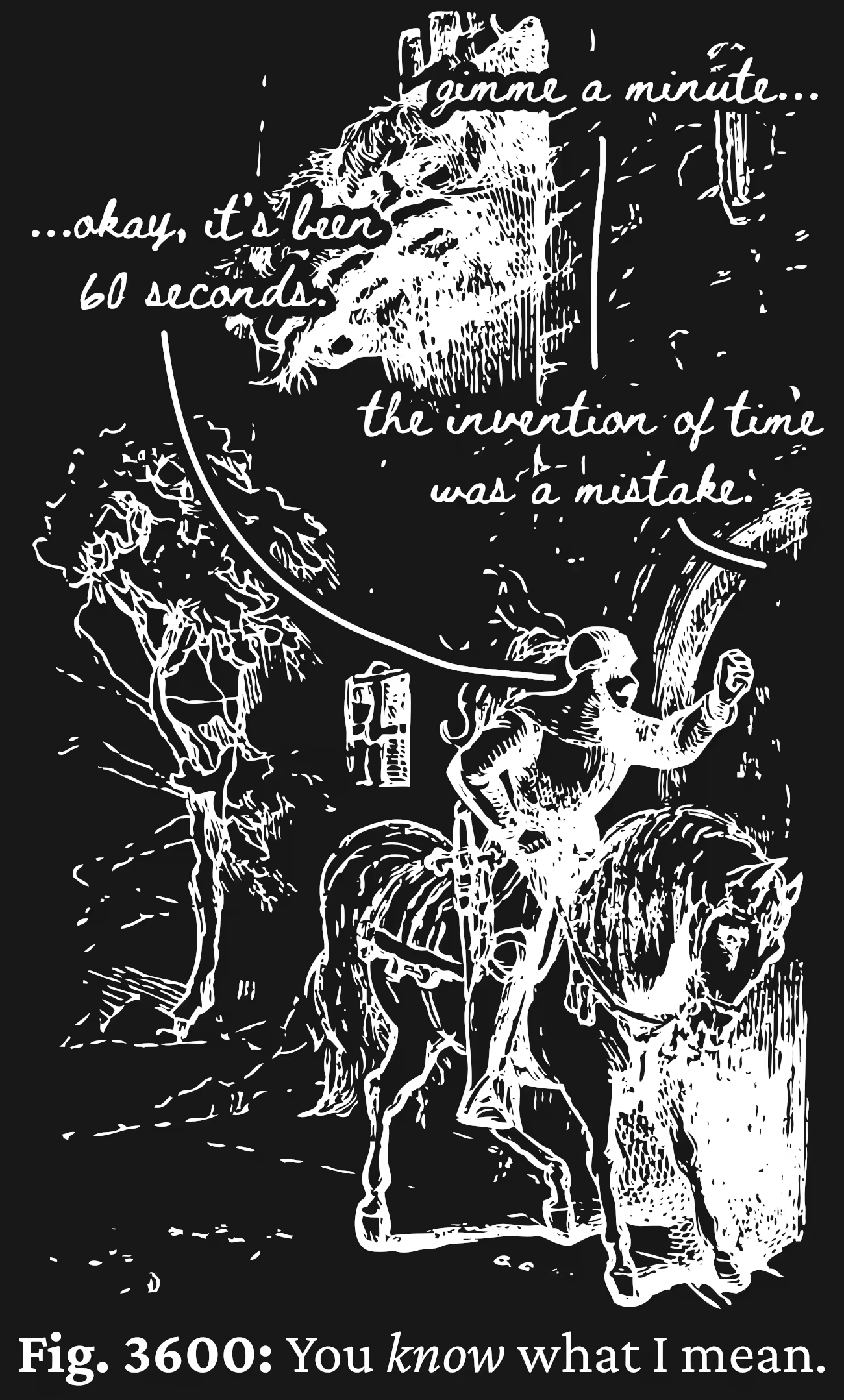
An example of large‐scale concrete time is given by the Christian timeline:[Pos93] the Fall → the Crucifixion → the Second Coming. In this conception, time is structured into periods based on each period’s relation to epochal events. There’s no sense whatever in saying that a certain “amount” of time elapses from one such event to the next. Moreover, this conception isn’t entirely unilineär: events (at least post‐Fall), even ordinary ones, have significances & causal structures that are radiated back from the eschaton.[Gor18]
Other concrete times aren’t lineär at all. Cyclic times correspond to, or derive from, cyclic processes: the day/night cycle, the menstrual cycle and lunar day/night, the seasons, musical metre,[55] etc.. Indeed, the English words time and tide (often used in exactly this pleonastic collocation) are etymological twins, effectively identifying the cycle of the sea with time as such.
An example of large‐scale cyclic time is given by saṃsāra, whereby cyclicity is extended to life & death in general. Somewhat similarly to the Christian conception, this is typically viewed teleologically: liberation is exactly liberation from the aimless circle of saṃsāra.
But let’s be honest. We’ve always had some notion of abstract time, right…?
###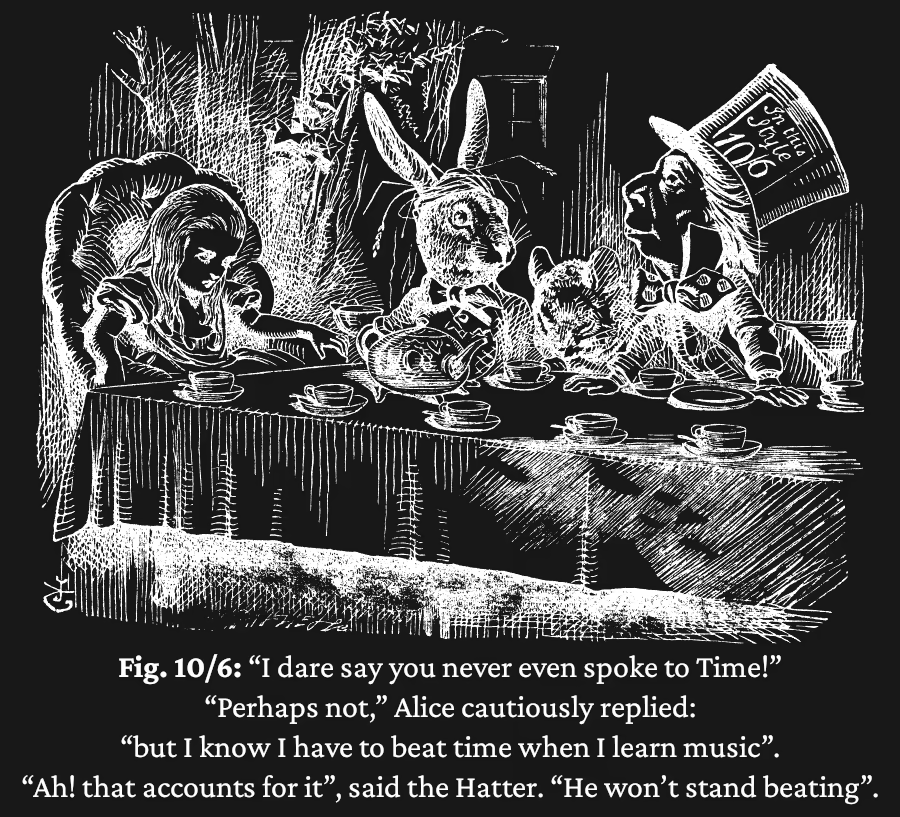
Ancient Greek (e.g. in the NT) had a chrónos vs. kairós distinction: time as reckoned vs. a moment in time, especially an opportune one in which to act. But the reckoning of chrónos was concrete. For instance, much of the Old World prior to the capitalist epoch divided the day into 24 hours as we do now, but by dividing the daytime equally into 12 hours and the nighttime into its own 12 hours.[Pos93] Thus a day‐hour was only ever abstractly equal to a night‐hour by coïncidence at each equinox, and a summer solstice’s day‐hour was much longer than a winter solstice’s day‐hour. And this is to say nothing of premodern cultures lacking an equivalent to chrónos altogether.
Nonetheless, one might suspect that abstract time failed to develop earlier due to technological limitations, or purely “philosophic” ones. But the relevant timekeeping technology existed in places like China & Europe centuries before abstract time began to develop, and was merely used for specialised purposes that in no way shaped daily life, e.g. astrology. When this technology eventually was adopted for timekeeping purposes, its uniform partition of time was used merely as an intermediate mechanic in service of the ultimate goal of measuring concrete (abstractly unequal) hours.[Pos93]
It’s not that premodern peoples were somehow incapable of comprehending the very notion of abstract time. For instance, the engineers who designed clocks to keep concrete hours understood well enough that they were making use of mechanics that regimented time into virtually equal segments. But for them, there was no particular significance to this kind of reckoning, in the same way that one finds no particular significance in reckoning time according to how long it’s been since one’s last micturation, in spite of comprehending the notion perfectly well.

As a last‐ditch effort to ahistoricise abstract time, one might try to naturalise it. This is the basis of Newton’s theory of “[a]bsolute, true, and mathematical time”,[New34] which later led to Kant grounding Newton’s spacetime in the conditions of the possibility of experience itself.
But this merely takes psychological projection onto premodern peoples, and shifts it onto “nature” (in the sense meant by physicists). For starters, we already know (so far, at least) that this didn’t work out: special relativity tells us that every event has its own lightcone, time & causality are only meaningful in reference to this lightcone structure, and thus there’s no general fact about how two arbitrary events are ordered w.r.t. each other in time. Worse, general relativity eschews abstract time even further by making time inextricable from the distribution of momentum & mass‐energy. Worse still, the closest relativistic analogue of abstract time — namely, proper time — is defined (circularly, for our purposes) as whatever it is that clocks measure!
More fundamentally, I put “nature” in scarequotes because mathematical concepts like abstract time are imposed upon nature by our sciences, and not the other way round.[Car83][Ort22] Even if our best physical theories all required abstract time, it would still be a mistake to ascribe such contentless (= abstract) theories to nature per se, when we know perfectly well that such theories only apply (at best) under the nature‐modifying conditions[56] (i.e. experiments) which the theories themselves demand — not to even speak of the theory‐ladenness of all observations.
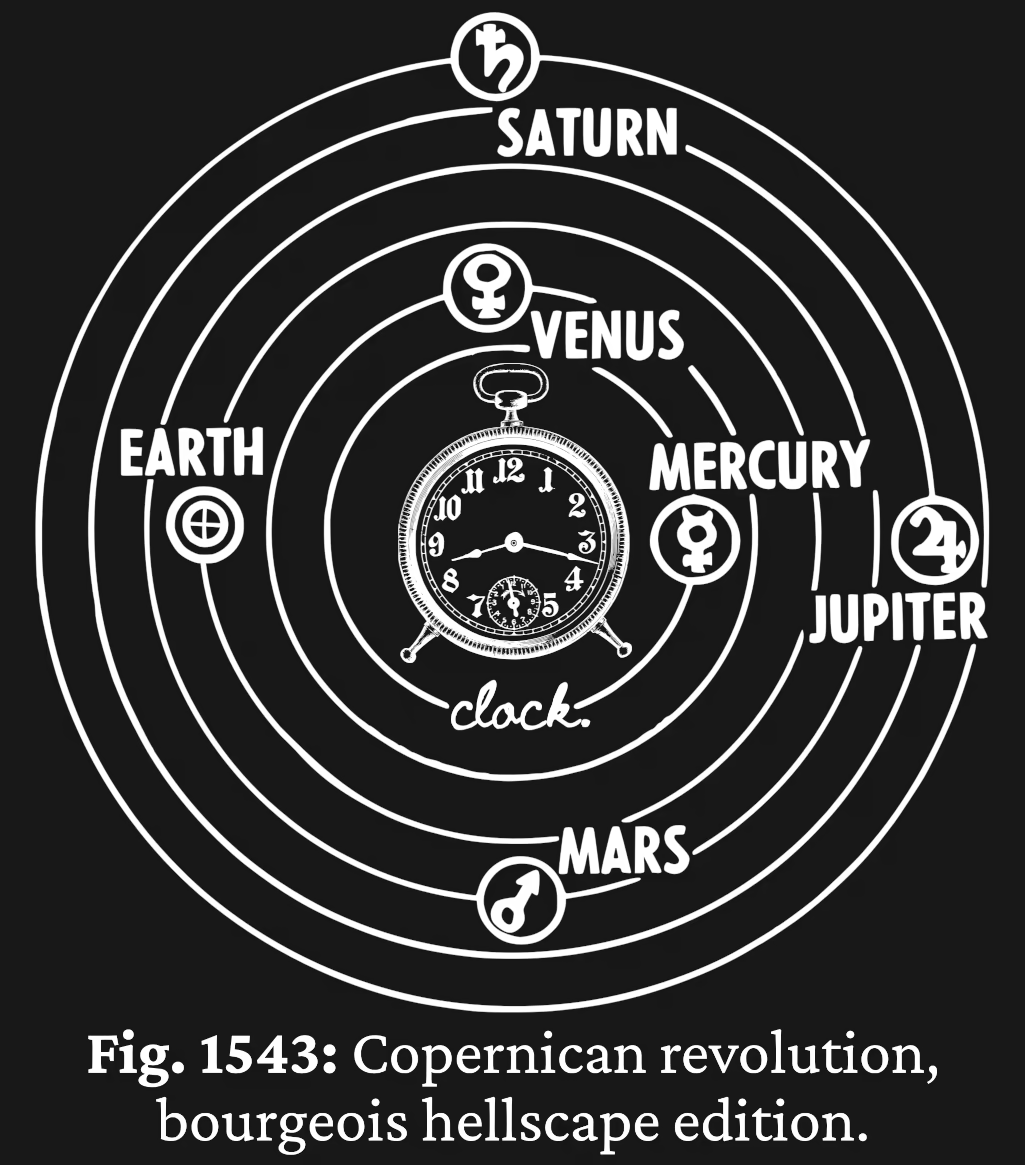
Ascribing abstract time to nature is basically at odds with our everyday experiences and empiric observations. Abstract time is neither experienced nor observed, but merely embodied in contrivances which are, in turn, the motivations and conditions of possibility of our abstract theories. Naturalising abstract time, then, completes the loop, thus making the reasoning fully circular.
Abstract time = abstract domination
###The clock “dissociated time from human events”,[57] making it possible for human activity to be subordinated to time, rather than to structure time.
Reducing human activity to mere “labour” is the process of alienating it from the human, and subordinating it to the social totality considered merely as a total‐social producer of commodities as such (i.e. not as useful things). Abstract time is the most basic substrate, the sine qua non, of the unconsciously human‐generated force that, perversely, dominates the species as an alien compulsion. Socially‐necessary labour‐time (≝ SNLT) is the meaning & essence of abstract time; it’s the socially‐constituted yardstick that bends back around to rigidly discipline the humans whose lives it’s ultimately parasitic upon.
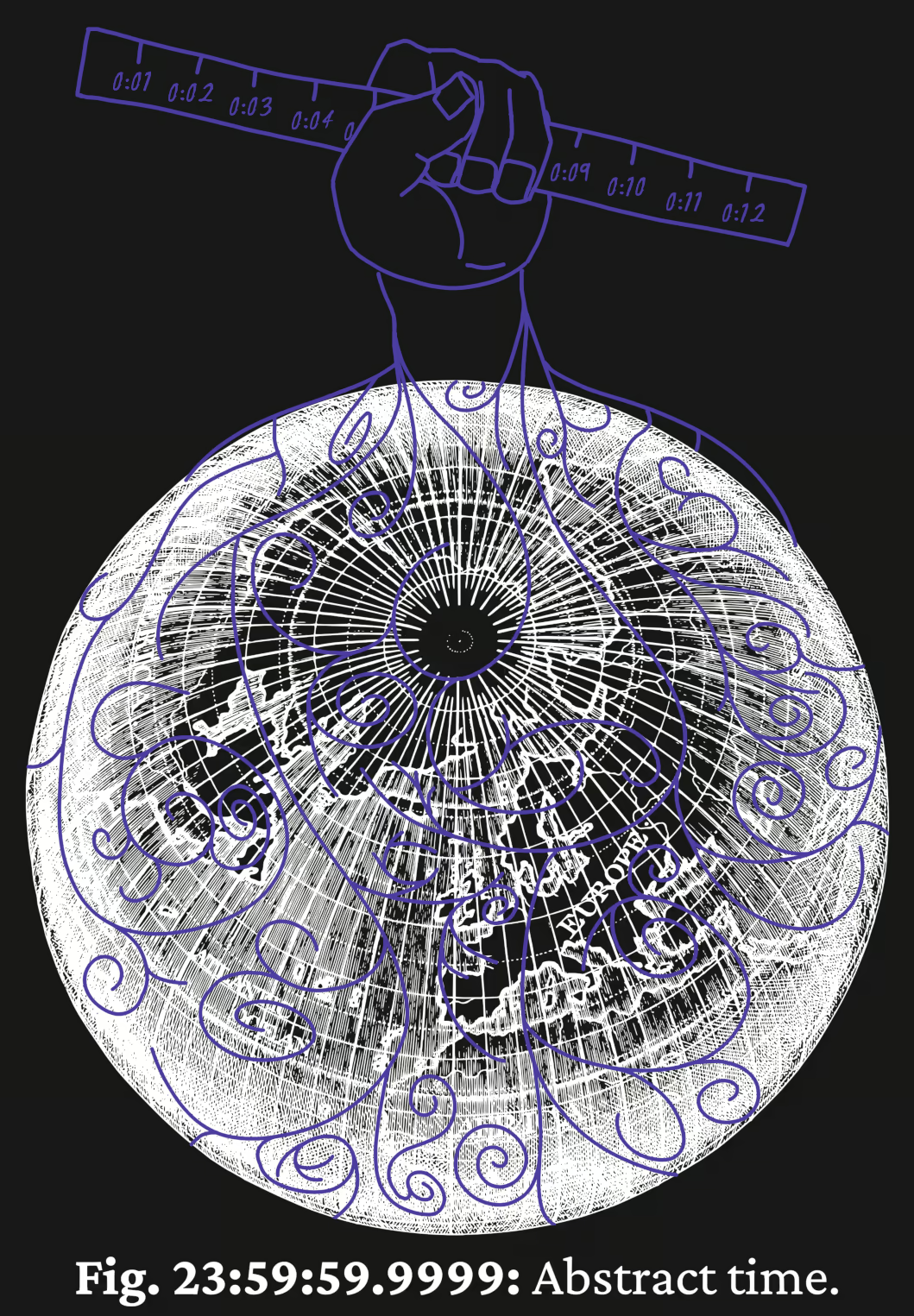
Any sociëty that structures much of its activity through abstract time is under the whip of SNLT — the whip of abstract domination — irrespective of the presence or absence of capitalists, bosses, etc. (mere personifications); profits (one of many phenomenal forms of surplus‐value); explicit markets (one possible form of the MPP); or what have you.
XII: Something resembling a conclusion
##The basic claim made here is that all this clearly historically‐specific stuff — the commodity‐form, abstract labour, concrete labour, sex‐gender in the form of value‐dissociation, racialisation, and abstract time — are all constitutive of (and, in turn, mere moments of) labour. None of these things can be separated from one another, except in the mind.
So, if this is labour, then what’s the alternative?
The work/play and workplace/domestic dichotomies are products of labour as such, i.e. products of the commodity’s — value’s — process of self‐creation; a process intrinsically aimed at “realisation” through exchange. When human activity is released from this straitjacket — from its subjugation to value’s infinitely self‐serving metabolism — these dichotomies are thereby dissolved. What remains is no more & no less than human activity, considered from the point of view of humans, and not that of the commodity‐form.
It’s difficult to imagine, now that our lives are deeply structured by labour. “Free time” is merely the negative image of the latter, denying the image any possibility of autonomy, and bestowing it only upon those too exhausted & dispossessed to make use of it. But a long time ago — and perhaps even a long time hence, if we’re so fortunate — it was possible for human beings to live their lives in a way adequate to, and flowing from, their phenomenologies & the phenomenology of their community. Not always an easy life, but at least one worth living for its own sake, and not the sake of despotic, insensate abstractions.

Abolishing labour is no small task. Indeed, it’s plausibly the biggest task ever put to the species. Moreover, people smarter than me have thought more than I have about how it could possibly happen. Nonetheless, I can say just one thing about it: if labour’s many facets can only be separated in the mind, then they cannot be separated in the process of abolition.
As valuable as its contributions have been — several of which have been cited here — intersectionality fundamentally rests upon the mistake of seeing dominations as independent variables; and worse, the mistake of seeing them as existing at the level of the individual.[58] This is no mere “theoretic” shortcoming. The practical implications replicate the logic of capital: certain changes are in the “interest” of some “individuals” more than others, based on the individual’s row & column within the matrix of domination.[59]
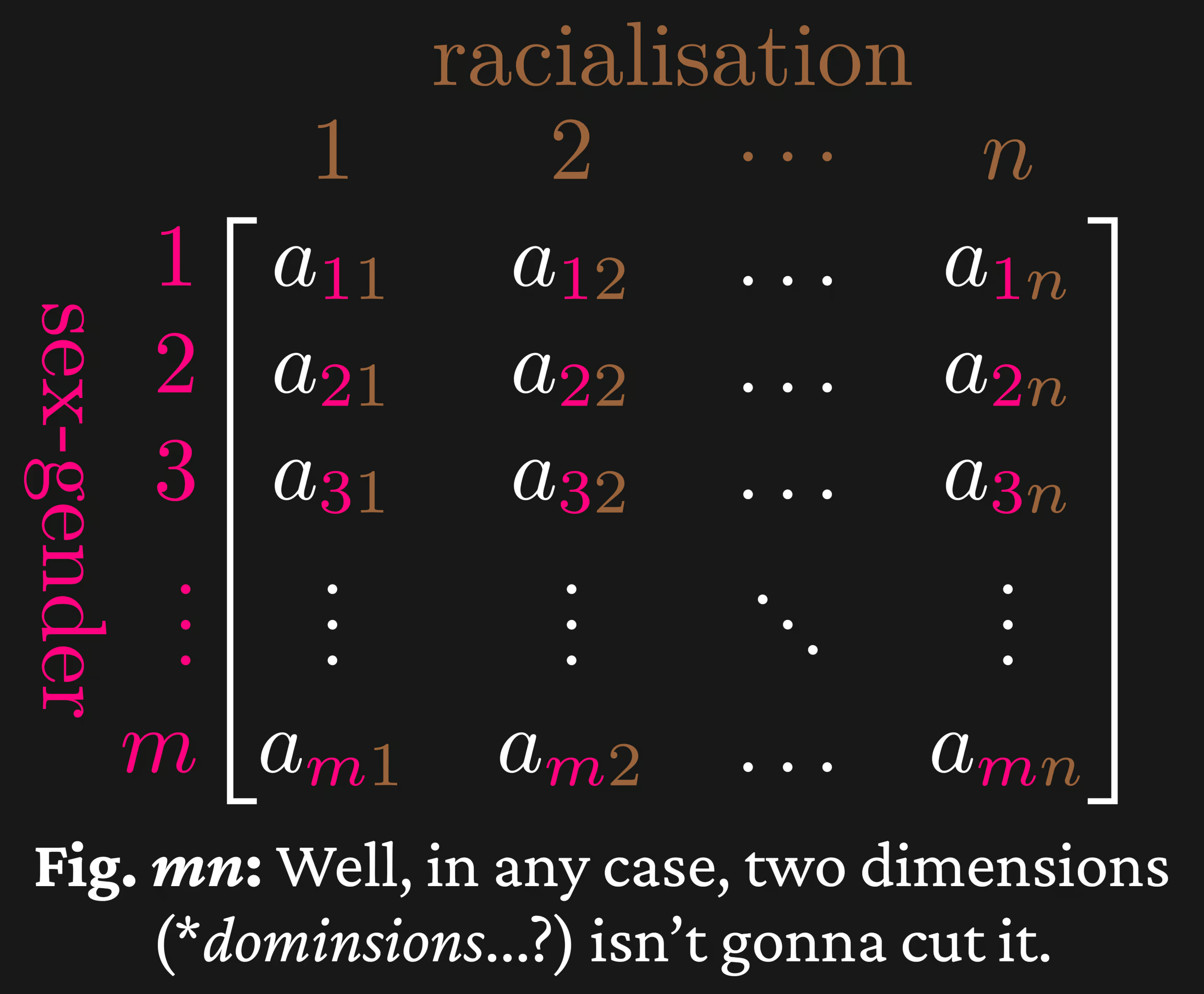
This takes the old leftist failure of “class”‐centrism — and, worse, affirmation of the labourer as labourer — and ameliorates it with a broader & more inclusive perspective. Yet it still retains the affirmation of capital’s logic. In the case of the worker’s movement, the infamous result was that the “class struggle” (as classically imagined) turned out to be just another facet of the life‐process of capital. Likewise, intersectionality offers to do capital’s job on its behalf: atomising human beings, thereby obfuscating the possibility of change.
This isn’t really a critique of intersectionality. Rather, it’s to point out that anyone dominated by the capitalist totality in any way has an “interest” in the abolition of all such dominations. The only thing that’s required is an historic process that makes these “interests” operative, not on a psychological — nor even a social‐psychological — level, but as an impersonal historic force. The dominations are all inextricable from labour, each of whose parts is necessarily inside of every other part. It’ll only take billions of people to finally explode the damned thing.

Endnotes
##- ↩︎
This essay will use social relation, social fact, and real abstraction interchangeably. Some distinctions could be made here, but none relevant to our purposes. We mostly just care that they’re real, sui generis, and historically‐specific.
- ↩︎
So far, value and exchange‐value are tentatively the same thing. This simplification will be lifted later on.
- ↩︎
This relationship is characterised by reluctance for reasons detailed in the previous part of this series.
- ↩︎
In Capital, Marx asserts abstract labour as the substance of value fairly early on. This is probably partly for ease of presentation, given that this fact was typically considered obvious in & before Marx’s time anyway. But we’ll get into the rigorous epistemological justification for this move later on.
- ↩︎
Yet this seems to assume that value — not of this individual commodity, but rather, in general — exists above (& through) individual exchange‐moments. In other words, that value cannot be subjective, nor intersubjective between buyer(s) & seller(s), but more like a web or constellation — better yet, a metabolism — that embraces the whole sociëty at once. I dunno, almost like a social relation[1] or something.
At this quasi–logico‐deductive level, ontologically falling short here is fatal, but this fatality only makes itself felt later on. The result is that economists are suddenly confused once we hit the level of the money‐form (or even just the general equivalent form), seeing it not as the adequate form of exchange‐value (exchange‐value qua exchange‐value;[6] value’s own yardstick), but as a mere practical tool, as “spending power”, as the lubricant of exchange, determined solely by convention or the state. Hence the lifelong tendency of “macro”‐economics to devolve into monetary policy wonkery.
Of course most “Marxists” make a similar sort of mistake, but typically in the other direction. Even Marx himself didn’t quite understand how to get from the general equivalent form to the money‐form (or if he did, it was in the late 1860s at the earliest).[6] But at least he understood the rest.
For further reading, see the previous part of this series.
- ↩︎
It is as if, alongside and external to lions, tigers, rabbits, and all other actual animals, which form when grouped together the various kinds, species, subspecies, families, etc. of the animal kingdom, there existed in addition the Animal, the individual incarnation of the entire animal kingdom.
Marx’s analogy here is incomplete (and doesn’t appear in any subsequent editions) for two reasons:
-
The commodities have no shared essence;[Art05] the very nature of value is to obliterate qualitative differences. A given individual (e.g. a lion, or the species Panthera leo considered as a biological individual) has, in the Aristotelian sense, an animal universality immanent to it: inspection reveals that it’s a eukaryote, it reproduces sexually, it has a certain Bauplan, etc.. No inspection can possibly reveal the “value” hiding inside of a commodity.
-
Unlike “the Animal”, which is presumably an animal itself (albeït a very special one), money is not a commodity; at best, a certain commodity just so happens to fulfil the money role. Because the commodities have no shared essence, the alien essence of value — as socially enacted, as a real abstraction[1] — can only congeal in something alien to commodities as such. This congealing occurs when, & only when, exchange‐value requires a form adequate to itself; whence money’s many forms: as the stuff of prices, as means of payment, as medium of circulation, as store of value, as money of account…
-
- ↩︎
The biological side of this analogy is inspired by the somewhat antiteleological ideas of [GL79], [GV82], & [LG17]. I plan to develop this idea a bit more fully in a separate essay.
- ↩︎
Mathematically: the dependency graph is a complete digraph (or at least mostly complete). Computationally speaking, this is Not Good™, because it implies many circular dependencies. But organic systems — sociëties, organisms, etc. — aren’t computers (pace economists & analytic philosophers), so we just have to live with that.
- ↩︎
The quantitative articulation[10] [Gliederung] of the social organism of production, which displays its disjecta membra in the system of the division of labour, is just as spontaneously arising and arbitrary as its qualitative counterpart. Our commodity owners learn, then, that the same division of labor that makes them into independent private producers also makes the social production process — and their relations within it — independent of them, the producers themselves: they learn that their independence from one another emerges in and is complemented by a system of all‐round dependence on things produced by other people.
- ↩︎
This is articulation in the anatomic sense.
- ↩︎
Capital vol. 1, part i, ch. 1, §2.
- ↩︎
An extreme example is given by [Car09], which insists not merely that Marx educates us in the ahistoricity of abstract labour, but that abstract labour is literally physical in the most reductionist possible sense. According to [Car09], because our scientific understandings of biology & human physiology have advanced greatly since Marx’s time, it’s now possible to prove(!) that “abstract labour is an observable expenditure of physiological and undifferentiated human energy”.
What exactly such a “proof” accomplishes is clear enough: presenting Marx as more “scientific” in a crude, naïve, scientismic sense. Oh, well.
- ↩︎
This style of argument is by no means exotic. It finds use in mathematics, for example, where strange assumptions or algebraïc manipulations are posited seemingly out of the blue, only to be justified by the remainder of the proof.
As another example, take [Mau07], which reconstructs a Boltzmannian argument for statistical mechanics. A certain probability distribution (uniform, or something else suitably simple) over the initial conditions of the system (in the example, a Galton board) is assumed. After the dynamical system — which may be totally deterministic — is shown to have certain statistical properties, it becomes clear that the distribution posited in the first place was almost entirely irrelevant to those statistics. The statistical mechanics are thereby shown to be immanent to the system itself, rather than a byproduct of the particular distribution assumed for the initial conditions.
One might be tempted to complain of a double standard: the “hard” sciences can get away with these perfectly good argumentative structures, but when Marx does the same within the “soft” sciences (read: sciences with apparent political implications), he’s consistently wildly misunderstood — for political reasons, perhaps?
But the standard is not as doubled as it might seem. Serious conceptual misunderstandings of modern scientific theories — statistical mechanics, relativity (even special), quantum mechanics, evolutionary biology, etc. — persist widely, even among professional scientists in the relevant fields. Subtle arguments are difficult, so it’s easier to just learn the received version. Unfortunately for Marx’s case, this obliterates almost everything worthwhile about his theory.
- ↩︎
Admittedly a slight abuse of the word “ends”. In reälity, value isn’t a means to an end, but rather a means to a means: the only purpose of generating surplus‐value is so that it can be used to generate even more surplus‐value.
- ↩︎
Really, “knew”. Left communism is no longer a living tradition or current, and its inheritors are now sometimes known as “communisers” (< communisation). But perhaps we ought to just say communist. A lovely word.
- ↩︎
Emphases in the original: [Wor19]. Worrell is far from being an anarchist — the quotation is taken wildly out of context — but this particular formulation just stuck out at me.
- ↩︎
Or is it? I hope to touch upon this in the context of another essay.
- ↩︎
[End13b] uses the term
directly market‐mediated
(≝DMM
) for the labour sphere, andindirectly market‐mediated
(≝IMM
) for the nonlabour sphere. - ↩︎
This is, by the way, one reason why Marx was never quite able to locate the underside of value. Marx’s basically Hegelian application of logic obviously didn’t inherit all of Hegel, but it did inherit what a Deleuzian might call the privileging of identity over difference.
- ↩︎
This isn’t a serious claim about whether prostitution can be (or is, in some particular case) formally subsumed…
- ↩︎
Capital vol. 1, part vi.
- ↩︎
In the interest of avoiding category errors, we should note that prices are categorically distinct from values (and from production‐prices, for that matter). Prices can, ultimately, be assigned arbitrarily, irrespective of any “underlying” value or lack thereof.
This is relevant to the wage fetish, but also relevant to the pricing or sale in general of anything that isn’t commodifiable and is therefore valueless. (Valueless not meaning *“having a value of zero”, but rather, “not being of the kind of thing that can have value”.)
- ↩︎
…And the increase in the constant capital required merely to maintain the correct technical composition.
- ↩︎
Yet another reason — perhaps the most important reason — why the neoricardian notion of a given “basket of wage goods” is wholly nonsensical.
Marx already wasn’t able to penetrate the secret of nonvalue and its associated forms of domination. But at least he did the right thing by remaining agnostic to how the value of labour‐power is formed, other than making clear that it’s socially determined. The neoricardians, not knowing what a social fact[1] is at all, desperately needed some way to make the value of labour‐power expressible in a value‐immanent way, so that they could… do economics. You know, the exact thing that Marx destroyed through his Capital: A Critique of Political Economy.
- ↩︎
This really is valuewise, and not *exchange‐valuewise, as we saw in “V: Value vs. exchange‐value in two different ways” above.
- ↩︎
And this is in no way related to so‐called “underconsumption”, as already thoroughly dismantled in the previous part. “Underconsumption” is an essentially value‐immanent notion, whereas our level of analysis now includes nonvalue. At a given standard of living, moving a good or service from customarily being produced by nonlabour to being produced by labour implies (waged nonlabour notwithstanding) the corresponding shift from nonvalue to value in the valuation of labour‐power (see Fig. 100011).
The phrase “[a]t a given standard of living” is doing some heavy lifting here for simplicity’s sake. The straightforward version of this process is not at all inevitable. Moreover, bear in mind that nonvalue is unquantifiable (Fig. 100011 isn’t to be taken too literally, hence the intentional distortion of the image). Nonvalue is “allocated” via direct, not abstract, domination.
- ↩︎
The dualism feminine/masculine corresponds to other closely‐related dualisms: body/mind, object/subject, emotion/reason, patient/agent, nature/culture, etc..
- ↩︎
This has historically been a stumbling block for feminism. There’s often a lack of understanding of the actual biology of the manifold candidate biological substrates of sex, which frequently point in several different directions — including outside of any purported dichotomy — within one & the same human being. This amounts to a lack of appreciation for how utterly disinterested Nature™ is in conforming to our artificial and ultimately vain attempts to categorise it into neat little boxes.
Ultimately, social context always decides which phenotypic traits are relevant, in what ways, and to what relative degrees. The result is that two legal systems, two cultures, two highly‐qualified professionals, etc. are prone to disagree on sexing even when all of the relevant biological data are evident.
In any case, the presence or absence of a plausible way to reduce sex‐gender to biology doesn’t affect the argument given here. Each human being does have a biology, so a hook that demands biological participation can still be ascribed to an individual, irrespective of the “consistency” of the ascription with biological fact or category.
- ↩︎
The irony is not lost on me that labour is also used to mean “the process of childbirth”. Certainly it is The Labour, if any activity is worthy of the epithet; thus the perversion of any socioëconomic formation that refuses to recognise it as such.
- ↩︎
Marx’s “reserve army” and “general law of capitalist accumulation”.
- ↩︎
Needless to say, is chosen as a reasonably accurate, but by no means definitive cutoff point — representative enough to be useful. Slapping a number on it is justified mostly because deïndustrialisation occurred rather precipitously in all industrialised or semi‐industrialised countries at about the same time. The U.S. got a head start, but not by much.
- ↩︎
In France, before , women could not engage in wage‐labour without the authorisation of their husband. In West Germany, that was not before
- ↩︎
Thus machine “learning” (≝ ML) — alongside positivism, its ideological partner in crime — is the technologisation of these kinds of abstract or abstracted forms of domination. Because such domination is concretely mediated at the surface level of myriad phenomena, all that remains is to capture these as machine‐encodable data, use ML to do a kind of statistical analysis, and Bob’s your uncle: your ML‐trained system can now somewhat accurately reproduce gendered/raced/etc. valuations, not the least of which being those of labour‐power, all seemingly without the need for human intervention.
Of course, the latter isn’t really true. Even in principle, the best you can do is a really good encoding for a particular timespan & locale, after or away from which the system needs to be retrained on fresh data. And those fresh data ultimately owe their existence to the underlying social relations.
The humour here, if any, is to be found in people’s surprise — feigned or otherwise — at ML‐trained systems consistently reproducing “unwanted biases” (typically racism) even when various superficial cover‐up strategies are deployed.
- ↩︎
See for example [End13b], which acknowledges the sociality of both sex & gender, but then insists on separating them so that they can be shoehorned into the use‐value/exchange‐value duality of the commodity‐form.
We saw that both use‐value & exchange‐value are real abstractions.[1] But the abstractions are categorically different: use∶exchange ∶∶ quality∶quantity. Sex & gender aren’t categorically different in this way. Although a quantitative gender difference certainly surfaces in the value of labour‐power, the substance of this quantity is abstract labour, not *abstract gendering. Gender isn’t an ordered field.
- ↩︎
[End13b] calls the latter “denaturalisation”, although my analysis of it differs considerably.
- ↩︎
A familiar reference point here is the Torah. Even putting aside the obvious patriarchal basis itself, the narrative is guided by God’s covenant to “multiply [Abraham’s] seed as the stars of the heaven, and as the sand which is upon the sea shore”, to make him a “father of many nations”, “exceeding fruitful”, etc. (Gen. 22:17; Gen. 17:2–6; et passim).
This extends to motivated violence: “ye shall chase your enemies, and they shall fall before you by the sword […] and an hundred of you shall put ten thousand to flight […]. For I will […] make you fruitful, and multiply you” (Lev. 26:7–9). One expected reward of this kind of violence is not women, but rather, wives:
they warred against the Midianites […]; and they slew all the males. […] And the children of Israel took all the women of Midian captives […]. And Moses said unto them, […] Now therefore kill every male among the little ones, and kill every woman that hath known man by lying with him. But all the women children, that have not known a man by lying with him, keep alive for yourselves.
- ↩︎
[Ler86] makes this point firmly, but fails to draw out all its logical consequences. The same old sex/gender duality is therefore reäffirmed anyway[28] (see especially: the “Definitions” appendix).
- ↩︎
This isn’t to say that all premodern or prepatriarchal sociëties were matrilocal (≝ uxorilocal) &/or matrilineäl, but rather, to make the (for our purposes) needed contrast between prepatrilineäl and patrilineäl.
- ↩︎
Also known as “original accumulation” or any number of other euphemisms.
- ↩︎
Capital vol. 1, part vii, chs. 24–25. Marx’s critical standpoint limits him to the arena of his chosen targets. We should also note that Marx intentionally limited himself to the perspective of western Europe (and especially England, of course).
- ↩︎
Take, for instance, the negros de ganho of Brazil, who were enslaved persons hired out by their masters for waged jobs.[Rob20] Also consider that most unfree forms of labour that are technically not slavery — debt peonage, inmate labour, etc. — are dressed up in the superficially respectable attire of the wage. And consider that wage‐labour which requires its labourers to be terrorised into accepting superexploitation‐level wages can only with Olympic‐level mental gymnastics be described as “free labour”. Between the Black chattel slave and the white “free” labourer of liberal mythology are just so many shades of grey.
- ↩︎
This defence against one (admittedly minor) aspect of [Rob20] has too many nuances for a footnote. Nevertheless, I leave it intact until it gets moved into a separate essay.
More generously, [Rob20] part i makes an argument to the effect that a cultural–ideological phenomenon which he calls
racialism
“ran deep in the bowels of Western culture, negating its varying social relations of production and distorting their inherent contradictions” (p. 66). This phenomenon was then the historic contingency that made possible the racial dominations that defined & define capitalism (thus “racial capitalism”, which is something of a pleonasm by my lights).My disagreement with this thesis has no bearing on the primary aim of [Rob20] — namely, to outline the existence of a Black radical tradition — which I think is successful. Moreover, I don’t even disagree that the “racialist” ideological phenomena found — sporadically, it seems — in premodern Europe made possible the particular form of “racial capitalism” that really did develop.
Nonetheless, I take issue with race (& derived terms) being applied to premodern sociëties in the same way we may feel comfortable applying the term sex‐gender. If the “race” in question, considered as an attribute, is capable neither of being hereditarily “sticky” (as it were), nor of being ascribed & reäscribed to particular individuals, then is it really “race”, or just a linguistic–cultural barrier or demarcation?
Comparison with sex‐gender is instructive. The way in which “race” is ascribed (i.e. the racialisation process) is unique to the capitalist epoch. One aspect of this is that racial domination is self‐perpetuating, with no particular need to rely on racism (i.e. “race” qua ideology) for its basic operation — although it certainly assists. This doesn’t square well with [Rob20]’s characterisation of premodern “racialism” as essentially cultural–ideological. On the other hand, although sex‐gender is never ascribed in exactly the same way across space & time, the basic sexing process (here the sex/gender dichotomy comes in useful) is directly inherited from premodern sex‐gender systems.
The implications of sex‐gender ascription have changed: value‐dissociation is unique to the capitalist epoch. Nonetheless, social formations that’ve subjugated women (i.e. that have sex‐gender) all share at least two features in common: women as such (but not necessarily as persons) are valued primarily based on childbearing, sexual, etc. capacity & performance; and women make up one half of every social stratum, however dominated (or not‐so‐dominated). On the other hand, “racialisms” of premodern sociëties have no comparable continuity.
For instance, although [Rob20] provides plenty of precapitalist examples of intra‐European worker migration that mobilised those workers — many of whom were enslaved — differentially along ethnolinguistic lines, this in no way implies racialisation of the relevant peoples. On the contrary, we’d expect that when such detectable differentiations did occur, this was an incidental byproduct of the human geography of the time. For instance, if migrational pressures brought Poles westward (as slaves or otherwise), then they may have remained distinct (for at least some time) partly on account of whatever skills, tools, knowledge, etc. they brought with them; and partly on account of speaking Lechitic, etc.. No racialisation thus occured by virtue of which such Poles were dominated, but rather, a narrative around occupational, linguistic, etc. differences was constructed by appeal to words like “Polish” etc.. No institution, much less a lasting one, thereby results.
Premodern slavery — in this case, in the Mediterranean and, later, in Europe — looked essentially the same whether it just so happened to be within or between sociëties or ethnicities, because these slaveries per se were forms of labour mobilisation in their own right. By contrast, the uniquely modern development of racialisation would be labour mobilisation, demobilisation, population control, and resource extraction all rolled into one domination package intelligible only in relation to (& relation from) the movement of capital.
A simpler example is given by [Rob20] p. 21f., in which mediaeval European nobility “considered themselves of better blood than the common people, whom they utterly despised” (Friedrich Hertz, quoted in [Rob20]). For this purpose, the curse of Ham was attributed to the peasants, which, given the later use of Ham’s story to justify Black slavery, retrospectively enhances the apparent racial bent. But of course, any such ideologies of inferior bloodlines (or what have you) weren’t constitutive of the social relation between noble & peasant, nor did they directly correspond to that relation, but rather read like simple post hoc ideological justifications. The difference with race is that racism may be ideology, but racialisation is not.
Given that these nobles were the rulers of their place & time, a comparison to modern rulers might help. When whites are the ones who find themselves in ruling positions in heavily racially‐stratified countries, this is one product of racialisation, and not the other way round. We see something resembling the other way round in premodern cases where rulers take power through, say, military victory, and then seek one source of legitimacy in tracing back a mythic lineäge.
[Rob20]’s notion of “racialism” also cannot account for historical processes by which racialisation is reïnvented under other guises. For example, as discussed below, the PRC’s hùkǒu system effects a kind of apartheid — one which fulfils & has fulfilled the manifold roles of racialisation — purely through a system of legal registration.
Insofar as this represents a genuine misunderstanding (which might not be very far), it bears some relation to [Rob20]’s misunderstanding of class. Ch. 1 gives (among other things) a treatment of the “rise of the middle classes” trope as it relates to the emergence of capital from western European feudalism. Perplexingly, this treatment goes looking for “class” as if it were a group of people — that is, the mathematical sense of “class”. Still worse, this “class” is expected to be meaningfully hereditary as a condition of forming a coherent “class”. The reader is left to wonder whatever happened to class being a social relation, the poles of which particular persons relate (or don’t relate) to in various ways.
Ch. 2 then summarises class with an E. P. Thompson quotation:
Class consciousness is the way in which the experiences are handled in cultural terms: embodied in traditions, value‐systems, ideas and institutional forms. If the experience appears as determined, class consciousness does not. … [C]lass is defined by men as they live their own history, and, in the end, this is its only definition.
Although class relations are no doubt historically‐specific, and therefore not Real™ with a capital ⟨R⟩, they’re nonetheless socially real relations which, “conscious” or not, aren’t defined “by men” if this is understood to mean a collection of persons (however large) considered as just so many individua.
Once again, none of this is to argue against the claim that what [Rob20] calls “racialism” considerably influenced, or even made possible, the racial domination that we now know in the modern era. The point is rather that using race — or any words derived therefrom — to refer to premodern phenomena is misleading at best, and at worst, obscures the profound historical specificity of “race” as a form of domination.
- ↩︎
In this respect, “race” fares better analytically than sex‐gender: the former is much more obviously nonbiological.
- ↩︎
Note that this definition underdetermines whether a given individual is a “member” of the working class. This is a feature of any good definition, since class isn’t meant in the mathematical sense. Rather, class is a social relation[1] (a “relation of production”) which particular human beings relate to, but are not part of as individuals. The relation is structural and doesn’t exist at the individual level per se, in the same way that an individual helium atom doesn’t have a well‐defined temperature.
In the specific case of working class, the “relation” in question can be summarised as: the intersection of waging with proletarianisation. This intersection is of course necessary for wage‐labour, but it’s also necessary (at least for want of an alternative) for proletarianisation and, crucially, continual reproletarianisation. Yet many, or even most, proletarians* have a complicated relationship with the wage, and therefore can neither be said to “belong” nor to “not belong” to the working class, as if the latter were a mere collection. This remains true even if some individuals have such a strong & persistent relation to the class that we can, in a manner of speaking, say that they “are” working‐class.
*Of course, this implies that the use of “proletarian” as a noun is also, technically, a mere manner of speaking. Furthermore, note that semiproletarians (≈ semipeasants) existed too, especially in incompletely “developed” countries. In this context, such countries are so called because they had, for historico–human‐geographic reasons — often, but not always, involving colonisation — failed to complete proletarianisation.
- ↩︎
For a much more thorough exposition of the general law of capitalist accumulation than can be given here, see: [End10].
- ↩︎
Or perhaps we should say, some Other way…?
- ↩︎
Scarequoting euphemisms for murder.
- ↩︎
Such populations are only “surplus” in the sense that they represent the expulsion, by capital, of labour from the IPP. That is, such populations are surplus insofar as capital simply cannot employ them at the going profit‐rate. If we abstract away from capital, then these populations are in no way surplus, since we have more than enough resources to afford them fulfilling lives.
- ↩︎
To paraphrase Joe Biden, if “race” didn’t exist, capital would have to invent it…
- ↩︎
After [End13b], I use abject in the etymologically literal sense of “(to) throw away, cast out/off/aside, discard”, although the other senses remain somewhat operative.
- ↩︎
Since the other main thing I tend to write about here is music, we should note that this coïncides with what I consider the golden age of avant‐garde jazz in the 1960s, followed by the popular near‐collapse of jazz as a genre in the 1970s.
This isn’t to claim that there was no good jazz in the 1970s (or ’80s etc.). Rather, the genre clearly suffered a massive economic blow that imposed something like a two‐pronged fork: either a diffuse smattering of avant‐garde (e.g. loft jazz) & traditionalist holders‐on, or attempts to “get with the times” by incorporating disco, rock, funk, etc. (Herbie’s discography is illustrative here). The latter prong no doubt found success with Miles Davis — inclusive of avant‐garde elements, to boot — but not enough to stop jazz from developing a distinct odour (to paraphrase Zappa) almost as soon as became .
One result was that jazz’s sudden failure demanded explanation, and the school of thought represented by Wynton Marsalis provided a simple one: being open to electrified instruments, influences from rock & funk, avant‐garde experimentation, or anything else insufficiently “authentic” (to what we must assume is “real” jazz) was responsible for alienating people from the genre. This was perhaps best personified by Stanley Crouch, who began as a patron of loft jazz before repudiating all that in favour of Marsalis‐style conservatism. This blindness to real social changes in favour of purely spiritual explanations has more than merely musical implications: Crouch became known more for Pound Cake speech–style rhetoric (with not a little contrarianism thrown in for good measure) than anything else.
- ↩︎
Comparisons can be made to the use of Latin‐American migrant (non)labour‐powers in the U.S., deportation & all.
- ↩︎
Much of this section is adapted from [Pos93].
- ↩︎
The invention of the reals followed on the heels of the development of abstract time. Traces of our current notion of “the reals” first appeared in the early modern era, and weren’t fully developed until the 19th c. with Dedekind cuts, Cauchy sequences, etc..
- ↩︎
Musical timing (pulse, beat, metre, etc.) leans heavily on its concrete nature. Even when playing a steady pulse, experienced musicians tend to speed up or slow down almost imperceptibly at several timescales simultaneously. Moreover, playing “ahead of” or “behind” the beat, playing with a particular “feel” or “swing”, rubato, and so on, all contribute profoundly to the music’s nature, and cannot generally be quantified.
- ↩︎
Or, in the case of so‐called “natural experiments”, exceptional — and therefore also irreplicable — conditions.
- ↩︎
Lewis Mumford, quoted in [Pos93].
- ↩︎
Again, the “individual” is a specifically bourgeois notion that emerges from the commodification of labour‐power and the concomitant public/private dichotomy. Thus the hard distinction between human being (ahistoric, if perhaps not always legible) vs. individual (specific to the capitalist epoch).
- ↩︎
To be clear: this is a pun. [Col00] presumably doesn’t have the mathematical sense of matrix in mind when she says “matrix of domination”. It should also be noted that the matrix concept places [Col00] above most intersectional theory by explicitly discouraging the “independent variables” view.
References
##| [Art05] | Christopher J. Arthur. . “The concept of money”, in Radical Philosophy vol. 134, pp. 31–40. |
|---|---|
| [Ber13] | Jasper Bernes. . “Logistics, Counterlogistics and the Communist Prospect”, in Gender, Race, Class and Other Misfortunes (Endnotes № 3), pp. 172–201. |
| [Cam78] | Jacques Camatte. (). Community and Communism in Russia. David Brown (trans.). London. |
| [Car09] | Guglielmo Carchedi. . “The Fallacies of ‘New Dialectics’ and Value‐Form Theory”, in Historical Materialism vol. 17, pp. 145–169. |
| [Car83] | Nancy Cartwright. . How the Laws of Physics Lie. Oxford University Press; Oxford. |
| [Che13] | Chris Chen. . “The Limit Point of Capitalist Equality”, in Gender, Race, Class and Other Misfortunes (Endnotes № 3), pp. 202–223. |
| [Chu16] | Chuǎng. . “Gleaning the Welfare Fields”, in Dead Generations (Chuǎng № 1), pp. 151–181. |
| [Chu16a] | Chuǎng. . “No Way Forward, No Way Back”, in Dead Generations (Chuǎng № 1), pp. 191–227. |
| [Chu16b] | Chuǎng. . “Sorghum and Steel”, in Dead Generations (Chuǎng № 1), pp. 11–148. |
| [CC93] | Paul Cockshott & Allin Cottrell. . Towards a New Socialism. Spokesman Books; Nottingham. |
| [Col00] | Patricia Hill Collins. (). Black Feminist Thought: Knowledge, Consciousness, and the Politics of Empowerment, 2nd edition. Routledge; New York. |
| [Dav97] | Angela Y. Davis. . “Race and Criminalization: Black Americans and the Punishment Industry”, in The House that Race Built, pp. 264–279. Wahneema Lubiano (ed.). Pantheon; New York. |
| [DR25] | Yige Dong & Ralf Ruckus. . “The Crisis of Social Reproduction, Women’s Agency, and Feminism in China”, in Spectre. Published at: https://spectrejournal.com/the‐crisis‐of‐social‐reproduction‐womens‐agency‐and‐feminism‐in‐china/. |
| [End10] | Endnotes. . “Misery and Debt”, in Misery and the Value Form (Endnotes № 2), pp. 20–51. |
| [End13] | Endnotes. . “A Rising Tide Lifts All Boats”, in Gender, Race, Class and Other Misfortunes (Endnotes № 3), pp. 92–171. |
| [End13a] | Endnotes. . “The Holding Pattern”, in Gender, Race, Class and Other Misfortunes (Endnotes № 3), pp. 12–55. |
| [End13b] | Endnotes. . “The Logic of Gender”, in Gender, Race, Class and Other Misfortunes (Endnotes № 3), pp. 56–90. |
| [GLLF18] | Jamie L. Gloor, Xinxin Li, Sandy Lim, & Anja Feierabend. . “An inconvenient truth? Interpersonal and career consequences of ‘maybe baby’ expectations”, in Journal of Vocational Behavior vol. 104, pp. 44–58. |
| [Gor18] | Uri Gordon. . “Prefigurative Politics, Catastrophe, and Hope”, in CrimethInc.. Published at: https://crimethinc.com/2018/06/12/prefigurative‐politics‐catastrophe‐and‐hope‐does‐the‐idea‐of‐prefiguration‐offer‐false‐reassurance. |
| [GL79] | Stephen Jay Gould & Richard C. Lewontin. . “The Spandrels of San Marco and the Panglossian Paradigm: A Critique of the Adaptationist Programme”, in Proceedings of the Royal Society B vol. 205, pp. 581–598. doi:10.1098/rspb.1979.0086 |
| [GV82] | Stephen Jay Gould & Elisabeth S. Vrba. . “Exaptation—a missing term in the science of form”, in Paleobiology vol. 8 (1), pp. 4–15. |
| [Ler86] | Gerda Lerner. . The Creation of Patriarchy. Oxford University Press; Oxford. |
| [LG17] | Elisabeth A. Lloyd & Stephen Jay Gould. . “Exaptation Revisited: Changes Imposed by Evolutionary Psychologists and Behavioral Biologists”, in Biological Theory vol. 12, pp. 50–65. doi:10.1007/s13752‐016‐0258‐y |
| [Mar75] | Karl Marx. (). “Draft of an Article on Friedrich List’s book”, in Marx/Engels Collected Works vol. 4, p. 265. Published at: http://hiaw.org/defcon6/works/1845/03/list.html. |
| [Mau07] | Tim Maudlin. . “What could be objective about probabilities?”, in Studies in History and Philosophy of Modern Physics vol. 38, pp. 275–291. |
| [MT17] | Salar Mohandesi & Emma Teitelman. . “Without Reserves”, in Social Reproduction Theory, pp. 37–67. Tithi Bhattacharya (ed.). Pluto Press; London. |
| [New34] | Isaac Newton. (). “Scholium on Time, Space, Place and Motion”, in Philosophiae Naturalis Principia Mathematica vol. 1, pp. 6–12. Andrew Motte (trans.). Florian Cajori (ed.). University of California Press; Berkeley. Published at: https://plato.stanford.edu/entries/newton‐stm/scholium.html. |
| [Ort22] | Claus Peter Ortlieb. (). “Math Delusion”, in EXIT! in English. Oliver Blackwell (trans.). Published at: https://exitinenglish.com/2022/02/07/math‐delusion/. |
| [Pos93] | Moishe Postone. . “Abstract time”, in Time, Labor, and Social Domination, pp. 186–225. Cambridge University Press. |
| [Rob20] | Cedric J. Robinson. (). Black Marxism: The Making of the Black Radical Tradition, 3rd edition. The University of North Carolina Press; Chapel Hill. |
| [Sch13] | Roswitha Scholz. (). “Patriarchy and Commodity Society: Gender without the Body”, in Mediations vol. 27 (1). Published at: https://mediationsjournal.org/articles/patriarchy‐and‐commodity‐society. |
| [Tho67] | E. P. Thompson. . “Time, Work‐Discipline, and Industrial Capitalism”, in Past and Present № 38, pp. 56–97. |
| [Wik26] | Elaine Wik. . “Managing Contradictions at the Border: Outsourcing Coercion Between Bangladesh and India”, in Spectre. Published at: https://spectrejournal.com/managing‐contradictions‐at‐the‐border/. |
| [Wor19] | Mark P. Worrell. . “The Beatings Will Continue Until Morale Improves”, in Fast Capitalism vol. 16 (2). |